
Explore the conversation.
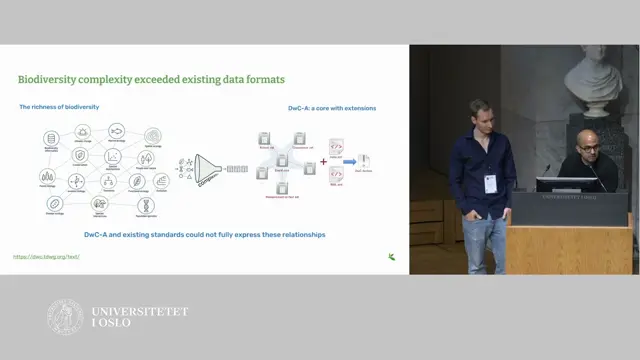
DwC-DP Integration at GBIF
GBIF is close to supporting Darwin Core Data Packages end to end, with typed and stricter validation, while keeping Darwin Core Archives fully supported.
Federico Mendez, Mikhail Podolskiy ↗
Keeping Colliders in Physics: Rebuilding the ALA taxonomic backbone
Taxonomic checklists are not backbones: data aggregators need a curated single hierarchy with quality-control feedback loops, not automated merging of checklists.
Cameron Slatyer ↗
An Introduction to the Biodiversity Data Quality Standard (BDQ)
BDQ provides 110 standard, use-case-linked tests so that data quality can be assessed consistently from collection to aggregation.
Lee Belbin ↗
Assessing record quality and completeness in geoscience collections
Element-level views of MIDS information elements are more useful than raw scores for targeting data improvement in large geoscience collections.
Adam Mansur ↗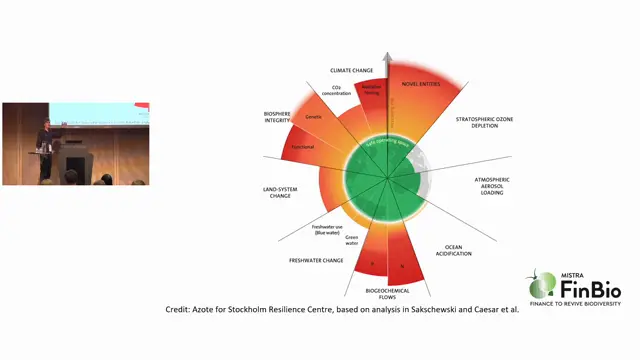
Data Quality in Focus: Bridging the Biodiversity Data Gap for Sustainable Finance
Biodiversity assessments for finance need local data; a tiered data-quality hierarchy like carbon accounting could make them credible.
Emma Granqvist ↗
GBIF Rule Based Annotations
Simple, scoped negative-range rules let non-experts flag suspicious GBIF occurrences persistently, including future records.
John Waller ↗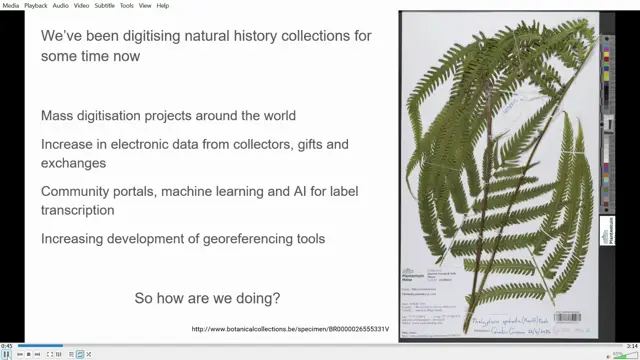
How is digitisation doing? Monitoring the increase in digitised collections using MIDS
MIDS can monitor global digitisation progress, and GBIF data show completeness improving unevenly and sometimes going backwards.
Elspeth Haston ↗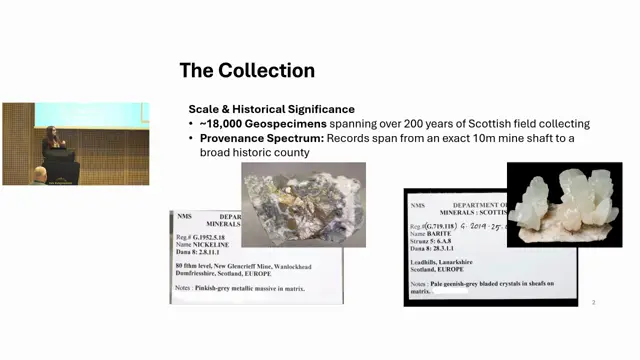
Improving geospecimen provenance and findability in the National Museums Scotland Scottish mineral collection
A scripted, reviewable workflow can quickly reconcile legacy mineral records and enrich them with Mindat coordinates, while giving data back to the community resource.
Sarah Stewart ↗
Interpreting the Responses from BDQ Tests
Every BDQ test returns a status, result and comment, and understanding these lets users decide fitness for their own use.
Arthur Chapman ↗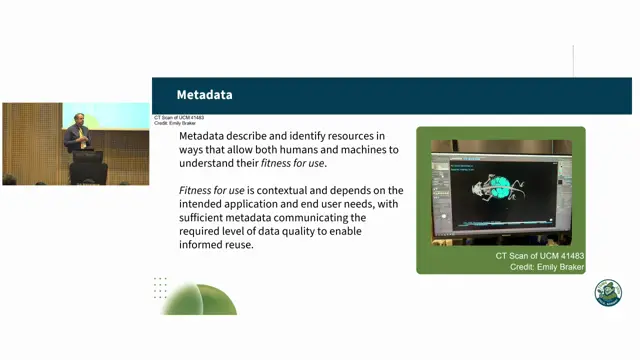
Metadata matters: perceptions on the implementation of Darwin Core in the biocollections cyberinfrastructure
Standardisation through Darwin Core can mask nuance, and practitioners report complex data, missing guidelines and limited capacity as the main implementation barriers.
Bradley Wade Bishop ↗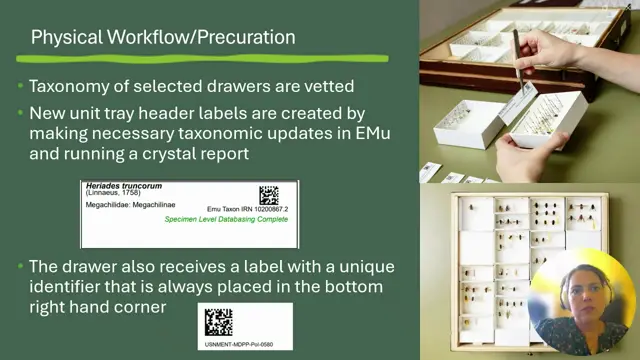
Pinned insect digitization conveyor: image and data transcription workflows
An industrial conveyor workflow with QR-encoded metadata and automated skeletal records makes mass digitisation of pinned insects feasible.
Jessica Bird, Sylvia Orli ↗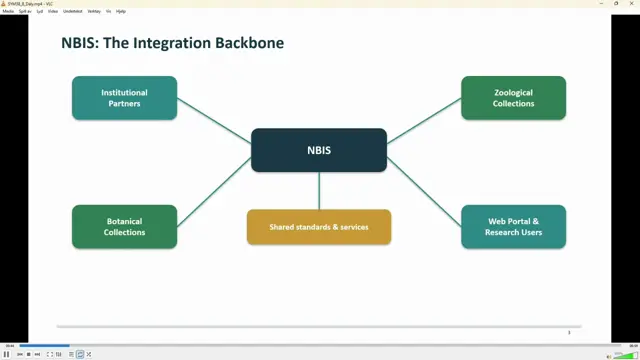
Architecting the National Biodiversity Information System: Standards-Driven Workflows for South Africa’s Botanical and Zoological Data
SANBI sustains NBIS through a statutory mandate plus a roadmap of diversified funding, partnerships and demonstrated return on investment.
Fhatani Ranwashe ↗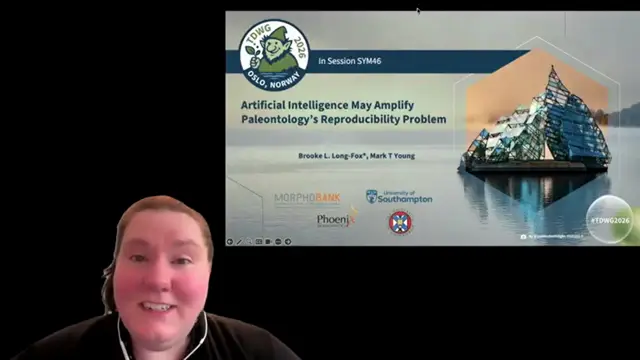
Artificial Intelligence Amplifies Paleontology's Reproducibility Problem
AI can make uncertain paleontological data look clean and authoritative, so AI-ready data must also be verifiable back to evidence and interpretation.
Brooke Long-Fox ↗
Challenges and Opportunities for FAIR Marine eDNA Data Publication Workflows
Making marine eDNA data FAIR is as much about clear, practical, less manual publication processes as about technology.
Berenice Talamantes Becerra ↗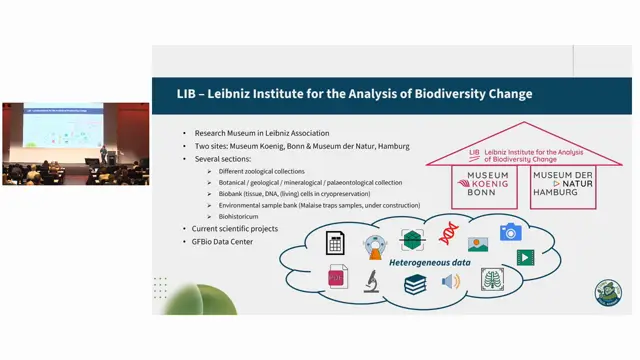
Diversity Workbench (DWB) as a Standards-Based Collection Management System for Heterogeneous Research Data and Biodiversity Data Mobilization
Diversity Workbench can hold very heterogeneous institutional data and publish it through standard pipelines, but its complexity pushes LIB to build web and API layers.
Birgit Rach ↗
Freshwater data platforms: acronym soup, abundance, classifications and data quality
The freshwater community prefers connected, specialised platforms feeding GBIF over one system, but must address abundance data, classification consistency and trust in data from diverse providers.
Koen Martens, Anne Lyche Solheim, Olaf Banki ↗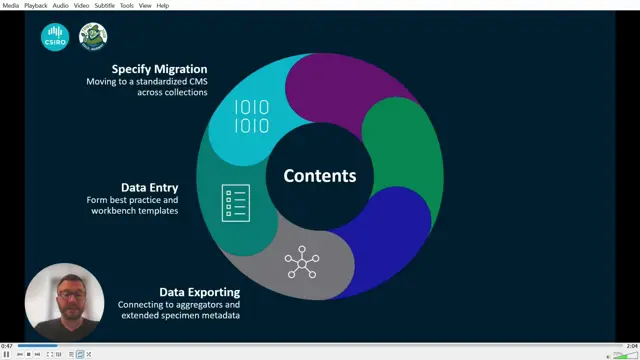
From Data Entry to Distribution: Streamlining Biodiversity Workflows with Specify at CSIRO
Layered standards in templates, roles and training let CSIRO keep five Specify instances consistent while each collection keeps its own outputs.
Dan Baker ↗
From Legacy Data to FAIR Workflows: Standardising Biodiversity Collections Using Specify
Standardised workflows, not just a new database, turned 11 differently managed collections into GBIF-ready data.
Siyabonga Zamisa ↗
The FIPbio data portal: towards an integrated freshwater biodiversity data ecosystem
FIPbio aims to make freshwater data publishing and analysis easier by combining FADA taxonomy, GBIF occurrences, site context, abiotic and remote-sensing data, and automated catchment annotation.
Vanessa Bremerich ↗
Reliable LLM-assisted curation of ecological survey data: a deployed agent bridging field collection and data curation
An LLM agent that proposes findings for curator approval, with confirmed patterns turned into deterministic rules, catches plausibility errors that schema validation misses.
Andrew Tokmakoff ↗