
From Data Entry to Distribution: Streamlining Biodiversity Workflows with Specify at CSIRO
Dan Baker · Meeting Biodiversity Data Standards Using Specify Software
The short versionLayered standards in templates, roles and training let CSIRO keep five Specify instances consistent while each collection keeps its own outputs.
What this was about
Dan Baker described how CSIRO's National Research Collections Australia migrated five of six collections into separate Specify instances between mid-2021 and end-2025. The collections now hold over two million specimens and more than 150 users. The data management team maintains standards at three levels: field definitions and controlled picklists, collection-specific formatting through a fully used agent table with aggregated views, and holistic minimum-dataset checks in WorkBench templates. They are supported by Excel templates with conditional formatting, a VBA script for collector names, batch edit and Power Query checks. He also covered training, support channels, standard roles, and uptake figures, and ended with a Specify wishlist.
Why it matters. Large multi-collection institutions need repeatable ways to enforce standards across many users. This talk gives a detailed practical toolkit and concrete feature requests for CMS developers.
In the room
- Five of six NRCA collections were migrated to Specify between mid-2021 and end-2025, each taking 12–18 months with staggered go-lives. Subject experts were seconded for at least 50% of their time.
- Darwin Core terms were the migration framework, so legacy data was split or merged, with rinse-and-repeat verification.
- Over two million registered specimens across five instances and over 150 registered users.
- Standards at three levels: field-level (descriptions, controlled picklists), collection-level (formatting via full agent records and aggregated views) and holistic (minimum dataset checks such as country and coordinate uncertainty).
- Excel WorkBench templates use conditional formatting, picklist copies, a VBA script to split collector names, a data-check tab and shared mapping files.
- Batch edit and SQL-based Power Query checks in Excel support ongoing clean-up, e.g. adding common names to the fish collection.
- In 28 months: over 50,000 new specimens and over 8,000 new taxa; about 25 actions per user per day.
Notable moments
Transcript
Automatically generated captions can contain mistakes, especially in names and technical terms. Times are relative to the room recording.
Read the transcript ↓
Related talks.
From Legacy Data to FAIR Workflows: Standardising Biodiversity Collections Using Specify
Standardised workflows, not just a new database, turned 11 differently managed collections into GBIF-ready data.
Metadata matters: perceptions on the implementation of Darwin Core in the biocollections cyberinfrastructure
Standardisation through Darwin Core can mask nuance, and practitioners report complex data, missing guidelines and limited capacity as the main implementation barriers.
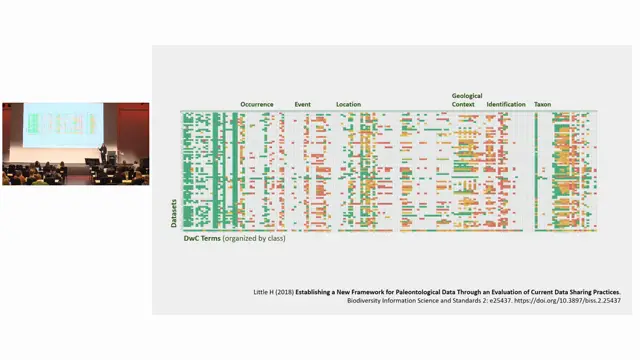
A framework for aligning collections data with the global data ecosystem from data creation to extension in the Smithsonian National Museum of Natural History Department of Paleobiology
Making paleo collections work in the global data ecosystem needs an iterative, full life-cycle framework, not one-off digitisation.