
Explore the conversation.
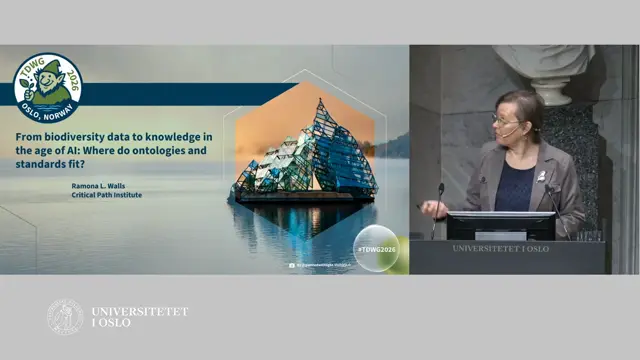
From biodiversity data to knowledge in the age of AI: where do ontologies and standards fit?
AI can generate data and candidate knowledge, but only standards, ontologies, provenance and governance let data become trusted evidence and therefore knowledge, which is why TDWG matters more than ever.
Ramona Walls ↗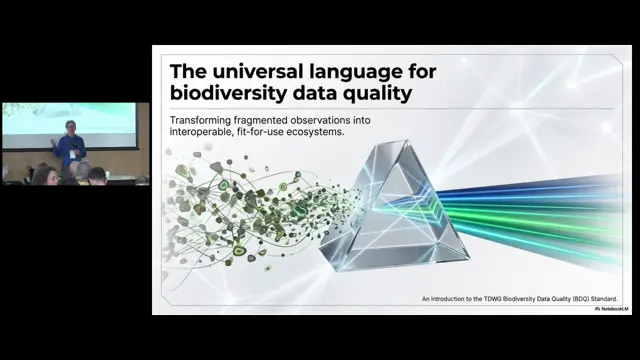
An Introduction to the Biodiversity Data Quality Standard (BDQ)
BDQ provides 110 standard, use-case-linked tests so that data quality can be assessed consistently from collection to aggregation.
Lee Belbin ↗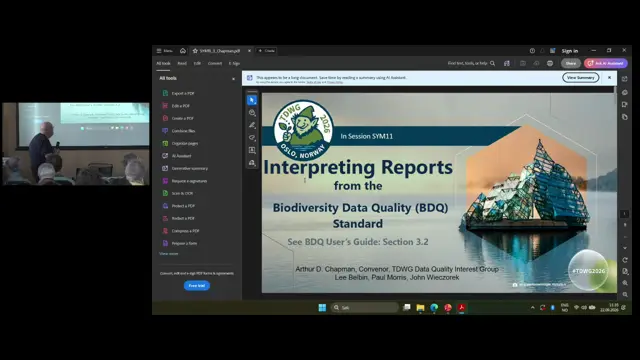
Interpreting the Responses from BDQ Tests
Every BDQ test returns a status, result and comment, and understanding these lets users decide fitness for their own use.
Arthur Chapman ↗
LT17 closing Q&A: AI hallucinations, validation and lightning-talk format
Validation of large-scale AI output remains open; for ML classifiers, accuracy should be judged on the ecological task rather than benchmark metrics.
Jack Hollister, Haris, Tanya Berger-Wolf ↗
From 'Lost in Translation' to Fit-for-Purpose Data: Why Ecologists and Conservation Practice Still Need Groupings and Uncertainties
Biodiversity data systems must be able to record identification uncertainty and taxonomic groupings, or ecologists face a choice between false certainty and lost ecological information.
Bernhard Kløw Askedalen, Natalie ↗
Panel discussion: From Mobilizing Data to AI-Ready Knowledge
AI-readiness is purpose-dependent, and the hardest remaining problems are social: trust, attribution, governance and data sovereignty, where ontologies and knowledge graphs offer some control and explainability.
Hilmar Lapp, Robert Guralnick, Tanya Berger-Wolf ↗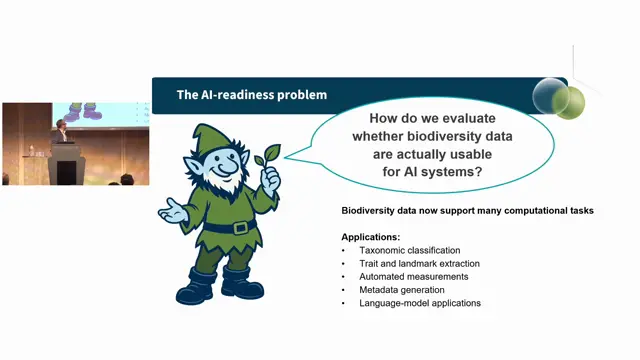
Toward Quantitative AI-Readiness Metrics for Biodiversity Data Infrastructures
AI readiness should be a task-specific, measurable profile rather than a single score, and current biodiversity standards lack most of the terms needed to describe it.
Yasin Bakış ↗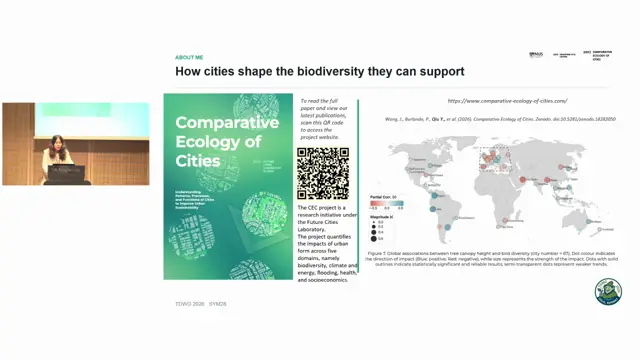
Reporting structure and sampling-bias correction in citizen-science bird data across Asian cities
Abundant citizen-science records do not guarantee inference support; reporting structure can distort richness hotspots and urban-biodiversity relationships unless it is diagnosed and controlled.
Yeshan Qiu ↗