
DwC-DP Integration at GBIF
Federico Mendez, Mikhail Podolskiy · Monday plenary programme
The short versionGBIF is close to supporting Darwin Core Data Packages end to end, with typed and stricter validation, while keeping Darwin Core Archives fully supported.
What this was about
Federico Mendez and a GBIF colleague (introduced as Nikolaj) described how GBIF is integrating the Darwin Core Data Package (DwC-DP) into its publishing and ingestion infrastructure. Mendez stressed that Darwin Core Archives are not going away. He explained that DwC-DP adds a Frictionless-style datapackage.json with typed fields, constraints and referential integrity, and that the IPT will support mapping and publishing DwC-DP. Nikolaj covered the stricter validation, metadata synchronisation to the registry, and a new ingestion that maps DwC-DP into GBIF's internal model, with examples from the Nice Botanic Garden herbarium. Everything is currently only in GBIF's test environment.
Why it matters. DwC-DP is the biggest change to the Darwin Core publishing model in years. How GBIF validates, ingests and displays it will decide how data publishers can express richer, relational biodiversity data.
In the room
- Darwin Core Archives (core plus extensions, meta.xml and EML) will stay supported. Publishers who are happy with them can keep using them.
- GBIF's 20-year review found that publishing around central entities (occurrences, events, taxa) was not enough for existing data or for engaging new communities.
- The DwC-DP conceptual model was ratified in May 2026. The final review's no-dissent period ended on 15 September, and ratification and release by the TDWG Executive is expected soon.
- A DwC-DP has data files, the same EML, and a new datapackage.json (from the Frictionless Data specification) that describes tables, fields, constraints, data types and relationships between tables.
- The IPT will support mapping, metadata editing, validation and publishing of DwC-DP, but only in the test environment for now.
- Validation checks the datapackage.json against its schema and against the standardised TDWG definitions, then checks unique and primary-key constraints and referential integrity, and reports statistics such as unique and populated values per column.
- Metadata synchronisation mainly uses EML, falling back to datapackage.json where needed.
Notable moments
Transcript
Automatically generated captions can contain mistakes, especially in names and technical terms. Times are relative to the room recording.
Read the transcript ↓
Related talks.
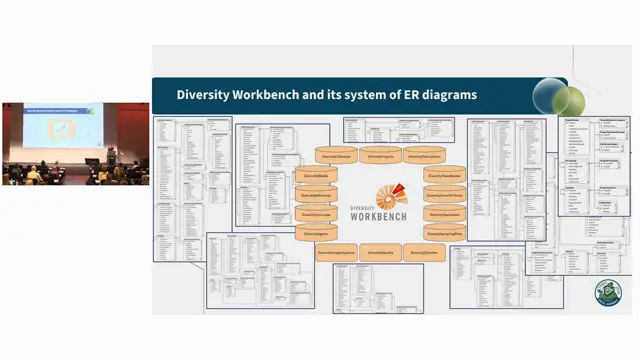
Mapping the Relational Data Schema of the Diversity Workbench (DWB) to the Darwin Core Data Package Data Model to fit better to GBIF´s New Data Model
DwC-DP promises to carry the relational richness that previously pushed GFBio centres to ABCD, and a first DWB-to-DwC-DP prototype via the test IPT works.

Address from the TDWG Chair: highlights of the year and TDWG at a crossroads
TDWG has had a productive year, but a growing, more diverse community and the rise of AI put it at a crossroads that needs more volunteers, better documentation and more sustainable maintenance and funding.
Aligning An Evolving Global Data Model To Software With Global Ambitions: GBIF x TaxonWorks
TaxonWorks and DwC-DP have converged conceptually, but exchange between rich models will always be lossy, so mappings should be recorded explicitly.