
Keeping Colliders in Physics: Rebuilding the ALA taxonomic backbone
Cameron Slatyer · Monday plenary programme
The short versionTaxonomic checklists are not backbones: data aggregators need a curated single hierarchy with quality-control feedback loops, not automated merging of checklists.
What this was about
Cameron Slatyer explained how the Atlas of Living Australia (ALA) rebuilt its taxonomic backbone. It had been assembled by an automated 'large taxon collider' that merged the ABRS National Species List with the Catalogue of Life, the New Zealand Organism Register and ad hoc sources. He argued that a backbone for matching data is different from a taxonomic checklist, and that a fully automated, human-free backbone is a fiction. ALA stopped the colliding: it now adds sources one at a time around the NSL, with metric checks and feedback loops through ChecklistBank and data matching. This sharply cut duplicates and unmatched records.
Why it matters. Names matching decides whether millions of occurrence records can be found and used, including for threatened species assessments, sensitive data handling and AI. ALA's metrics-driven approach is a practical model for other aggregators.
In the room
- ALA holds more than 184 million records. Its backbone is built on the ABRS National Species List because of endemism, Australia-specific taxonomy, undescribed phrase-name species, names fixed in legislation, invasive species risk and traditional ecological knowledge.
- The large taxon collider merged checklists automatically. It relied on consistent hierarchies and complete name combinations; any variance produced errors and duplicates.
- Example: records of the endangered common bent-wing bat, long misidentified as Miniopterus schreibersii, did not connect to the endemic species because the misidentification was not a synonym in the NSL.
- Listing a misapplied name both under the taxon it was misapplied to and in its correct place, which is common in checklists, is a disaster for data matching.
- The old backbone had jumbled concepts and duplicates. More than 10 million records (10% of holdings) matched nothing, and one name had 78 variants.
- A backbone needs a single hierarchy, not necessarily a fully scientifically valid one. It needs names inserted (prioritising legislated species), concepts removed or moved to avoid mis-routing records, and sometimes a commonly accepted name used over the best current name.
- ChecklistBank metrics (duplicates, orphan taxa) plus data matching (higher matches and no matches) guide curation. The team extracted all 2.06 million names-match parameter combinations.
Notable moments
Transcript
Automatically generated captions can contain mistakes, especially in names and technical terms. Times are relative to the room recording.
Read the transcript ↓
Related talks.
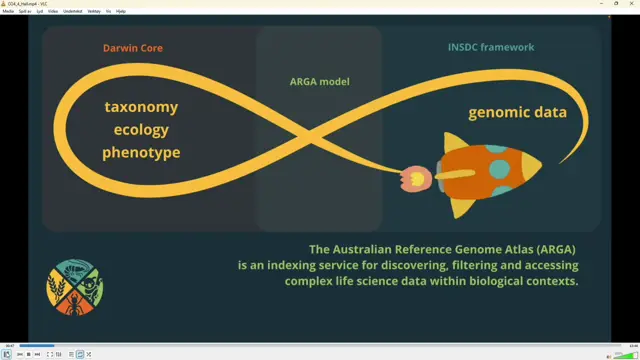
Visualising specimens as event chains on the Australian Reference Genome Atlas
Modelling genomic data as event chains from organism to data product preserves context and provenance that flat records collapse.
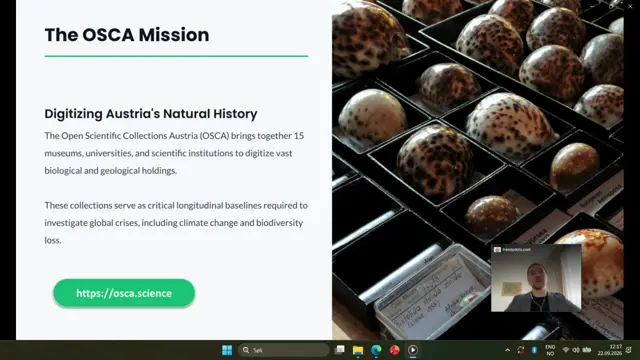
How Darwin Core enables harmonizing Biodiversity Data via the OSCA Consortium
A shared Darwin Core-based cloud pipeline lets 15 Austrian institutions of very different IT capacity publish harmonised specimen data.
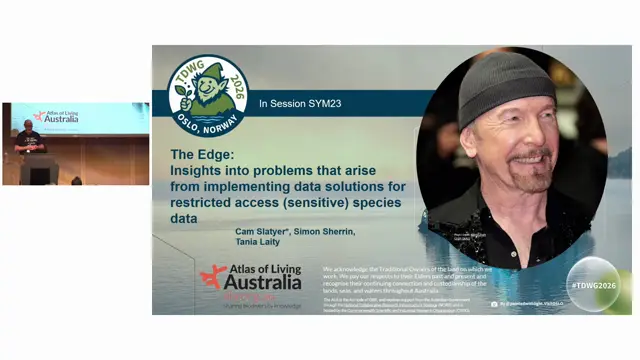
The Edge: Insights into problems that arise from implementing data solutions for restricted access (sensitive) species data
Plan RASD treatments carefully, because taxonomy, data errors and associated records can silently defeat simple rules like 'generalise to 10 km'.