
Architecting the National Biodiversity Information System: Standards-Driven Workflows for South Africa’s Botanical and Zoological Data
Fhatani Ranwashe · Sustaining the Geo- and Biodiversity Data Ecosystem: Standards-Driven Approaches to Long-Term Resilience
The short versionSANBI sustains NBIS through a statutory mandate plus a roadmap of diversified funding, partnerships and demonstrated return on investment.
What this was about
A SANBI presenter described the National Biodiversity Information System (NBIS), which integrates botanical data managed in BRAHMS and zoological data in Specify, uses TaxaMatch fuzzy matching against an authoritative backbone, and applies staging instances with automated quality checks and ETL synchronisation. NBIS implements the Digital Extended Specimen through persistent identifiers linking specimens to descriptions, literature, names, uses and media. Most of the talk set out a diversified sustainability model: a legislative mandate under NEMBA securing baseline funding, project grants, a proposed biodiversity information fund, alignment with national priorities, a co-investment consortium, a multisectoral steering committee, paid value-added services with open core data, and monitoring to demonstrate return on investment.
Why it matters. It shows a national biodiversity institute combining technical standards workflows with a concrete, multi-pronged sustainability roadmap.
In the room
- NBIS integrates data from institutional partners using BRAHMS (botanical) and Specify (zoological).
- TaxaMatch fuzzy matching resolves misspelled or variant names against an authoritative taxonomic backbone; SANBI distributes authoritative taxon and gazetteer dictionaries.
- Data flow via staging instances with automated QC, then production, synchronised by ETL packages.
- The NEMBA mandate provides baseline infrastructure-grant funding; external grants fund functional extensions.
- SANBI is investigating a dedicated biodiversity information fund to receive donor funds without financial year-end clawbacks.
- Proposals include a co-investment consortium with universities, science councils and SANParks, a multisectoral steering committee, and paid analytics services while keeping core data open.
- The roadmap: secure core funding, align with national priorities, co-invest, diversify, demonstrate value, preserve capability.
Notable moments
Transcript
Automatically generated captions can contain mistakes, especially in names and technical terms. Times are relative to the room recording.
Read the transcript ↓
Related talks.
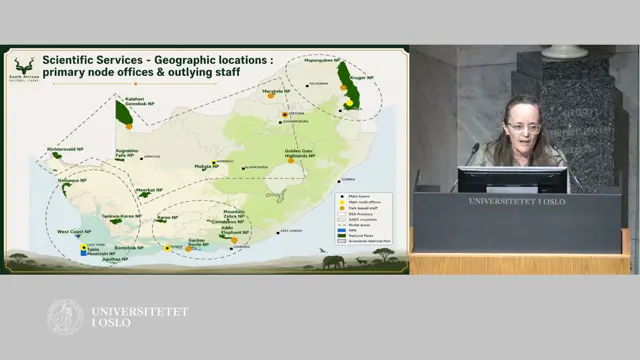
Using automation to consolidate biodiversity occurrence data in South African National Parks
Automating the harvest, integration and summary of biodiversity data lets park staff get evidence-based species lists and dashboards without laborious manual compilation.

How Darwin Core enables harmonizing Biodiversity Data via the OSCA Consortium
A shared Darwin Core-based cloud pipeline lets 15 Austrian institutions of very different IT capacity publish harmonised specimen data.
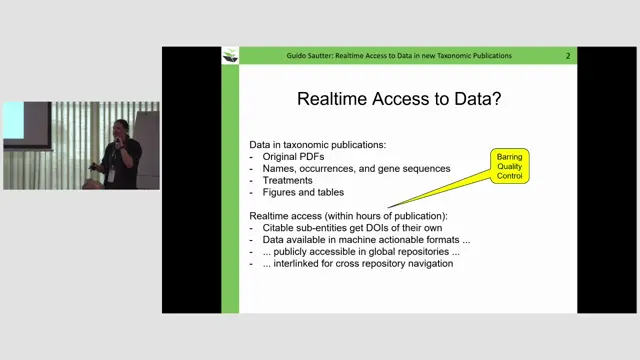
Realtime Access to Data in new Taxonomic Publications
Plazi can deliver interlinked, machine-actionable data from new taxonomic papers within hours, and XML-first publishing removes most of the costly effort.