
Interpreting the Responses from BDQ Tests
Arthur Chapman · Data Quality: From Standard to Practice
The short versionEvery BDQ test returns a status, result and comment, and understanding these lets users decide fitness for their own use.
What this was about
Arthur Chapman explains how to interpret the reports and responses produced by BDQ tests. The only normative output is the response, consisting of a status (e.g. run has result, internal or external prerequisites not met, amended, not amended), a result (compliant/not compliant, potential issue, a value) and a human-readable comment, plus an optional qualifier. Worked examples cover day-in-range validation, data-generalizations issue flags, day amendments and measures, with emphasis that amendments should never enter a database of record without human checking.
Why it matters. Implementers and data users need to read BDQ outputs correctly, e.g. distinguishing data problems from temporary external failures.
In the room
- Report form is not specified by BDQ, but a report should include a response for every test run, in a strict order.
- Response = status (operational metadata), result (core assertion from controlled vocabulary), comment (human-readable), optional qualifier.
- Internal prerequisites not met: the data cannot be evaluated and will always give this result until the record changes.
- External prerequisites not met: an external authority (e.g. a GBIF vocabulary) was unavailable; rerunning may succeed.
- Validation example: day 30 with month 2 of 1952 is not compliant; day 31 without a month cannot be evaluated.
- Issue tests (e.g. data generalizations not empty) raise warnings for human judgement.
- Measures: single-record direct, single-record derived and multi-record.
Notable moments
Transcript
Automatically generated captions can contain mistakes, especially in names and technical terms. Times are relative to the room recording.
Read the transcript ↓
Related talks.
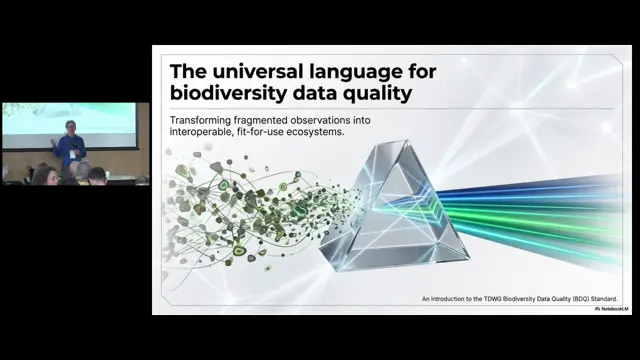
An Introduction to the Biodiversity Data Quality Standard (BDQ)
BDQ provides 110 standard, use-case-linked tests so that data quality can be assessed consistently from collection to aggregation.
Challenges and Opportunities for FAIR Marine eDNA Data Publication Workflows
Making marine eDNA data FAIR is as much about clear, practical, less manual publication processes as about technology.
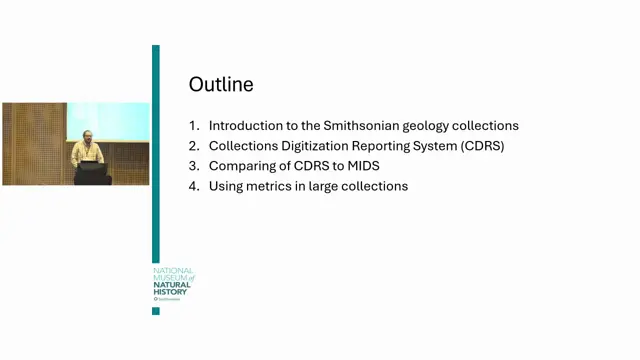
Assessing record quality and completeness in geoscience collections
Element-level views of MIDS information elements are more useful than raw scores for targeting data improvement in large geoscience collections.