
Diversity Workbench (DWB) as a Standards-Based Collection Management System for Heterogeneous Research Data and Biodiversity Data Mobilization
Birgit Rach · Solutions for Research Collection Management Systems Challenges
The short versionDiversity Workbench can hold very heterogeneous institutional data and publish it through standard pipelines, but its complexity pushes LIB to build web and API layers.
What this was about
Birgit Rach, digital collection manager at LIB (Bonn and Hamburg), gave an overview of how LIB has used Diversity Workbench (DWB) for more than ten years to manage very heterogeneous data. This covers zoological, botanical, geological, mineralogical and paleontological collections, a biobank, an environmental sample bank, a historical library, research projects and external data as a GFBio data centre. DWB is an open-source, relational, multi-tenant system with granular rights and a customisable import wizard. It is integrated with a DAM system for media, Geneious for sequences and an ASV registry. Publication runs via BioCASe (ABCD) and IPT (Darwin Core) with DOIs. Challenges: gaps in data types, a complex Windows-only interface (a browser client is in development), custom scripts, and keeping up with external APIs.
Why it matters. It shows how a research museum integrates many specialised systems around a standards-based CMS, with publishing to multiple portals from one source.
In the room
- LIB is a Leibniz research museum at two sites with diverse collections, a biobank, an environmental sample bank and a GFBio data centre role.
- DWB: relational, developed in Munich, open source, multi-tenant, granular rights, customisable import wizard, links to many repositories.
- Supporting systems: a digital asset management system for media/PDFs, Geneious for sequence data, an ASV registry.
- Publication via BioCASe Provider Software (ABCD) and GBIF IPT (Darwin Core), with DOIs and stable identifiers served as RDF and JSON.
- Challenges: data types not covered, complex interface, no macOS/Linux client, custom sync scripts, changing external APIs.
- Quality control: controlled vocabulary templates, pre-import checks, reference lookups and portal validators (GFBio).
Notable moments
Transcript
Automatically generated captions can contain mistakes, especially in names and technical terms. Times are relative to the room recording.
Read the transcript ↓
Related talks.
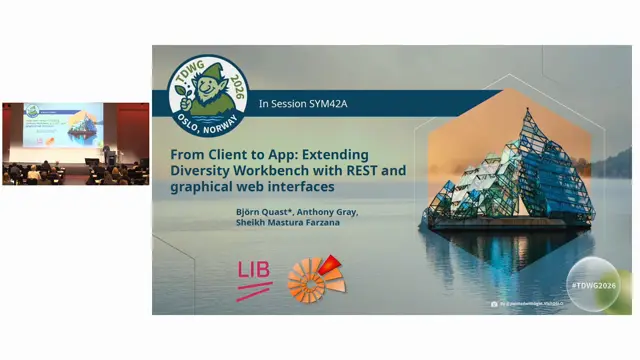
From Client to App: Extending Diversity Workbench with REST and graphical web interfaces
A concept-based REST API and search index let LIB build flexible web interfaces and ingest data on top of the complex Diversity Workbench database.
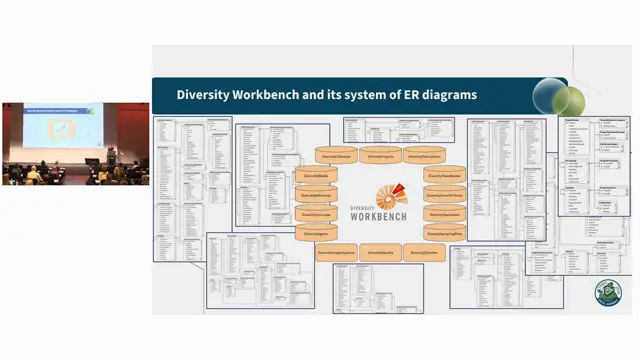
Mapping the Relational Data Schema of the Diversity Workbench (DWB) to the Darwin Core Data Package Data Model to fit better to GBIF´s New Data Model
DwC-DP promises to carry the relational richness that previously pushed GFBio centres to ABCD, and a first DWB-to-DwC-DP prototype via the test IPT works.
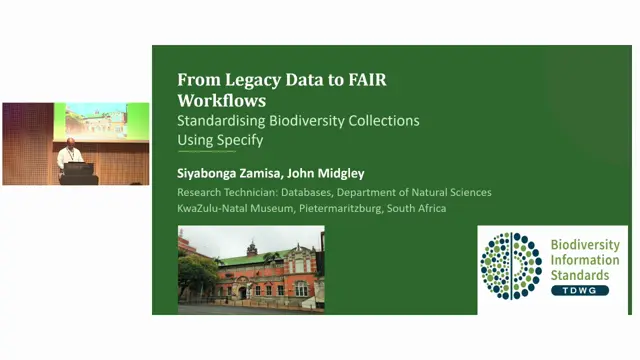
From Legacy Data to FAIR Workflows: Standardising Biodiversity Collections Using Specify
Standardised workflows, not just a new database, turned 11 differently managed collections into GBIF-ready data.