
Freshwater data platforms: acronym soup, abundance, classifications and data quality
Koen Martens, Anne Lyche Solheim, Olaf Banki, Vanessa Bremerich, Yury Roskov, Bernhard Kløw Askedalen, Astrid Schmidt-Kloiber · A consensus taxonomic reference for improved freshwater biodiversity data and knowledge
The short versionThe freshwater community prefers connected, specialised platforms feeding GBIF over one system, but must address abundance data, classification consistency and trust in data from diverse providers.
What this was about
After announcements, Anne Lyche Solheim asked how the many freshwater platforms and acronyms could be integrated and noted that most seem to handle presence/absence rather than abundance. Olaf Banki acknowledged the community's 'acronym soup' and argued for distinct niches connected machine-to-machine, noting sample-based abundance data exist in GBIF; Vanessa Bremerich positioned GBIF as the unifier fed by high-quality published data and mentioned a possible GBIF-hosted freshwater portal. Yuri Roskov suggested using AI search with credible sources to navigate resources and urged freshwater checklists to adopt WoRMS and other aggregators' classifications; the moderator noted WoRMS preserved FADA lists but does not want insect data. Bernhard Askedalen raised the quality of consultancy survey data, prompting ideas of quality control, community flagging and a traffic-light tag for how reliably a species can be identified.
Why it matters. It surfaces the user perspective (ecologists confused by many platforms) and concrete ideas such as identifiability tags for handling heterogeneous data quality.
In the room
- Ecologists struggle with a 'myriad' of biodiversity platforms and acronyms.
- Most platforms seem presence/absence based, yet abundance and dominance matter for environmental management.
- Response: platforms have different purposes and niches but should speak the same language machine-to-machine, human-to-machine and human-to-human.
- GBIF can hold sample-based data with abundances; FBIS supports abundance entry and data should be pushed to GBIF.
- GBIF is seen as the unifying endpoint; a GBIF-hosted freshwater portal is under discussion once FADA lists are available.
- Yuri Roskov: use AI search with a prompt for credible sources to navigate resources; freshwater checklists for groups covered by WoRMS or other aggregators should use their classifications to avoid conflicting classifications.
- WoRMS picked up FADA checklists when FADA went into hibernation, but is not interested in harvesting FADA insect data, about 60% of FADA diversity.
Notable moments
Transcript
Automatically generated captions can contain mistakes, especially in names and technical terms. Times are relative to the room recording.
Read the transcript ↓
Related talks.
The FIPbio data portal: towards an integrated freshwater biodiversity data ecosystem
FIPbio aims to make freshwater data publishing and analysis easier by combining FADA taxonomy, GBIF occurrences, site context, abiotic and remote-sensing data, and automated catchment annotation.
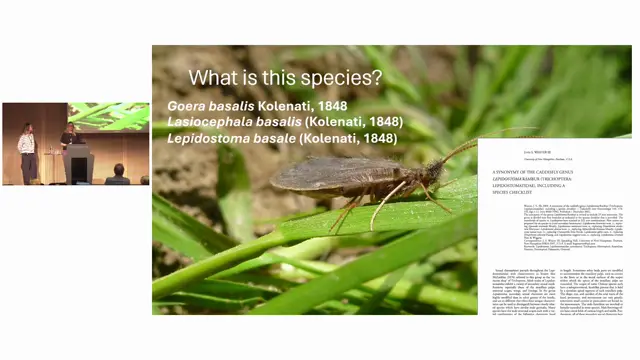
Not just another database: building the future of freshwater taxonomy with FADAtims
FADAtims turns the dormant FADA checklists into a living, expert-curated and interoperable freshwater taxonomic infrastructure, but its future depends on sustaining experts and systems.
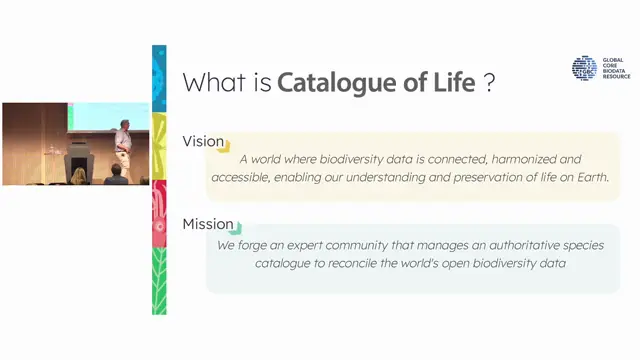
Catalogue of Life and Freshwater species data
Catalogue of Life pledges to model and expose freshwater designations within a year, fed by FADAtims and WoRMS, finally allowing freshwater species and occurrences to be identified via GBIF.