
Data Quality in Focus: Bridging the Biodiversity Data Gap for Sustainable Finance
Emma Granqvist · Bots, Bits, and Biodiversity
The short versionBiodiversity assessments for finance need local data; a tiered data-quality hierarchy like carbon accounting could make them credible.
What this was about
Emma Granqvist, director of SBDI, presented work from the Finance to Revive Biodiversity (FinBio) programme. The finance sector assesses biodiversity mostly top-down with global models or proxies; using high-quality arthropod eDNA survey data from Sweden and Madagascar with environmental covariates, the team showed that machine learning predictions of essential biodiversity variables degrade heavily at sites without local data, leading to wrong site rankings. They propose a biodiversity data hierarchy with quality scores modelled on carbon accounting standards, to be refined in phase two.
Why it matters. Connects TDWG-style data quality to decision quality in sustainable finance, a growing user of biodiversity data.
In the room
- Planetary boundaries show seven of nine limits exceeded; finance flows more to harmful than beneficial activities.
- Finance typically uses top-down global predictive models or proxies; bottom-up local data such as eDNA are needed alongside.
- Study: year-long bulk arthropod eDNA surveys in Sweden and Madagascar plus environmental covariates; ML predicting five EBV-like summary measures, evaluated within and at new sites.
- Predictive performance drops heavily at sites with no local data, leading to many wrong decisions (e.g. site rankings for protection or exploitation).
- Proposal: a biodiversity data hierarchy with quality tiers modelled on carbon accounting and linked to reporting frameworks; phase two starts in January.
- Data quality here means informativeness for a decision, not just correcting observations.
Notable moments
Transcript
Automatically generated captions can contain mistakes, especially in names and technical terms. Times are relative to the room recording.
Read the transcript ↓
Related talks.
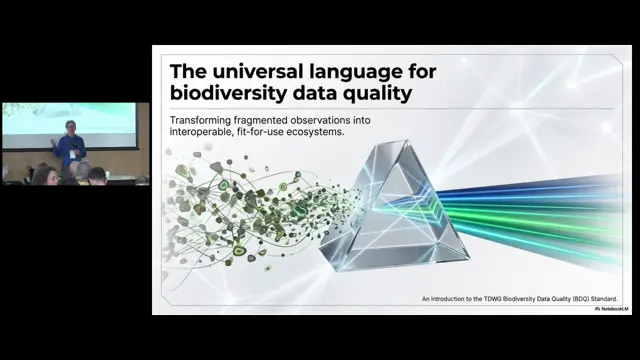
An Introduction to the Biodiversity Data Quality Standard (BDQ)
BDQ provides 110 standard, use-case-linked tests so that data quality can be assessed consistently from collection to aggregation.
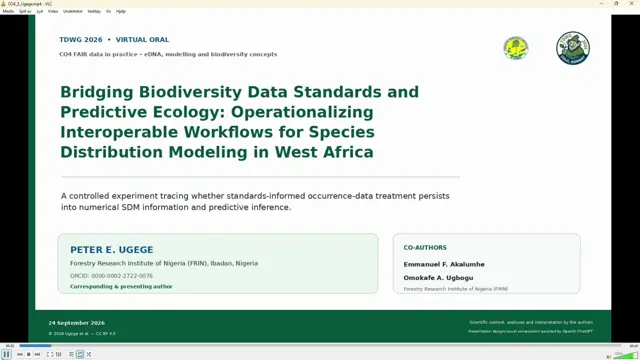
Bridging Biodiversity Data Standards and Predictive Ecology: Operationalizing Interoperable Workflows for Species Distribution Modeling in West Africa
Standards change what enters a modelling pipeline, but workflow design determines whether that difference survives and validation design determines what claims can be made.

Symposium discussion: funding models, open data and sustaining biodiversity infrastructure
The community broadly agreed that core data should stay open, but that products, services, credits, regulation and partnerships must become part of sustaining the infrastructure.