
Metadata matters: perceptions on the implementation of Darwin Core in the biocollections cyberinfrastructure
Bradley Wade Bishop · Digitizing Collections & Legacy Data
The short versionStandardisation through Darwin Core can mask nuance, and practitioners report complex data, missing guidelines and limited capacity as the main implementation barriers.
What this was about
Wade Bishop, a social scientist, presented results of a survey (57 responses, about 98% from the US) of collections staff on Darwin Core implementation, building on earlier interviews and focus groups. Respondents were mostly senior collection managers or curators in academic settings who largely learned data skills on the job; 82% deposit data in GBIF. Open responses on challenges were coded into simplification of complex data (e.g. trawl start/end locations, host-microbe relationships, dynamicProperties flattening), lack of community guidelines, limited capacity, and other mapping issues, and most respondents were unsure how their data were licensed.
Why it matters. Evidence from practitioners on where Darwin Core implementation breaks down can guide guidelines, training and standard development.
In the room
- Earlier microfossil research found a gap between metadata users need for fitness-for-use and what is provided.
- 57 survey responses, about 98% from the US; 71% collection managers or curators; most in role for 10+ years; 75% academic; about half with PhDs.
- Most learned their data skills on the job.
- 82% deposit data in GBIF; storage spans cloud, institutional servers and local drives.
- Challenging elements include record-level metadata, occurrence, event and location terms.
- Challenges coded as simplification of complex data, lack of community guidelines, limited capacity, and others (e.g. administrative 'bookkeeping' metadata).
- Most respondents were unsure how their data are licensed, which matters for machine-actionable reuse.
Notable moments
Transcript
Automatically generated captions can contain mistakes, especially in names and technical terms. Times are relative to the room recording.
Read the transcript ↓
Related talks.
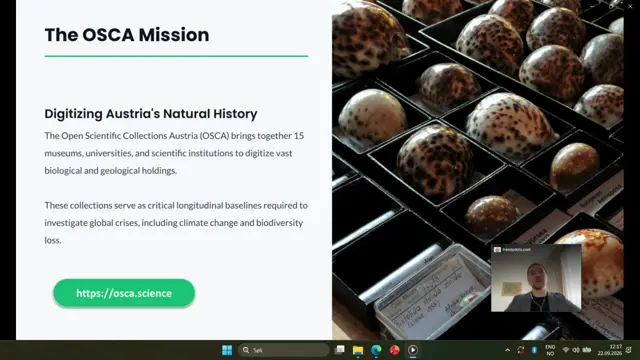
How Darwin Core enables harmonizing Biodiversity Data via the OSCA Consortium
A shared Darwin Core-based cloud pipeline lets 15 Austrian institutions of very different IT capacity publish harmonised specimen data.
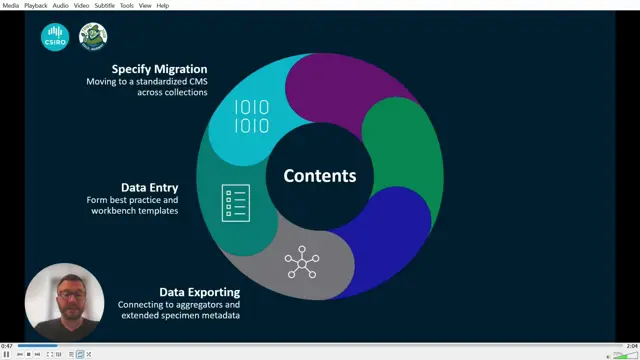
From Data Entry to Distribution: Streamlining Biodiversity Workflows with Specify at CSIRO
Layered standards in templates, roles and training let CSIRO keep five Specify instances consistent while each collection keeps its own outputs.
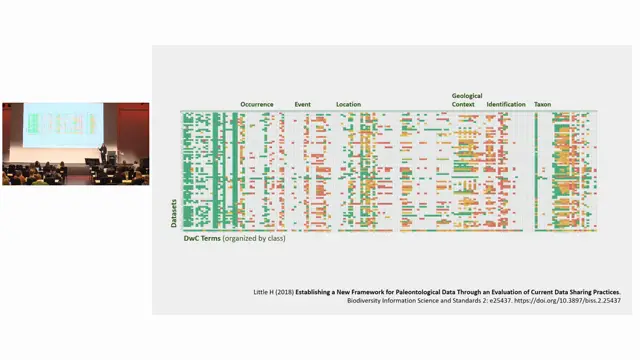
A framework for aligning collections data with the global data ecosystem from data creation to extension in the Smithsonian National Museum of Natural History Department of Paleobiology
Making paleo collections work in the global data ecosystem needs an iterative, full life-cycle framework, not one-off digitisation.