
Explore the conversation.
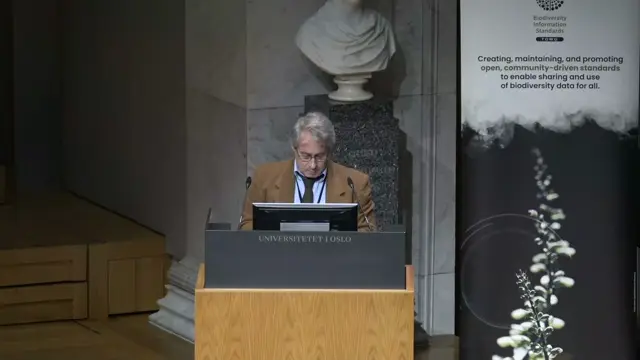
Address from the TDWG Chair: highlights of the year and TDWG at a crossroads
TDWG has had a productive year, but a growing, more diverse community and the rise of AI put it at a crossroads that needs more volunteers, better documentation and more sustainable maintenance and funding.
David Bloom ↗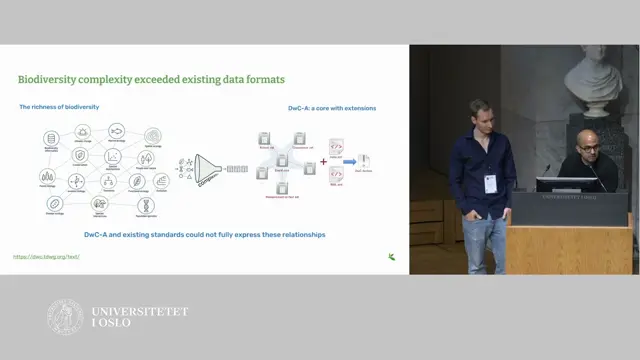
DwC-DP Integration at GBIF
GBIF is close to supporting Darwin Core Data Packages end to end, with typed and stricter validation, while keeping Darwin Core Archives fully supported.
Federico Mendez, Mikhail Podolskiy ↗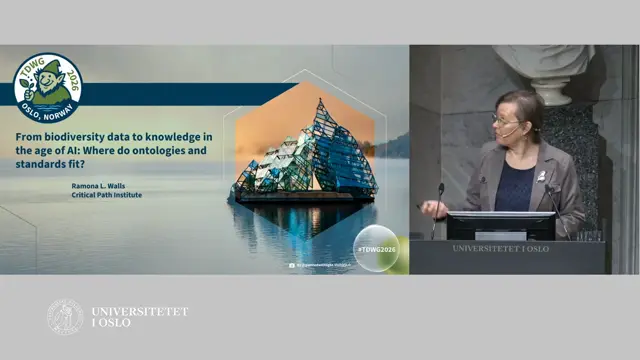
From biodiversity data to knowledge in the age of AI: where do ontologies and standards fit?
AI can generate data and candidate knowledge, but only standards, ontologies, provenance and governance let data become trusted evidence and therefore knowledge, which is why TDWG matters more than ever.
Ramona Walls ↗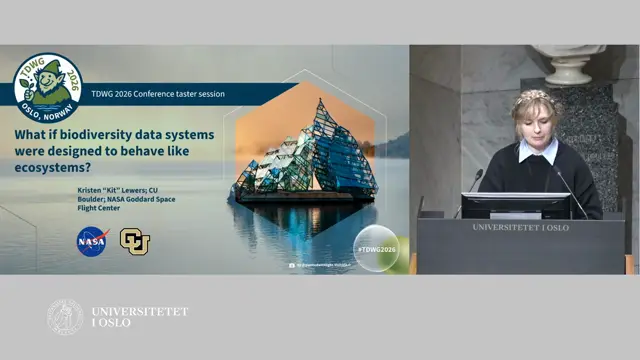
What if biodiversity data systems were designed to behave like ecosystems?
Biodiversity information systems should be designed like ecosystems: loosely coupled, event-driven components linked by shared standards, able to reorganise as conditions change.
Kit Lewers ↗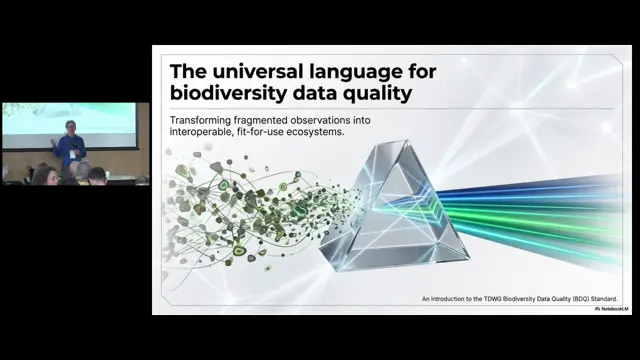
An Introduction to the Biodiversity Data Quality Standard (BDQ)
BDQ provides 110 standard, use-case-linked tests so that data quality can be assessed consistently from collection to aggregation.
Lee Belbin ↗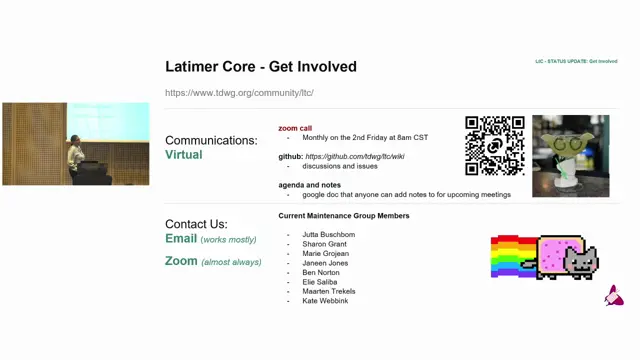
Once and future Latimer Core: status update and open conversation
Latimer Core is being restructured as a data package with unique term IRIs, enabled by TDWG now accepting standards with formal structure.
Sharon Grant ↗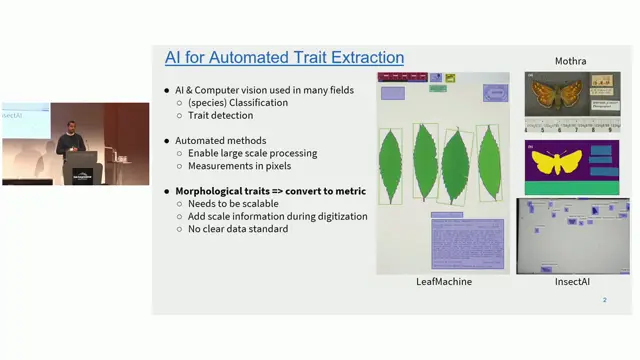
Towards Scalable Trait Measurements from Digitized Specimens
Matching rulers to an annotated reference set lets specimen images be calibrated to real-world units with under 1% error in 96% of cases.
Kenzo Milleville ↗
Aligning An Evolving Global Data Model To Software With Global Ambitions: GBIF x TaxonWorks
TaxonWorks and DwC-DP have converged conceptually, but exchange between rich models will always be lossy, so mappings should be recorded explicitly.
Matthew Yoder ↗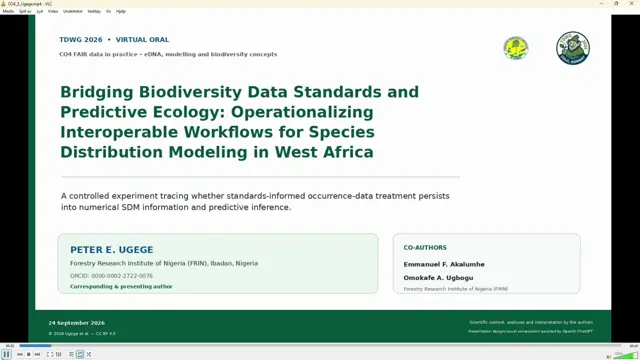
Bridging Biodiversity Data Standards and Predictive Ecology: Operationalizing Interoperable Workflows for Species Distribution Modeling in West Africa
Standards change what enters a modelling pipeline, but workflow design determines whether that difference survives and validation design determines what claims can be made.
Peter Ugege ↗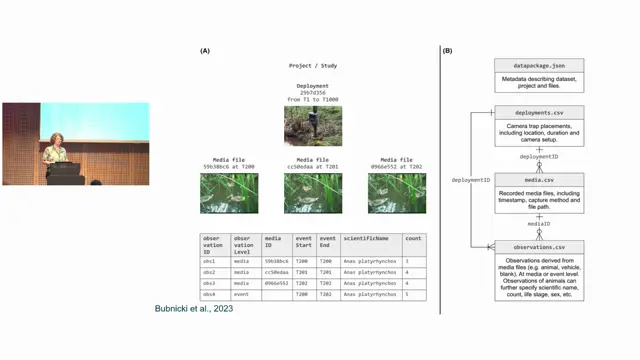
Camtrap DP: extending data standard designed for camera trapping research to support AI workflows and new data sources
Camtrap DP fits data from any stationary sensor, and converging community feedback shows how to extend it for AI provenance and multimodal monitoring.
Karolina Kuczkowska ↗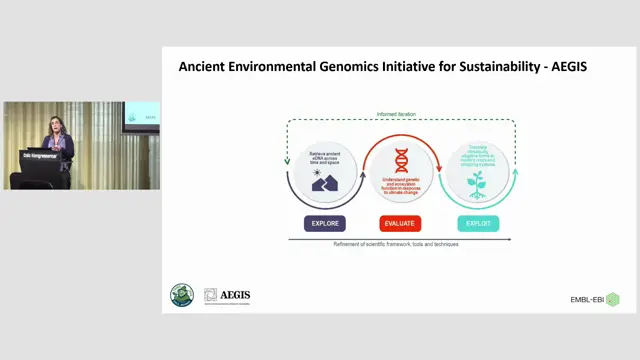
FAIR ancient environmental DNA data in practice: developing and implementing interoperable metadata standards in AEGIS
Community-driven ancient DNA metadata standards, now in MIxS, can make paleogenomic data FAIR and reusable across biodiversity infrastructures.
Joana Pauperio ↗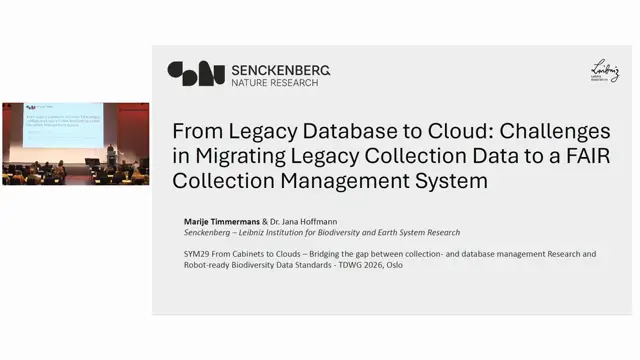
From Legacy Database to Cloud: Challenges in Migrating Legacy Collection Data to a FAIR Collection Management System
A dedicated data manager who acts as liaison and uses iterative prototypes can make a small institute's move to a shared CMS workable despite fragmented legacy practices.
Marije Timmermans ↗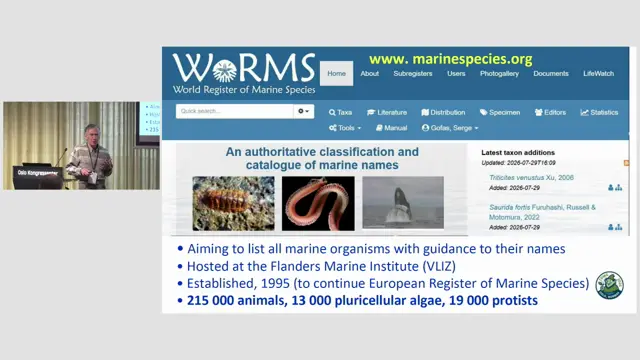
Mapping geographical distributions in the World Register of Marine Species
A country-aware, hierarchical marine geoscheme will let WoRMS and others record and query distributions consistently, pending a solution for defining spatial units in a TDWG standard.
Serge Gofas ↗
Meeting Biodiversity Standards with Specify 7
Specify's new built-in Darwin Core mapping tool aims to make publishing from highly customised databases straightforward without giving up local flexibility.
Grant Fitzsimmons ↗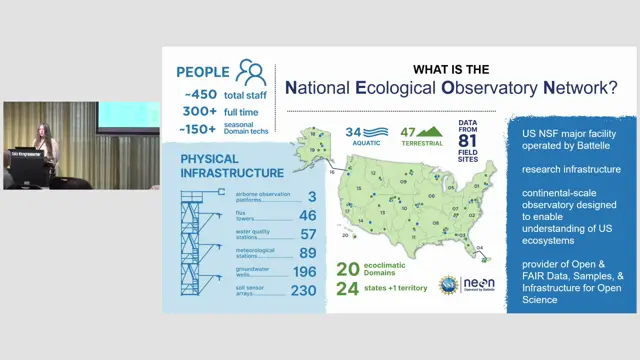
NEON, Community Standards, and the Hyper-Extended Specimen
NEON was built for interoperability from the start, but sustaining standards, crosswalks and value-added links needs community-level solutions.
Chandra Earl ↗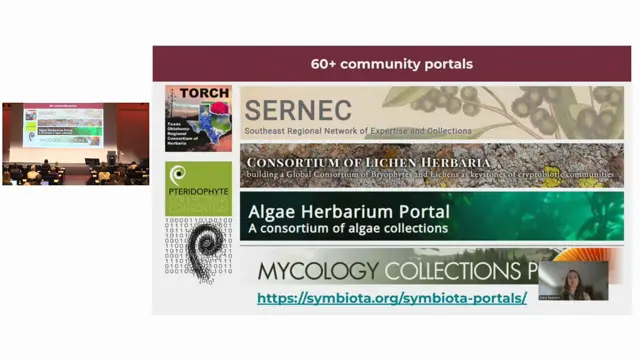
Sharing Extended Specimen Data from Symbiota Portals using Registered Extensions
Existing registered Darwin Core extensions met each of Symbiota's extended-specimen needs, so look for existing standards before inventing new ones.
Katie Pearson ↗
SYM42 discussion: DwC-DP profiles, deriving occurrences, ABCD's future and system boundaries
Richer relational models bring the community together but raise hard governance questions about profiles, occurrence derivation, system scope and link persistence.
James A. Macklin, Jonas Grieb, John Wieczorek ↗
The More Extended, The More Open: Semantic Integration of 3D Natural Heritage Data into Biodiversity CMS
Treating 3D specimen models as entry points in a knowledge graph that includes heritage context and digitisation paradata makes them reusable knowledge assets.
Yeeun Lee ↗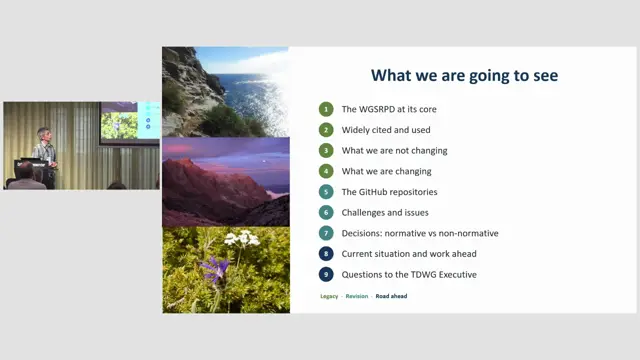
The new World Geographical Scheme for Recording (not only) Plant Distributions: process, progress and challenges
The terrestrial update is complete and the standard is nearly ready for public review, with packaging, naming and polygon hosting still to decide.
Francisco Pando ↗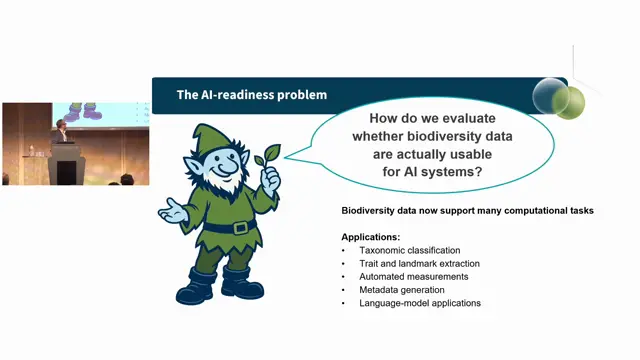
Toward Quantitative AI-Readiness Metrics for Biodiversity Data Infrastructures
AI readiness should be a task-specific, measurable profile rather than a single score, and current biodiversity standards lack most of the terms needed to describe it.
Yasin Bakış ↗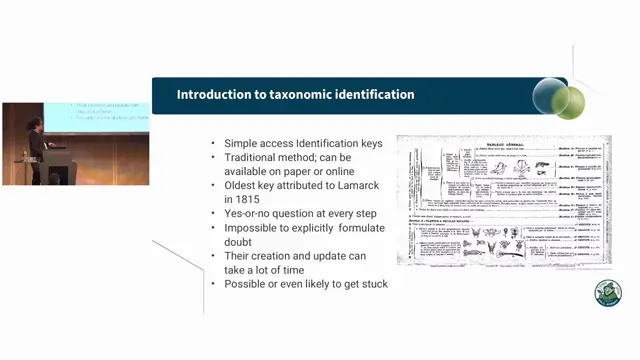
Ctrl+Alt+SDD: A Historical Review Toward a Standard Reboot
SDD is well-documented but dormant and imperfectly interoperable, and the Xper4 rebuild is an opportunity to reopen and modernise it together with the community.
Elie Saliba, Adeline Kerner ↗
Discussion: designing institutional biodiversity knowledge and data science centres
Interoperable institutional knowledge spaces depend less on technology than on people, shared storage and semantics, incentives and governance.
Unidentified session chair, Lars Vogt, Tarek Al Mustafa ↗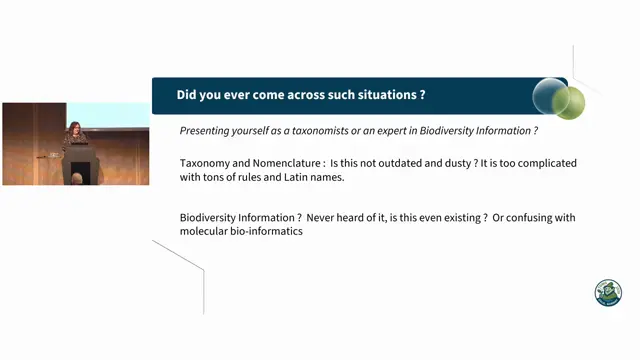
Strengthening Taxonomic capacity and Biodiversity Information in Education
Taxonomy and biodiversity informatics need to be visible, modern parts of curricula, and TDWG should revive its curriculum interest group to secure training and knowledge transfer.
Patricia Mergen ↗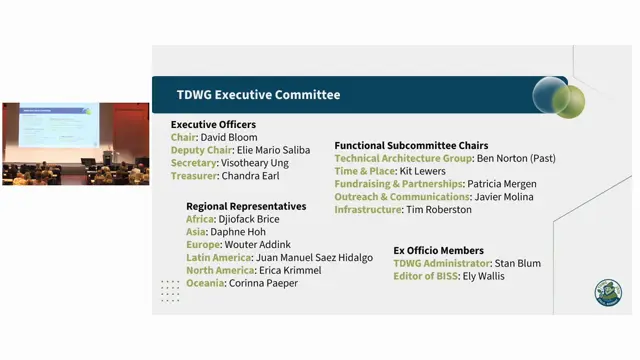
TDWG Business Meeting: elections, subcommittee and working group reports, and TDWG 2027 announcement
TDWG is recruiting for key elected roles and subcommittees while reporting a busy standards year and announcing a large joint 2027 meeting in Montreal.
David Bloom, Ben Norton, Kit Lewers ↗