
Camtrap DP: extending data standard designed for camera trapping research to support AI workflows and new data sources
Karolina Kuczkowska · From Mobilizing Data to AI-Ready Knowledge: Infrastructure for Multimodal Biodiversity Data
The short versionCamtrap DP fits data from any stationary sensor, and converging community feedback shows how to extend it for AI provenance and multimodal monitoring.
What this was about
Karolina Kuczkowska introduced Camtrap DP, the TDWG camera-trap data exchange standard: a Frictionless data package with metadata plus deployments, media and observations tables. It can be published directly to GBIF, with 25 datasets and nearly a million occurrences in the WildAlbum portal. She explained how easy extensibility threatens interoperability and why the classificationMethod/classifiedBy fields no longer capture modern AI pipelines. She then summarised evaluations by the Safe and Sound bioacoustics project and the COST action Insect AI, plus feedback from Trapper users. Together they call for device-neutral hardware fields, recording schedules, audio media fields, an assertions table, all classifications rather than only consensus, and a models table. Work continues through the NLBIF-funded Safer and Sounder project and on GitHub.
Why it matters. Passive sensors are producing huge multimodal datasets processed by AI. Standardising how AI detections and model provenance are recorded keeps these data comparable and FAIR across camera traps, audio and insect monitoring.
In the room
- A Camtrap DP package has datapackage.json (package and project metadata) plus deployments, media and observations tables linked to each other.
- Packages can be published to GBIF without mapping to Darwin Core; the GBIF-hosted WildAlbum portal had 25 datasets with almost one million animal occurrences.
- Based on Frictionless Data, it is easily extended with new tables, but ad-hoc extensions undermine interoperability.
- The current AI fields (classificationMethod human/machine, classifiedBy with model name) are insufficient for today's multi-model pipelines.
- Safe and Sound (WILDLABS-funded) found Camtrap DP suitable for bioacoustics with changes: device-neutral field names, recording schedules, audio-specific media fields and an assertions table analogous to MeasurementOrFact.
- Insect AI (COST action, WG3) found it a good fit with changes: 'baitUse' → 'attractantUse', richer hardware description, schedules, all classifications per resource and a models table.
- Traditional camera-trap users (via Trapper) want all identifications from multiple models shared, not just the final consensus, and more model detail.
Notable moments
Transcript
Automatically generated captions can contain mistakes, especially in names and technical terms. Times are relative to the room recording.
Read the transcript ↓
Related talks.
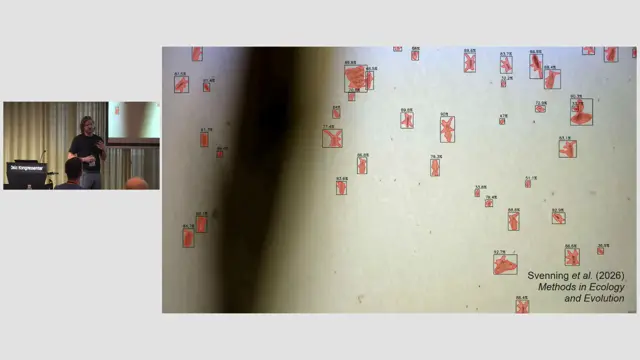
Standardizing Multimodal Insect Monitoring Data for AI-Ready Pipelines: Lessons from an InsectAI Community Datathon
Camtrap DP can largely accommodate automated insect monitoring data today, but the community needs agreed guidance and a few targeted extensions (track IDs, parent media and crop offsets, target taxonomic scope, identification provenance) to handle insect-specific challenges.
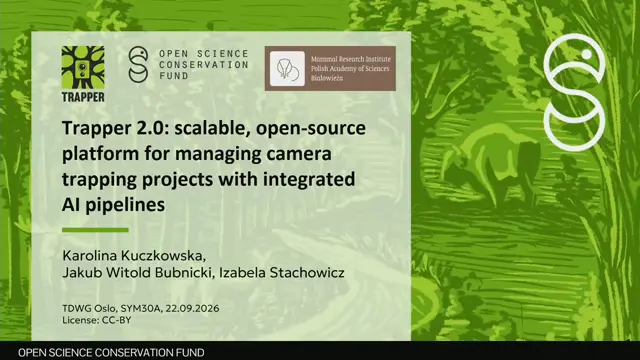
Trapper 2.0: scalable, open-source platform for managing camera trapping projects with integrated AI pipelines
Trapper 2.0 offers an open, model-agnostic, edge-deployable pipeline for camera trap photos and videos with expert review and Camtrap DP export.
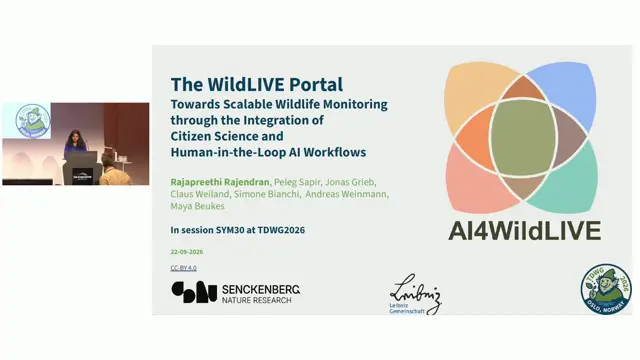
The WildLIVE Portal: Towards Scalable Wildlife Monitoring through the Integration of Citizen Science and Human-in-the-Loop AI Workflows
WildLIVE combines a model registry, provenance-tracked human verification and FAIR publication to move camera trap data from raw images to publishable data.