
Explore the conversation.
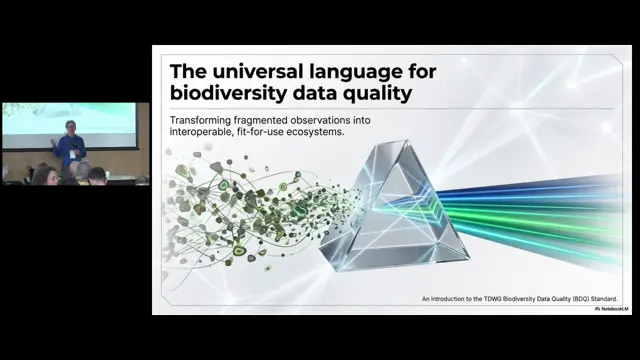
An Introduction to the Biodiversity Data Quality Standard (BDQ)
BDQ provides 110 standard, use-case-linked tests so that data quality can be assessed consistently from collection to aggregation.
Lee Belbin ↗
Delivering AI for biodiversity data in the public sector: data handling, security and humans-in-the-loop when small teams build at pace
Small public-sector teams can use AI tools productively if they set clear boundaries between prototype, dev, test and production and keep expert humans in the loop.
Rachel Wiles ↗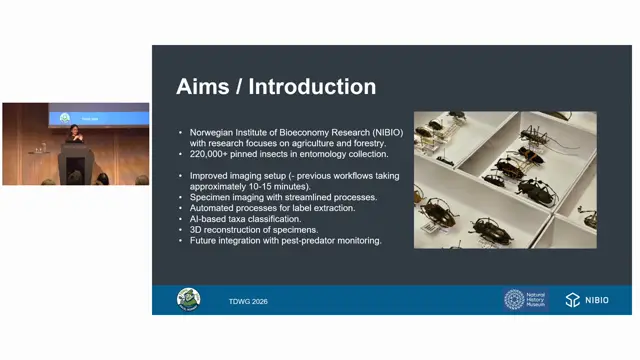
From Collection Drawers to AI - A One-Week Recipe
A useful AI-ready digitisation setup can be built in a week from recycled materials and borrowed cameras.
Arianna Salili-James ↗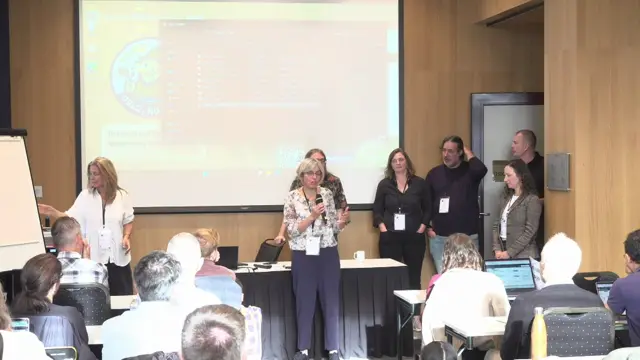
SYM18 discussion: who sustains biodiversity data infrastructures?
Volunteer and single-developer infrastructures deliver proven value, but the community lacks mechanisms and funding to protect them.
Eva Alonso, Giuditta Parolini, Mareike Petersen ↗
Aligning An Evolving Global Data Model To Software With Global Ambitions: GBIF x TaxonWorks
TaxonWorks and DwC-DP have converged conceptually, but exchange between rich models will always be lossy, so mappings should be recorded explicitly.
Matthew Yoder ↗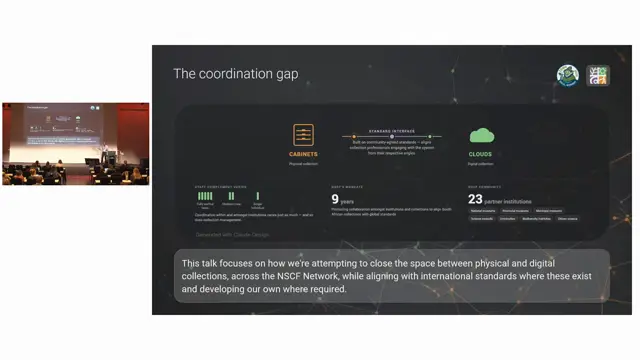
From Silos to Standards - Advancing Standardised Collection State Documentation for Institutional Continuity and Coordination
Standardising how collection state (readiness, risk, conditions) is recorded turns tacit curatorial knowledge into shared, comparable institutional memory.
Jacobus Christiaan Steenkamp ↗
SYM42 discussion: DwC-DP profiles, deriving occurrences, ABCD's future and system boundaries
Richer relational models bring the community together but raise hard governance questions about profiles, occurrence derivation, system scope and link persistence.
James A. Macklin, Jonas Grieb, John Wieczorek ↗