
What if biodiversity data systems were designed to behave like ecosystems?
Kit Lewers · Monday plenary programme
The short versionBiodiversity information systems should be designed like ecosystems: loosely coupled, event-driven components linked by shared standards, able to reorganise as conditions change.
What this was about
Kit Lewers used the 1995 reintroduction of wolves to Yellowstone and the trophic cascades that followed as an analogy for biodiversity information infrastructure. The argument was that system-level behaviour emerges from interactions between loosely coupled components, not from any single blueprint. Lewers proposed event-driven, modular, microservices-style architectures in which new data arriving triggers workflows and updates that cascade through the system. They framed Darwin Core as an existing 'data contract' that already lets diverse institutions interoperate, and suggested making that implicit modularity explicit. NASA remote sensing processing levels were given as an example of adding data without changing the whole paradigm.
Why it matters. It offers a conceptual design pattern for bringing new data types (such as remote sensing) into biodiversity infrastructure without monolithic redesign, and treats standards like Darwin Core as connective infrastructure.
In the room
- Molly Beattie (US Fish and Wildlife Service director from 1993) oversaw the 1995 reintroduction of 14 wolves to Yellowstone, with 17 more the next year, despite opposition and uncertainty.
- Trophic cascades are nonlinear, spatially uneven and still debated. Change came from networks of interactions, not simple chains.
- An ecosystem can be seen as information unfolding in real time. Biodiversity information systems are likewise interdependent, loosely coupled, heterogeneous and only partly coordinated information ecosystems.
- Data gains value through interaction: a new dataset arriving is an event that triggers workflows, updates products and recalibrates models, and the outputs become new events.
- Lewers proposed event-driven modular systems based on microservices, where ingestion, processing, analysis, transformation and dissemination run independently through well-defined interfaces.
- Loosely coupled does not mean structureless. Shared standards and governance let components understand each other.
- Darwin Core already works as a data contract that lets museums, the NEON Biorepository, iNaturalist and NASA contribute without the same internal systems. Making this explicit prompts questions about translation, embedded assumptions, provenance and who maintains interfaces.
Notable moments
Transcript
Automatically generated captions can contain mistakes, especially in names and technical terms. Times are relative to the room recording.
Read the transcript ↓
Related talks.
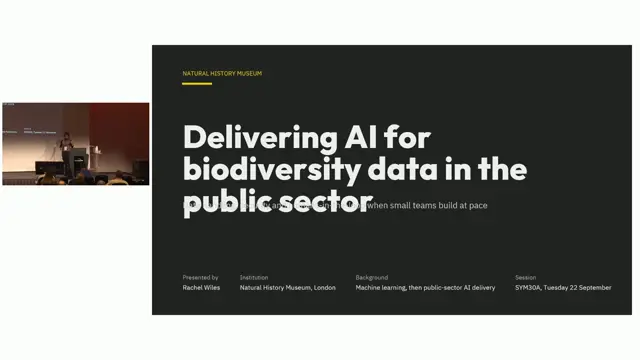
Delivering AI for biodiversity data in the public sector: data handling, security and humans-in-the-loop when small teams build at pace
Small public-sector teams can use AI tools productively if they set clear boundaries between prototype, dev, test and production and keep expert humans in the loop.
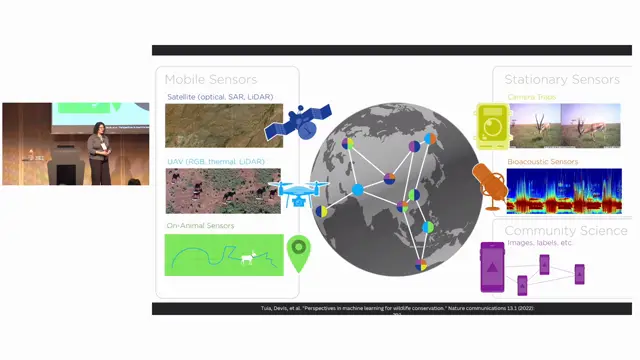
Digital Twins as System-Optimization Tools: Provisioning Edge and Cloud Infrastructure for Biodiversity Monitoring at Scale
Digital twins should close the sim-to-real loop for the sensor systems too, letting teams plan where and how to deploy multimodal monitoring before going into the field.
SYM18 discussion: who sustains biodiversity data infrastructures?
Volunteer and single-developer infrastructures deliver proven value, but the community lacks mechanisms and funding to protect them.