
The new World Geographical Scheme for Recording (not only) Plant Distributions: process, progress and challenges
Francisco Pando · From WDSRPD to GeoSchemes: Recording Biodiversity Distributions for Science and Policy
The short versionThe terrestrial update is complete and the standard is nearly ready for public review, with packaging, naming and polygon hosting still to decide.
What this was about
Paco Pando described updating the WGSRPD, conceived by Dick Brummitt as a politically neutral, four-level scheme following political borders with phytogeographic sense. The terrestrial task group reviewed changes since 2001, now referencing UN naming conventions and precise polygons (prepared by the Pl@ntNet team from OpenStreetMap coastlines) rather than the Times Atlas; about 50 changes were needed and 34 issues resolved, yielding 9, 52, 369 and 617 units at levels one to four. Remaining meta-issues include one or two standards, where polygons live (Marine Regions, Zenodo), the name (GeoSchemes?) and open polygon formats (GeoJSON, FlatGeobuf).
Why it matters. WGSRPD is the most widely used TDWG standard after Darwin Core, so its modernisation and extension to all taxa affects many databases.
In the room
- WGSRPD is used by Plants of the World, IUCN, USDA GRIN and cited 300+ times since 2022.
- It is not a biogeographic standard; that role is played by the older Takhtajan floristic regions standard.
- The Interest Group (2021) has two task groups: terrestrial update and new marine scheme, coordinated to avoid duplicate identifiers.
- References move from the Times Atlas to UN naming conventions and the UN country names database; definitions become actual polygons.
- Around 50 changes in names or borders; 34 issues resolved; terrestrial work considered complete.
- Next: publish tables as CSV, public review, ratification; also a crosswalk from the old version and guidance.
Notable moments
Transcript
Automatically generated captions can contain mistakes, especially in names and technical terms. Times are relative to the room recording.
Read the transcript ↓
Related talks.
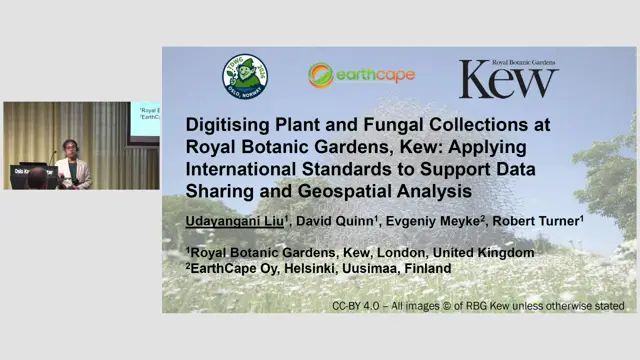
Digitising Plant and Fungal Collections at Royal Botanic Gardens, Kew: Applying International Standards to Support Data Sharing and Geospatial Analysis
WGSRPD enables cross-collection geospatial analysis at Kew, but historical, heterogeneous data leave half of records without fine-level assignment.
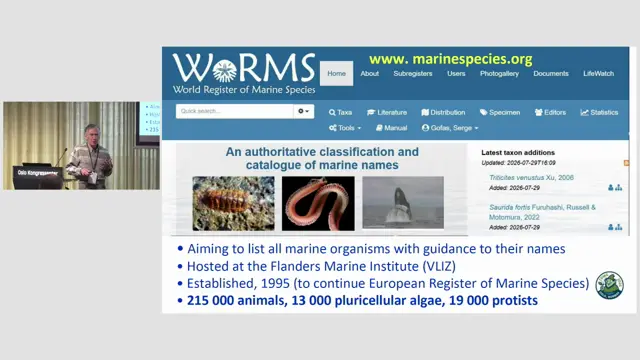
Mapping geographical distributions in the World Register of Marine Species
A country-aware, hierarchical marine geoscheme will let WoRMS and others record and query distributions consistently, pending a solution for defining spatial units in a TDWG standard.
Address from the TDWG Chair: highlights of the year and TDWG at a crossroads
TDWG has had a productive year, but a growing, more diverse community and the rise of AI put it at a crossroads that needs more volunteers, better documentation and more sustainable maintenance and funding.