
Meeting Biodiversity Standards with Specify 7
Grant Fitzsimmons · Meeting Biodiversity Data Standards Using Specify Software
The short versionSpecify's new built-in Darwin Core mapping tool aims to make publishing from highly customised databases straightforward without giving up local flexibility.
What this was about
Grant Fitzsimmons presented Specify Collections Consortium work that lets collections keep local flexibility while sharing data in standard form. He described exportable schema-configuration packages, an updated, detached web portal (largely contributed by the Florida Museum), and a new Darwin Core mapping tool built on the Specify Query Builder. The tool supports Occurrence, Event and Taxon cores, every GBIF-registered extension, and custom terms by IRI. It shows term definitions in the app, auto-suggests mappings, starts from existing queries or templates, and enforces GBIF's minimum required terms. Release is expected by the first quarter of next year, and the SCC is joining multi-CMS work on the Darwin Core Data Package.
Why it matters. Mapping local CMS schemas to Darwin Core is a persistent bottleneck for publishing. A mapping tool in the CMS that knows GBIF extensions and requirements could lower the barrier for hundreds of institutions.
In the room
- The SCC is a non-profit funded only by its member institutions and offers hosting, asset management and workshops.
- Customisations (schema configurations) can be exported as packages and shared between institutions, databases or disciplines.
- The updated web portal is a detached copy of Specify data that can hide sensitive localities and Red List species. It is free to SCC members and largely contributed by the Florida Museum of Natural History.
- The new mapping tool uses the Query Builder interface to map fields to Darwin Core terms, grouped by class, with in-app term definitions, IRIs and examples.
- It supports Occurrence, Event and Taxon cores, all GBIF-registered extensions (e.g. identification history, GGBN, Audiovisual Core), unregistered extensions and custom terms by IRI.
- Adding a field auto-suggests a mapping. Adding an extension (e.g. Audiovisual Core) maps its standard terms automatically, and the tool flags missing GBIF-required terms.
- Release is expected by Q1 of next year. The SCC is also in the multi-CMS Darwin Core Data Package grant project and a planned Leiden hackathon, and all work will be public on GitHub.
Notable moments
Transcript
Automatically generated captions can contain mistakes, especially in names and technical terms. Times are relative to the room recording.
Read the transcript ↓
Related talks.
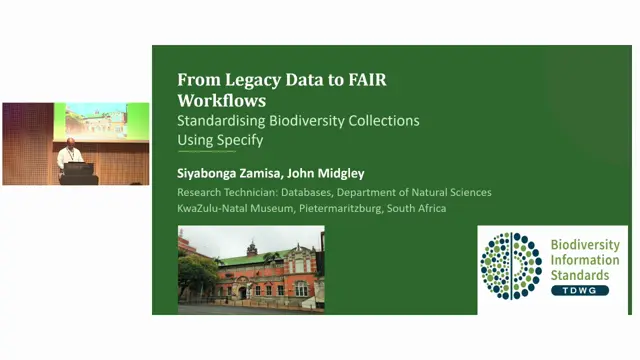
From Legacy Data to FAIR Workflows: Standardising Biodiversity Collections Using Specify
Standardised workflows, not just a new database, turned 11 differently managed collections into GBIF-ready data.

How Darwin Core enables harmonizing Biodiversity Data via the OSCA Consortium
A shared Darwin Core-based cloud pipeline lets 15 Austrian institutions of very different IT capacity publish harmonised specimen data.
Aligning An Evolving Global Data Model To Software With Global Ambitions: GBIF x TaxonWorks
TaxonWorks and DwC-DP have converged conceptually, but exchange between rich models will always be lossy, so mappings should be recorded explicitly.