
Once and future Latimer Core: status update and open conversation
Sharon Grant · State of the Collections Description Interest Group. What's Happening and What's Not!
The short versionLatimer Core is being restructured as a data package with unique term IRIs, enabled by TDWG now accepting standards with formal structure.
What this was about
Sharon Grant updated the room on the Latimer Core maintenance group, which meets monthly and describes intentionally grouped things ('Latimer Core is to groups as Darwin Core is to individual occurrences'). Users asked for structure to implement it, which required identifiers; the group discovered that term IRIs obtained at ratification were duplicated with different meanings because of its generic 'has identifier' structure, conflicting with TDWG's globally scoped IRIs. After the group asked TDWG whether standards could formally include structure, TDWG agreed, following Darwin Core DP and Camtrap DP, so Latimer Core is building an LTC DP structure layer for public review later in the year (after MIDS), with a conceptual/relationship layer still to come.
Why it matters. The change affects how TDWG standards are defined generally and determines whether collection-level data can be implemented in machines like GRSciColl.
In the room
- The group moved from task group to maintenance group, meets monthly and has 15 open issues; MCZbase and another system are exploring implementation.
- URIs, IRIs and persistence were explained: persistence requires someone to maintain the string and a resolving service, which costs money.
- TDWG issues IRIs for vocabularies, documents and terms; Latimer Core found some term IRIs duplicated with different meanings.
- TDWG agreed to formalise how standards document structure (grouping and repeating terms, IRIs for statistics as in MIDS).
- LTC DP will define how terms hang together; a new ratification round and public review is planned, after MIDS.
- A conceptual layer and term relationships remain future work.
- The standard is named after Marjorie Courtenay-Latimer and the coelacanth Latimeria, deliberately honouring a woman who managed a collection.
Notable moments
Transcript
Automatically generated captions can contain mistakes, especially in names and technical terms. Times are relative to the room recording.
Read the transcript ↓
Related talks.
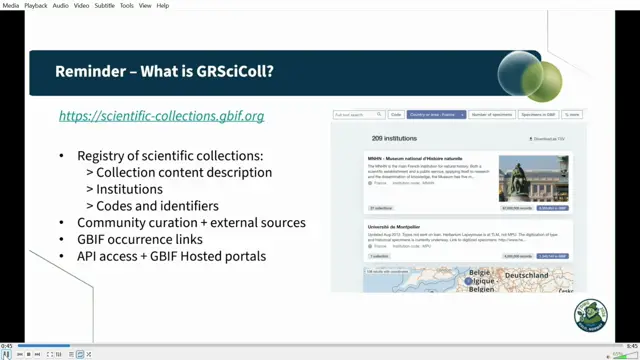
The Latimer Core standard and the Global Registry of Scientific Collections
Latimer Core gives GRSciColl a common language and exchange format for describing collections between free text and specimen records.
SYM42 discussion: DwC-DP profiles, deriving occurrences, ABCD's future and system boundaries
Richer relational models bring the community together but raise hard governance questions about profiles, occurrence derivation, system scope and link persistence.
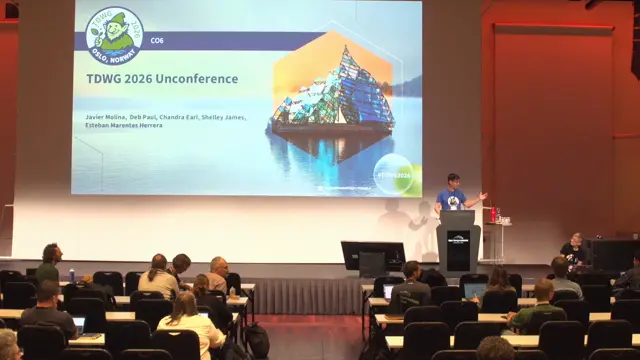
TDWG 2026 Unconference: pitches, topic voting and breakout report-backs
The Unconference showed the community's priorities (controlled vocabularies, AI readiness, project sustainability, Wikidata, Darwin Core data packages) and started several follow-up groups.