
Sharing Extended Specimen Data from Symbiota Portals using Registered Extensions
Katie Pearson · Solutions for Research Collection Management Systems Challenges
The short versionExisting registered Darwin Core extensions met each of Symbiota's extended-specimen needs, so look for existing standards before inventing new ones.
What this was about
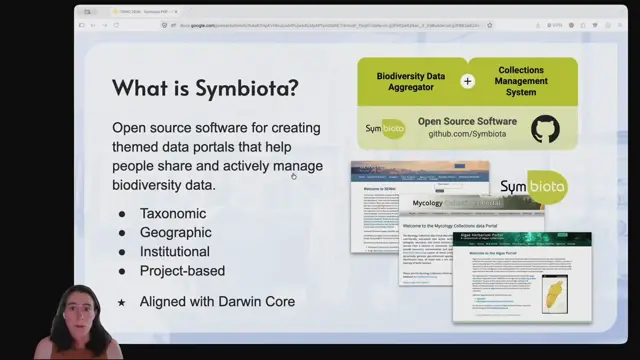
Katie Pearson described how Symbiota, open-source software serving as both CMS and mini-aggregator, stores and shares extended specimen data. It underlies 60+ portals, about 52 hosted at the University of Kansas Symbiota Support Hub, used by over 2,000 collections. Keeping a low barrier to entry, Symbiota stays occurrence-centred but supports registered GBIF/Darwin Core extensions: multimedia, identifications, Extended Measurement or Fact, GGBN Material Sample, Alternative Identifiers and Resource Relationship. Examples include herbarium phenology captured in eMoF linked to ontologies, NEON's DNA and tissue subsample tracking, and the Carlquist project linking field notebooks and photos to specimens. The trade-off is that extended data can no longer go in one CSV upload.
Why it matters. It shows how a widely used, low-barrier CMS can share richer extended specimen data via existing standards, immediately visible on GBIF.
In the room
- Symbiota underlies about 60+ portals and is used by over 2,000 collections.
- Built-in publishing sends data directly to GBIF without an IPT.
- Extended Measurement or Fact captured herbarium phenology without a new standard, using ontology IDs for types and values.
- The Material Sample extension (mostly GGBN terms) is used heavily by NEON for DNA and tissue subsamples.
- Identifiers concatenated in 'other catalog numbers' became a separate table aligned with the Alternative Identifiers extension.
- Resource Relationship links specimens to other specimens or external resources, e.g. the Carlquist project's field photos and notebooks.
- New import/export tools were needed; the single-CSV upload was discontinued in favour of standards alignment.
Notable moments
Transcript
Automatically generated captions can contain mistakes, especially in names and technical terms. Times are relative to the room recording.
Read the transcript ↓
Related talks.
Mobilizing rich, interoperable, and secure fossil data from underserved collections using Symbiota
Targeted Symbiota enhancements around geological context, taxonomy and relationships make a low-barrier CMS viable for under-resourced fossil collections.
Machine-Ready Botanical Data: Mapping Integrated Collections and Traits with Darwin Core Data Package
Darwin Core Data Package can serve as a semantic integration layer for a botanical garden's diverse collections and trait data, and MBG's draft mapping is offered for community refinement.
Updates on Data Mobilization in the KU Entomology Collection
Moving to Specify 7 with a nightly Darwin Core archive feed made KU Entomology's data and images continuously available to GBIF, Symbiota portals and students.