
From Legacy Database to Cloud: Challenges in Migrating Legacy Collection Data to a FAIR Collection Management System
Marije Timmermans · From Cabinets to Clouds - Bridging the gap between collection- and database management
The short versionA dedicated data manager who acts as liaison and uses iterative prototypes can make a small institute's move to a shared CMS workable despite fragmented legacy practices.
What this was about
Marije Timmermans, the first data manager at SDEI (since February 2026), described preparing for migration to the DINA collection management system, which Senckenberg's central Data and Modelling Centre implements across eight institutes. SDEI's five entomology sub-collections use separate Corel Paradox database instances with diverging schemas, plus card catalogues and personal spreadsheets. Collection data is treated as a management tool rather than research infrastructure, and there is no formal data governance. She acts as liaison, runs one-on-one sessions and workshops, and proposes mappings. Her working method is design-thinking prototypes that domain specialists test.
Why it matters. It shows the organisational side of CMS migration: divergent schemas, missing governance and the value of empathy-led prototyping. Several audience members picked this up in the discussion.
In the room
- Senckenberg has about 900 staff, eight research institutions and seven locations; SDMC implements DINA for all of them.
- SDEI was founded in 1886 in Berlin, joined Senckenberg in 2009 and has about 35 people including volunteers.
- Four of five sub-collections use Corel Paradox instances (from the 1990s) on individual computers; one manager keeps a card catalogue backup and another uses personal spreadsheets.
- Schemas have diverged as managers added, moved and renamed fields; practices like putting subspecies in the species field hinder sharing.
- There is no formal data governance or ownership, and decision power varies between technical assistants and scientific heads.
- Her role: data life cycle documentation, legacy structure assessment, training, liaison with SDMC, and workflows for enrichment, mapping and migration.
- Treating work as prototypes (design thinking) and letting specialists test them builds ownership.
Notable moments
Transcript
Automatically generated captions can contain mistakes, especially in names and technical terms. Times are relative to the room recording.
Read the transcript ↓
Related talks.
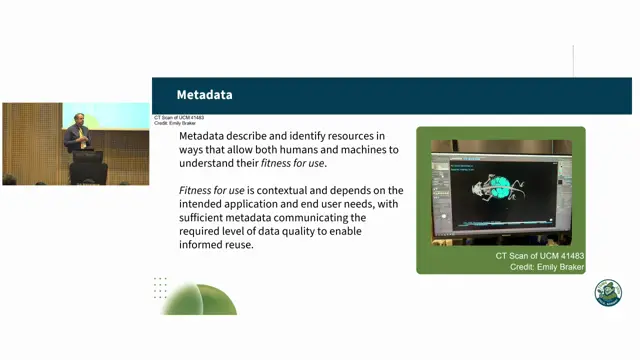
Metadata matters: perceptions on the implementation of Darwin Core in the biocollections cyberinfrastructure
Standardisation through Darwin Core can mask nuance, and practitioners report complex data, missing guidelines and limited capacity as the main implementation barriers.
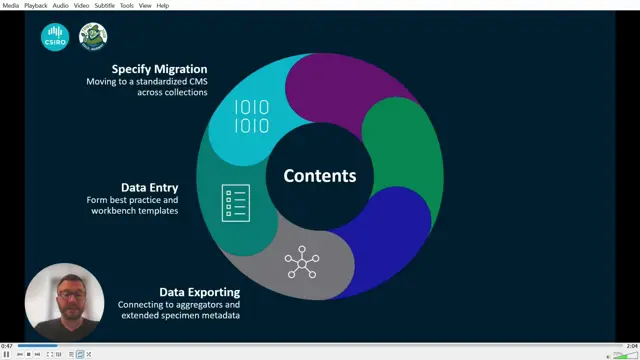
From Data Entry to Distribution: Streamlining Biodiversity Workflows with Specify at CSIRO
Layered standards in templates, roles and training let CSIRO keep five Specify instances consistent while each collection keeps its own outputs.
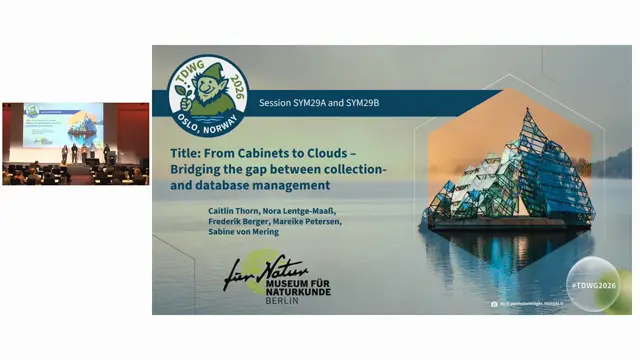
SYM29A panel discussion: working with collection managers, documentation and institutional strategy
Bridging cabinets and clouds depends on people: engaging collection managers, making data work visible, institutional strategy and durable documentation.