
Aligning An Evolving Global Data Model To Software With Global Ambitions: GBIF x TaxonWorks
Matthew Yoder · Solutions for Research Collection Management Systems Challenges
The short versionTaxonWorks and DwC-DP have converged conceptually, but exchange between rich models will always be lossy, so mappings should be recorded explicitly.
What this was about
Matt Yoder compared TaxonWorks' API-first data model with the new Darwin Core Data Package (DP). He found the conceptual overlap 'uncanny' after years of independent development. DP's many media, identifier, protocol and reference link tables collapse into single polymorphic annotation tables in TaxonWorks. TaxonWorks lacks a primary Survey concept and full nucleotide analysis, while DP lacks precise anatomy links and physical container hierarchies. He proposed recording mappings (broader/narrower) in SSSOM, merging them in RDF into a 'data mapping of all data mappings', and exposing /vocab endpoints. His observations: partial alignment and lossy exchange are the norm, both models have competing 'fuzzy buckets', and DP's role as an exchange format is unclear.
Why it matters. It is a concrete software–standard alignment exercise with ideas (SSSOM mappings, /vocab endpoints) that could help many CMSs map to DwC-DP. It also flags practical issues like duplicate extension buckets.
In the room
- TaxonWorks serves taxonomists first and now about 10–11 large collections; it is API-first and set up for human and agentic contributions.
- It already offers Darwin Core import/export, a built-in IPT-like GBIF endpoint, EML persistence and lossless DwC import; an Orthoptera project round-tripped over a million GBIF records.
- Conceptual overlap with DwC-DP is remarkable; TaxonWorks models one image depicting many concepts via a single annotation pattern.
- Gaps in TaxonWorks: Survey as a primary concept, full nucleotide analysis; gaps in DP: precise anatomy, physical containers, loans, stronger geo-reference primacy.
- Mappings can be expressed as broader/narrower relations and persisted in SSSOM, merged in RDF.
- Both models have two 'buckets' for fuzzy data (resource relationship vs assertions; observations), which will confuse users.
- Needs identified: equipment and configuration, experiments, genomes, more strongly typed agents; comments used as definitions cause confusion.
Notable moments
Transcript
Automatically generated captions can contain mistakes, especially in names and technical terms. Times are relative to the room recording.
Read the transcript ↓
Related talks.
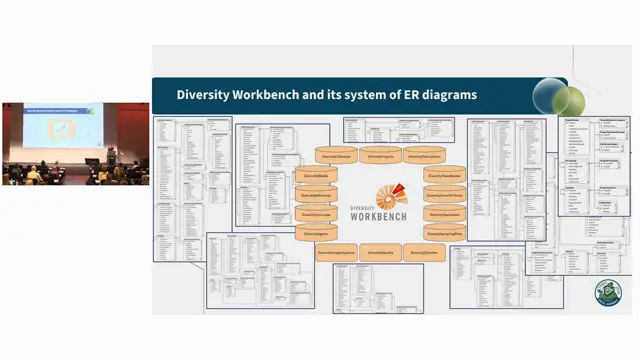
Mapping the Relational Data Schema of the Diversity Workbench (DWB) to the Darwin Core Data Package Data Model to fit better to GBIF´s New Data Model
DwC-DP promises to carry the relational richness that previously pushed GFBio centres to ABCD, and a first DWB-to-DwC-DP prototype via the test IPT works.
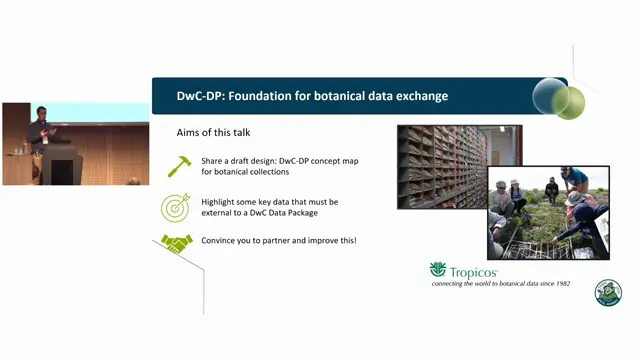
Machine-Ready Botanical Data: Mapping Integrated Collections and Traits with Darwin Core Data Package
Darwin Core Data Package can serve as a semantic integration layer for a botanical garden's diverse collections and trait data, and MBG's draft mapping is offered for community refinement.
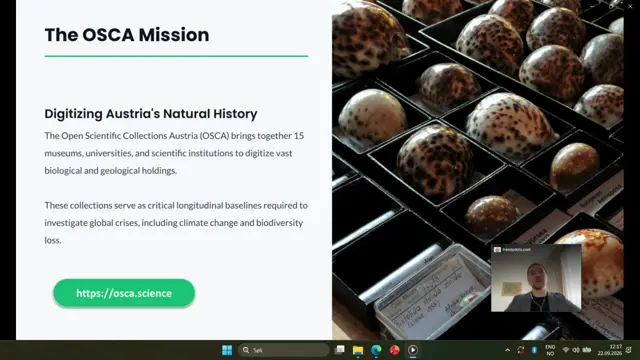
How Darwin Core enables harmonizing Biodiversity Data via the OSCA Consortium
A shared Darwin Core-based cloud pipeline lets 15 Austrian institutions of very different IT capacity publish harmonised specimen data.