
Towards Scalable Trait Measurements from Digitized Specimens
Kenzo Milleville · AI for Biodiversity Data
The short versionMatching rulers to an annotated reference set lets specimen images be calibrated to real-world units with under 1% error in 96% of cases.
What this was about
Kenzo Milleville presented a method to convert pixel measurements on specimen images into metric units by reading the ruler on the sheet. Instead of predicting scale directly, the ruler is detected and normalised, similar rulers are retrieved from an annotated reference set with a CLIP-like similarity model, and a keypoint-matching model transforms the known tick marks onto the new image, requiring in principle only one labelled example per ruler type. The reference set grew to about 2,000 rulers (21,000 annotated points, ~350 institutions), and 96% of predictions now have under 1% error (mean ~0.3%, below the ~0.8% manual annotation error). A proof of concept with Segment Anything 3 measured leaf sizes across taxa and geography. He recommended including ArUco markers or QR codes of known size during digitisation, and noted a proposal to Audiovisual Core to standardise such metadata and the idea of sharing length annotations via DiSSCo.
Why it matters. Normalised measurements are a prerequisite for comparing traits across collections and at global scale from digitised specimens.
In the room
- Rulers are highly diverse but frequently reused across institutions.
- Pipeline: object detection, normalisation, similarity retrieval (top 3), keypoint matching, post-processing.
- Main improvement over last year's Living Data version comes from a larger dataset and renewed models, especially keypoint matching.
- Robust to lower resolution and partial occlusion; high-contrast popular rulers perform best; simple block rulers worst.
- Annotation error is roughly constant in pixels regardless of image resolution.
- No standard yet for storing calibration metadata; proposal submitted on GitHub for Audiovisual Core.
Notable moments
Transcript
Automatically generated captions can contain mistakes, especially in names and technical terms. Times are relative to the room recording.
Read the transcript ↓
Related talks.
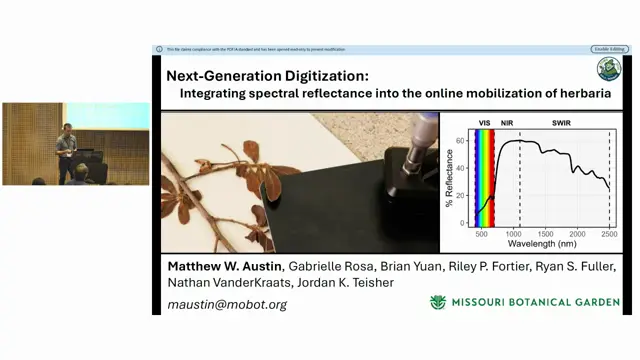
Next-generation digitization: integrating spectral reflectance into the online mobilization of herbaria
Spectral reflectance can be captured at scale during herbarium digitisation and supports accurate species identification from leaves alone.
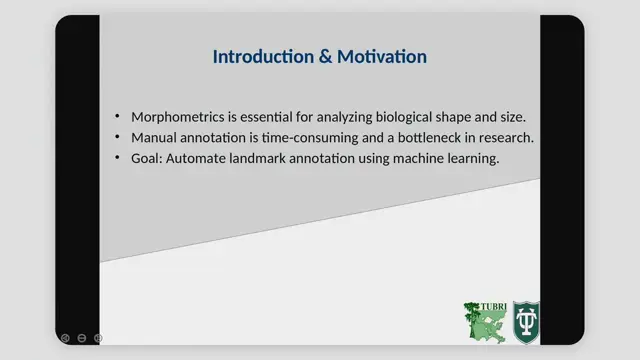
Automated Landmark Detection for Scalable Morphometric Data Extraction from Digitized Fish Collections
A lightweight dlib shape-regression model can automate most fish landmarking from museum images, but inner landmarks and variable specimen poses remain hard.
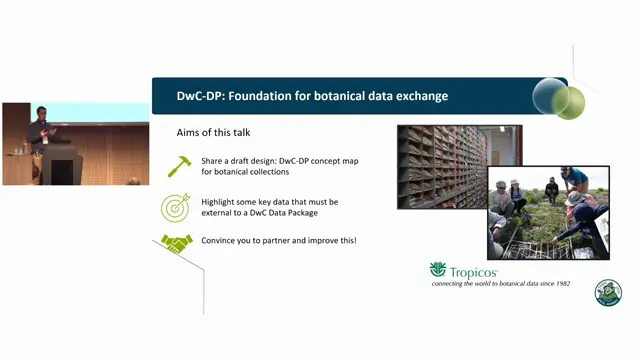
Machine-Ready Botanical Data: Mapping Integrated Collections and Traits with Darwin Core Data Package
Darwin Core Data Package can serve as a semantic integration layer for a botanical garden's diverse collections and trait data, and MBG's draft mapping is offered for community refinement.