
The More Extended, The More Open: Semantic Integration of 3D Natural Heritage Data into Biodiversity CMS
Yeeun Lee · Solutions for Research Collection Management Systems Challenges
The short versionTreating 3D specimen models as entry points in a knowledge graph that includes heritage context and digitisation paradata makes them reusable knowledge assets.
What this was about
Yeeun Lee argued that specimens bridge natural history and heritage, because they record biological evidence along with histories of collection, curation, research and exhibition. Existing services (GBIF, BHL, Smithsonian 3D, DiSSCo) cover parts of the task in separate systems, and 3D data are often low quality. The project combines AI-assisted photogrammetric 3D capture of specimens from seven institutions, sized from insects to large mammals, with a semantic model of data, metadata and paradata layers. The model is aligned with openDS, Dublin Core, Europeana and CIDOC CRM, and visualised in Neo4j as a knowledge graph of about 2,400 nodes and 3,600 relations. Example applications are CMS integration, recommendations and map-based views.
Why it matters. It links biodiversity and cultural heritage standards and argues for recording 3D production paradata, which matters as 3D specimens are used for exhibitions, citizen science and AI.
In the room
- Specimens carry both natural history evidence and heritage value formed through human curation and interpretation.
- Natural heritage information is distributed across institutions with differing quality, and 3D data are often low quality.
- Photogrammetric 3D production in four stages: capture, multi-point imaging, registration and meshing, with setups adapted to specimen size.
- The semantic model has three layers: data (nature, specimen, occurrence), metadata (heritage, resource) and paradata (project, institution, item).
- It is aligned with openDS, Dublin Core, Europeana and CIDOC CRM via one-to-one mappings.
- The Neo4j knowledge graph has about 2,400 nodes and 3,600 relations.
Notable moments
Transcript
Automatically generated captions can contain mistakes, especially in names and technical terms. Times are relative to the room recording.
Read the transcript ↓
Related talks.
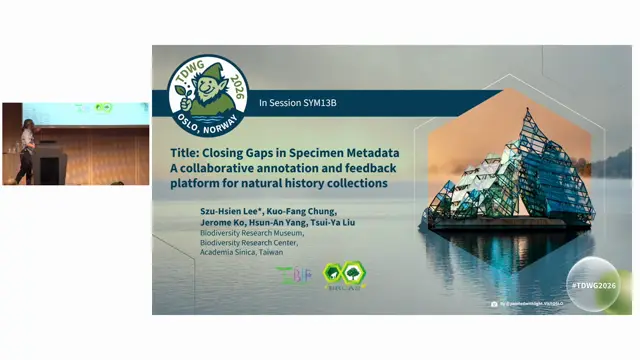
Closing Gaps in Specimen Metadata: A Collaborative Annotation and Feedback Platform for Natural History Collections
A national collaborative annotation platform with AI-assisted transcription can close metadata gaps across many Taiwanese collections.
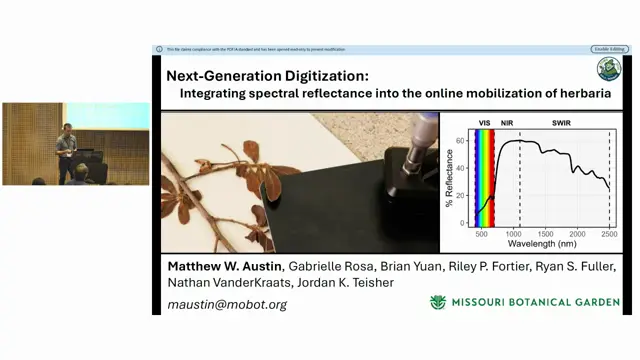
Next-generation digitization: integrating spectral reflectance into the online mobilization of herbaria
Spectral reflectance can be captured at scale during herbarium digitisation and supports accurate species identification from leaves alone.
From Images to Structured Data: A Scalable AI Workflow for Natural History Museums
A simple 'just do it' AI transcription pipeline with schema prompts, an intent step and full provenance can make label digitisation scale.