
Explore the conversation.
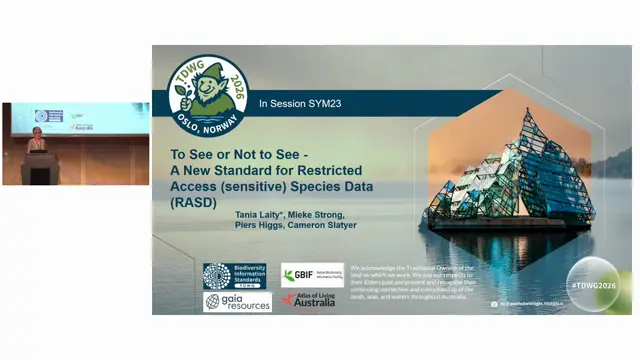
A new standard for restricted access (sensitive) species data
A proposed Darwin Core extension would record why data were restricted and what treatment was applied, in a one-to-many way similar to MeasurementOrFact.
Tania Laity ↗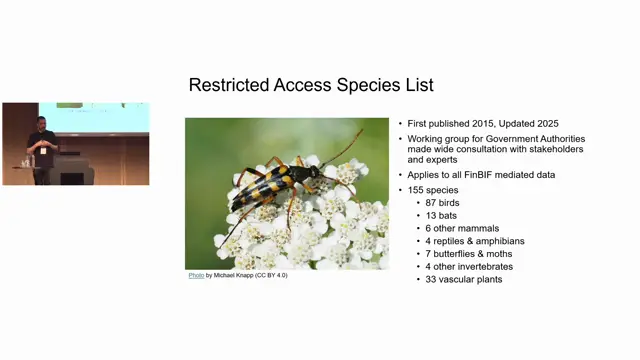
Restricted access species data in Finland
FinBIF applies an authority-maintained restricted species list to all mediated data, but lacks a standard way to share what it restricted and why.
Will Morris ↗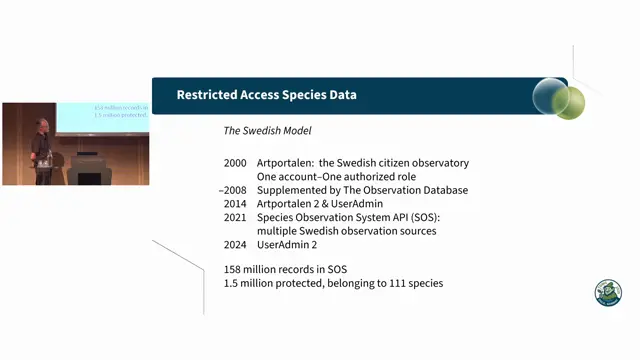
Restricted Access Species Data: The Swedish Model
Sweden combines a long-running role system, diffusion classes and a yes/no 'signal search' to manage 1.5 million protected records while gradually restricting fewer species.
Johan Liljeblad ↗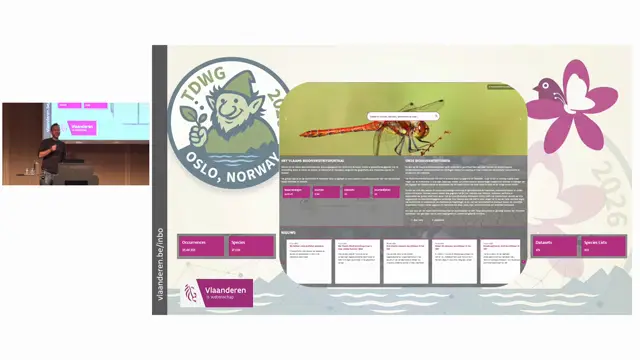
Role-Based Access Control (RBAC) for RASD: The Flemish Biodiversity Portal Approach
The Flemish portal implements restricted access through role-based access control, with institutions rather than the portal team deciding who may see high-resolution data.
Dimitri Brosens ↗
SYM23 panel discussion on restricted access species data
Restricting data is costly and imperfect; panellists argued for targeted, 'shrink-wrapped', well-justified restrictions handled centrally rather than blanket redaction.
Cameron Slatyer, Dimitri Brosens, Will Morris ↗
The Edge: Insights into problems that arise from implementing data solutions for restricted access (sensitive) species data
Plan RASD treatments carefully, because taxonomy, data errors and associated records can silently defeat simple rules like 'generalise to 10 km'.
Cameron Slatyer ↗
The Swedish experience on verification and how to improve quality on observations
Human verification remains essential, and the community needs a standard to exchange verification status between systems.
Mora Aronsson ↗
The WildLIVE Portal: Towards Scalable Wildlife Monitoring through the Integration of Citizen Science and Human-in-the-Loop AI Workflows
WildLIVE combines a model registry, provenance-tracked human verification and FAIR publication to move camera trap data from raw images to publishable data.
Rajapreethi Rajendran ↗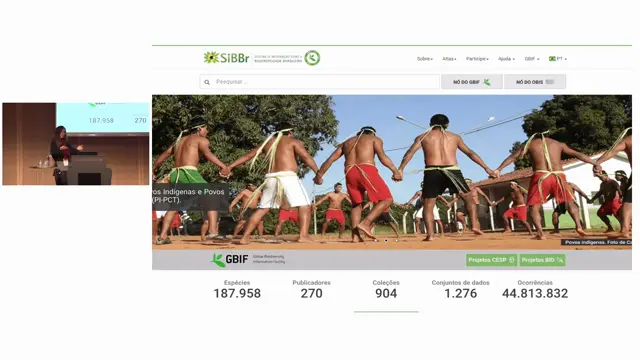
Toward RASD Implementation in Brazil: Integrating Conservation, Open Data, and Traditional Knowledge Safeguards
Protecting traditional knowledge requires community-controlled, attribute-level and semi-restricted access, not just hiding species locations.
Clara Baringo Fonseca ↗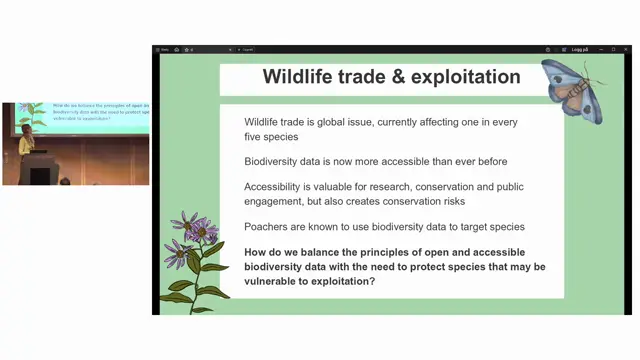
Using wildlife trade data to support proactive RASD decision-making
Wildlife trade data can act as an early warning system to protect species' locality data before formal conservation assessments catch up.
Charlotte Lassaline ↗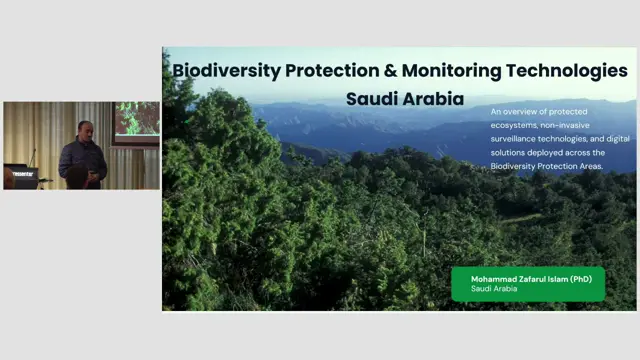
Integrating advanced monitoring technologies for spatially explicit, ecosystem-based biodiversity conservation across diverse habitats in Saudi Arabia
Saudi Arabia's network of 35 Biodiversity Protection Areas combines reintroductions, spatial risk mapping and satellite, camera-trap and drone monitoring to conserve species across very diverse ecosystems.
Mohammad Zafarul Islam ↗