
The WildLIVE Portal: Towards Scalable Wildlife Monitoring through the Integration of Citizen Science and Human-in-the-Loop AI Workflows
Rajapreethi Rajendran · AI for Biodiversity Data
The short versionWildLIVE combines a model registry, provenance-tracked human verification and FAIR publication to move camera trap data from raw images to publishable data.
What this was about
Rajapreethi Rajendran presented the WildLIVE portal, which supports the lifecycle of camera trap wildlife monitoring: data management (Camtrap DP import/export, a Wildlife Monitoring Ontology built on SOSA and Web Annotation), a model registry supporting internally and externally hosted models ('bring your own model'), taxonomic name resolution through Catalogue of Life's ChecklistBank API, and human-in-the-loop verification by citizen scientists and experts. The ontology distinguishes classification from verification with full provenance, and project-level confidence thresholds can auto-approve high-confidence annotations. A GeoEngine-based virtual research environment connects results to Earth observation data, and data are published as FAIR digital objects with RO-Crate and FAIR Signposting.
Why it matters. It addresses trust in AI annotations by preserving the machine annotation and appending verification history, while making outputs machine-actionable.
In the room
- Model registry versions models; currently SpeciesNet and a custom jaguar model (Bolivia, South Africa).
- Catalogue of Life ChecklistBank provides stable species identifiers across models with different class names.
- Each annotation has one provenance object to which verification steps are appended.
- Consensus/threshold setting at project or capture-event level auto-approves annotations above chosen confidence.
- Virtual research environment by GeoEngine gives access to Sentinel-2, Copernicus land cover, burn data, etc.
- Planned: active learning, separating MegaDetector for blanks/humans, IUCN Red List-driven location obscuring, direct GBIF mobilisation.
Notable moments
Transcript
Automatically generated captions can contain mistakes, especially in names and technical terms. Times are relative to the room recording.
Read the transcript ↓
Related talks.
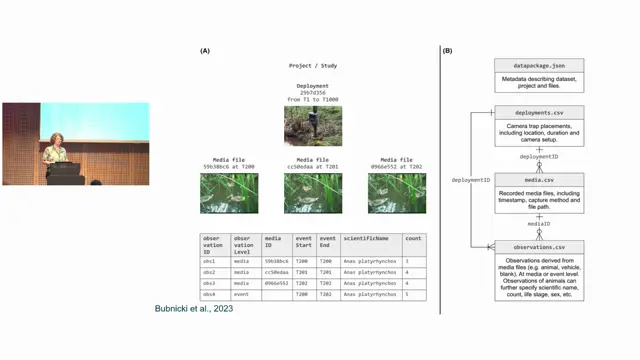
Camtrap DP: extending data standard designed for camera trapping research to support AI workflows and new data sources
Camtrap DP fits data from any stationary sensor, and converging community feedback shows how to extend it for AI provenance and multimodal monitoring.
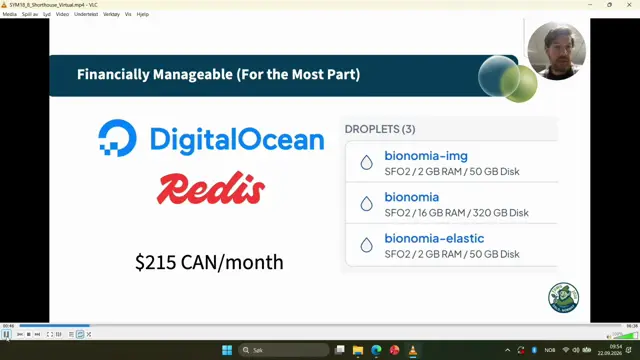
Resilient Attribution Infrastructures for Biodiversity Science: Archiving and Risk Mitigation in Bionomia
Small niche infrastructures can be resilient by planning for their own end: keep things simple and push versioned data and reusable code outward.
Delivering AI for biodiversity data in the public sector: data handling, security and humans-in-the-loop when small teams build at pace
Small public-sector teams can use AI tools productively if they set clear boundaries between prototype, dev, test and production and keep expert humans in the loop.