
The Swedish experience on verification and how to improve quality on observations
Mora Aronsson · Data Quality: From Standard to Practice
The short versionHuman verification remains essential, and the community needs a standard to exchange verification status between systems.
What this was about
Mora Aronsson describes human verification of species observations in Sweden's Artportalen, as distinct from automated validation. Quality now covers not only identity but accurate positions, especially for red-listed, sensitive and EU-regulated invasive species. About 480-500 contracted, trained verifiers handle roughly 20,000 observations a day (about 7.5 million a year in Artportalen alone), aiming to verify around 10%, with focus on rare, threatened and invasive species. The main open problem is communicating verification status between databases and back to primary repositories, for which a standard is needed.
Why it matters. Without a way to share verification results, corrected or doubtful records keep circulating uncorrected through aggregators.
In the room
- Position accuracy has become as important as identification, driven by protected and invasive species legislation.
- Verification focuses on rare birds, species new to the country, outliers, threatened and invasive species.
- Verification classes range from expert-determined samples to trusted reporters; "not approved" is used sparingly after dialogue with reporters.
- Verifiers receive education and sign contracts covering confidentiality of sensitive data and courteous behaviour.
- Artportalen has had verification for about 25 years (initially birds).
- Coverage is biased: birds and vascular plants have higher verification rates.
- Verification results need to flow between databases and back to primary repositories.
Notable moments
Transcript
Automatically generated captions can contain mistakes, especially in names and technical terms. Times are relative to the room recording.
Read the transcript ↓
Related talks.
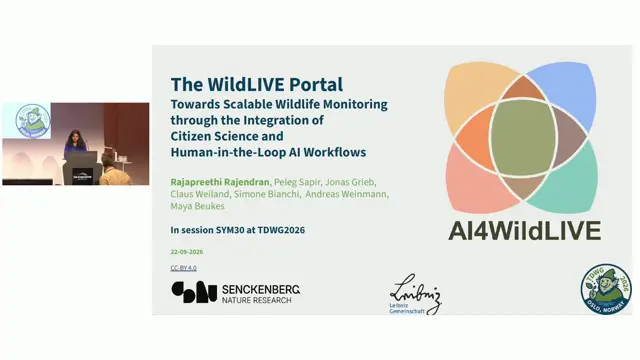
The WildLIVE Portal: Towards Scalable Wildlife Monitoring through the Integration of Citizen Science and Human-in-the-Loop AI Workflows
WildLIVE combines a model registry, provenance-tracked human verification and FAIR publication to move camera trap data from raw images to publishable data.
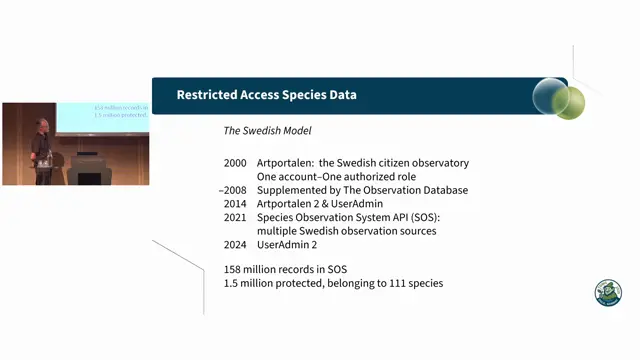
Restricted Access Species Data: The Swedish Model
Sweden combines a long-running role system, diffusion classes and a yes/no 'signal search' to manage 1.5 million protected records while gradually restricting fewer species.
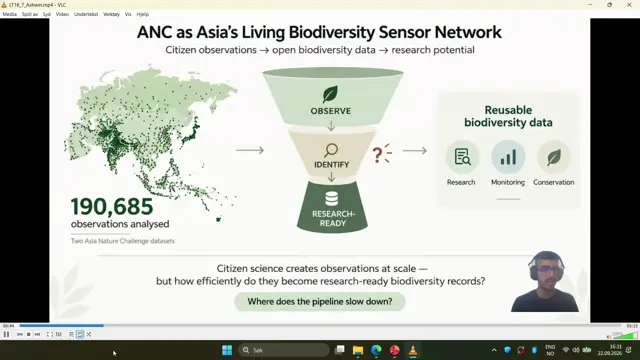
The Asian Nature Challenge as a Beacon of Citizen Science: Regional Contributions, Macroecological Data Networks, and Strategies for Optimizing Taxonomic Identification Efficiency in India
More observations do not mean more usable data; identification capacity is the bottleneck for India's citizen science.