
A new standard for restricted access (sensitive) species data
Tania Laity · To see or not to see - that is the question. Managing restricted access data (RASD)
The short versionA proposed Darwin Core extension would record why data were restricted and what treatment was applied, in a one-to-many way similar to MeasurementOrFact.
What this was about
Tania Laity presented the work of the TDWG Sensitive Species Extension Task Group (convened by the ALA, GBIF and Gaia Resources), which arose from a 2023 Hobart workshop and is building on Arthur Chapman's work. The group has drafted hierarchical vocabularies of RASD reasons (privacy, sensitive location, harm, biosecurity, species attributes, usage restrictions, First Nations cultural significance) and treatments (coordinate obfuscation, attribute generalisation, date generalisation, withholding and embargo). She showed how treatments attach to records in Darwin Core Archives (as a star-schema extension) and Darwin Core Data Package (via join tables), walked through the treatment fields, and demonstrated a cave case study with a troglobitic spider, fossils and undescribed mites.
Why it matters. Would give data users visibility of restrictions and reasons across providers and aggregators, supporting FAIR handling of restricted data; submission to TDWG was planned by end of year.
In the room
- Task group first met in September 2024; conveners from ALA (Cam Slatyer, Tania Laity, Simon Sharon), GBIF and Gaia Resources; members from government, universities, data providers and aggregators in several countries.
- The group prefers 'restricted access species data' over 'sensitive' because 'sensitive' makes people reluctant to share.
- Reason vocabulary: personal information and privacy; sensitive species location; potential harm to people or property; biosecurity risk; species attributes (e.g. roosting or nesting sites); usage restrictions (legal contracts); First Nations cultural significance.
- Hierarchical treatment vocabulary: coordinate obfuscation (truncation to grid, snapping to polygon centroid, randomising), generalising attributes (taxon level, locality text), generalising dates (month, year, decade), withholding records/attributes/datasets and embargoes.
- A treatment needs a reason; one reason may need several treatments; a record may have several reasons - applied one-to-many like the MeasurementOrFact extension.
- In Darwin Core Archive, treatments are an extension pointing to the core; in Darwin Core Data Package, a treatment class is joined to events or occurrences via join tables (e.g. event-treatment).
- Treatment fields include target field, treatment reason, treatment type, free-text description, start and end dates (for embargoes), treatment organisation and a contentious 'treatment in effect' flag.
Notable moments
Transcript
Automatically generated captions can contain mistakes, especially in names and technical terms. Times are relative to the room recording.
Read the transcript ↓
Related talks.
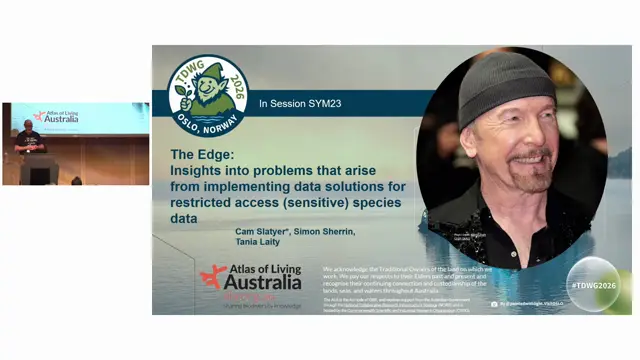
The Edge: Insights into problems that arise from implementing data solutions for restricted access (sensitive) species data
Plan RASD treatments carefully, because taxonomy, data errors and associated records can silently defeat simple rules like 'generalise to 10 km'.
SYM23 panel discussion on restricted access species data
Restricting data is costly and imperfect; panellists argued for targeted, 'shrink-wrapped', well-justified restrictions handled centrally rather than blanket redaction.
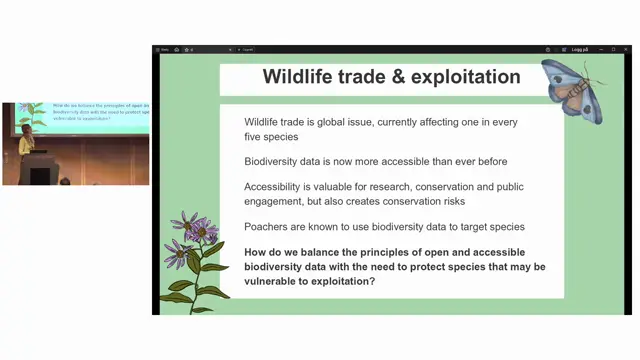
Using wildlife trade data to support proactive RASD decision-making
Wildlife trade data can act as an early warning system to protect species' locality data before formal conservation assessments catch up.