
Restricted Access Species Data: The Swedish Model
Johan Liljeblad · To see or not to see - that is the question. Managing restricted access data (RASD)
The short versionSweden combines a long-running role system, diffusion classes and a yes/no 'signal search' to manage 1.5 million protected records while gradually restricting fewer species.
What this was about
Johan Liljeblad traced Sweden's handling of restricted species data from a simple role table in the first citizen-science observatory (2000) to the UserAdmin role system launched with Artportalen 2 (2014) and a federation system harvesting other datasets (2021). About 1.5 million of 158 million records, belonging to 111 species, are protected in diffusion classes (5, 25 or 50 km squares), with users also able to hide or diffuse their own records. He explained authorised access via contracts, three access systems and 'signal search', which tells authorised users whether any sensitive records exist in an area without revealing species, and noted the trend is to restrict less over time.
Why it matters. Illustrates a mature national approach with practical tools (signal search, logged searches, delegated role management) and identifies the need for standardised authorised APIs and verification categories to exchange sensitive data.
In the room
- Timeline: 2000 citizen observatory with one role per account; offline sensitive observation database until 2008; 2014 UserAdmin with Artportalen 2 allowing role switching; 2021 federation system harvesting other Swedish datasets via APIs; new version of UserAdmin a few years ago.
- About 158 million records in total, of which about 1.5 million are protected, belonging to 111 species; the list is published as an Excel spreadsheet.
- Protection classes generalise to 5, 25 or 50 km squares; users can hide their own observation until a future date (treated as class three) or privately diffuse it.
- The system is revised roughly every five years, and the trend is to restrict less, because hidden observations can't be protected if nobody knows about them.
- Access routes: ask authorised staff, signal search, or sign a contract giving access to certain classes, usually for a region and taxonomic group; accessed through Artsök, Navet (Swedish Forest Agency) and the Centre's own system.
- County administrative boards grant roles to their own staff, so role management is not centralised; searches are logged so leaks can be traced, though leaks usually come from Facebook groups or research papers.
- Signal search answers yes/no for whether sensitive data exist in an area for a list of species, with at least a one-year date window; large diffusion areas (e.g. nesting eagles) make it say yes for much of southern Sweden.
Notable moments
Transcript
Automatically generated captions can contain mistakes, especially in names and technical terms. Times are relative to the room recording.
Read the transcript ↓
Related talks.
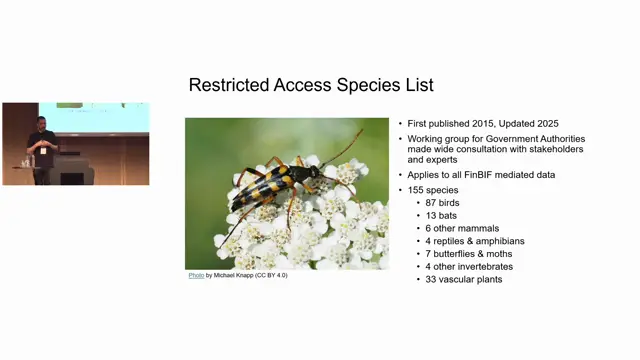
Restricted access species data in Finland
FinBIF applies an authority-maintained restricted species list to all mediated data, but lacks a standard way to share what it restricted and why.
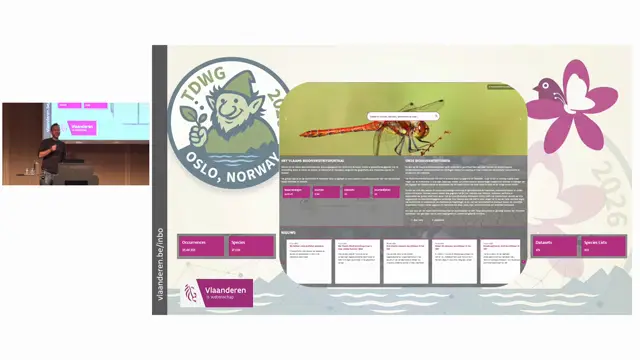
Role-Based Access Control (RBAC) for RASD: The Flemish Biodiversity Portal Approach
The Flemish portal implements restricted access through role-based access control, with institutions rather than the portal team deciding who may see high-resolution data.
SYM23 panel discussion on restricted access species data
Restricting data is costly and imperfect; panellists argued for targeted, 'shrink-wrapped', well-justified restrictions handled centrally rather than blanket redaction.