
Restricted access species data in Finland
Will Morris · To see or not to see - that is the question. Managing restricted access data (RASD)
The short versionFinBIF applies an authority-maintained restricted species list to all mediated data, but lacks a standard way to share what it restricted and why.
What this was about
The recorded portion of Will Morris' talk explains how FinBIF applies Finland's government-maintained restricted species list (first published 2015, updated 2025, a little over 150 species) to all data it mediates. Restrictions range from full concealment to generalisation to 1-100 km grids and may be limited by region, season or specific sites; field notes are withheld and multi-record events are unlinked so co-observed species cannot reveal locations. Restricted data are published through a public portal and API, while a logged government authorities portal gives unrestricted access and a request service lets others ask providers for restricted data. He noted that GBIF-bound Darwin Core Archives only use informationWithheld and dataGeneralizations, and that much of the restriction information has no standard home yet.
Why it matters. A national-scale implementation showing both the mechanics of restricting data (generalisation, unlinking events) and the gap that motivates the TDWG RASD extension.
In the room
- A working group of government authorities (e.g. Finnish Environment Institute, Parks and Wildlife) maintains the list of restricted species and the restrictions to apply; the list was first published in 2015 and updated in 2025.
- FinBIF conservatively applies these restrictions to all data it mediates, not only government data.
- The list has just over 150 species and mirrors taxonomic bias: about half are birds (about a third of Finland's breeding birds), nearly all bats, some reptiles, amphibians, butterflies and a moth, and many vascular plants (largely orchids).
- Restrictions include full concealment or generalisation to 1, 5, 10, 25, 50 or 100 km grids, possibly limited to parts of Finland, seasons (breeding, wintering) or specific sites.
- Field notes that might reveal locations are withheld, and multi-record events are unlinked so an unrestricted co-observed species does not reveal a restricted one.
- A public portal, API and bulk download service (with persistent identifiers) serve restricted data; a separate logged authorities portal gives unrestricted access to government employees; others can use a data request service mediated between users and providers.
- Data published to GBIF use Darwin Core informationWithheld and dataGeneralizations, but the sensitive species checklist is only an Excel spreadsheet and information about restricting entities and access routes is not shared via any standard.
Notable moments
Transcript
Automatically generated captions can contain mistakes, especially in names and technical terms. Times are relative to the room recording.
Read the transcript ↓
Related talks.
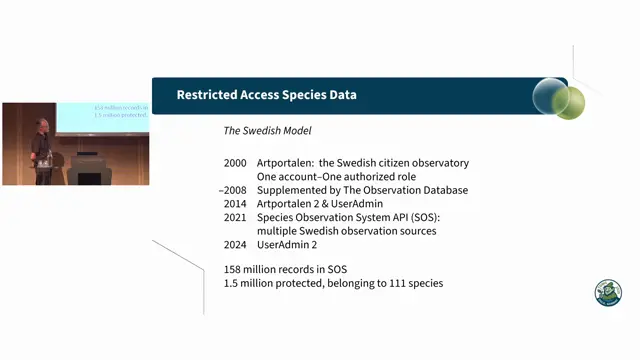
Restricted Access Species Data: The Swedish Model
Sweden combines a long-running role system, diffusion classes and a yes/no 'signal search' to manage 1.5 million protected records while gradually restricting fewer species.
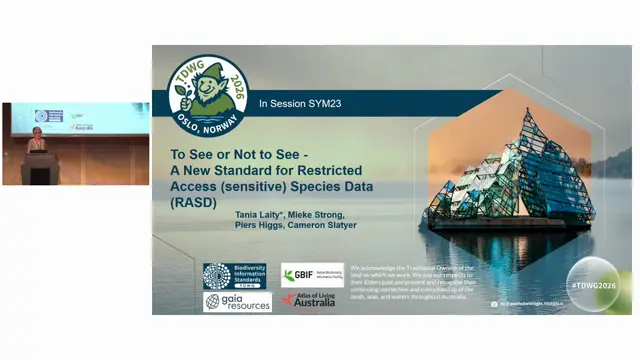
A new standard for restricted access (sensitive) species data
A proposed Darwin Core extension would record why data were restricted and what treatment was applied, in a one-to-many way similar to MeasurementOrFact.
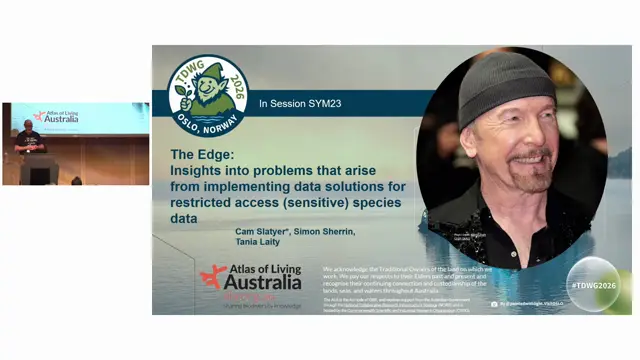
The Edge: Insights into problems that arise from implementing data solutions for restricted access (sensitive) species data
Plan RASD treatments carefully, because taxonomy, data errors and associated records can silently defeat simple rules like 'generalise to 10 km'.