
Toward RASD Implementation in Brazil: Integrating Conservation, Open Data, and Traditional Knowledge Safeguards
Clara Baringo Fonseca · To see or not to see - that is the question. Managing restricted access data (RASD)
The short versionProtecting traditional knowledge requires community-controlled, attribute-level and semi-restricted access, not just hiding species locations.
What this was about
Clara Baringo Fonseca explained that Brazil's national biodiversity information system currently handles sensitive data only by generalisation, informationWithheld and splitting data into private and public datasets. She identified three areas needing distinct rules: endangered species, ongoing research, and socio-biodiversity data and traditional knowledge. Focusing on the last, she argued that communities must control their data, that it is often attributes such as uses, local names or preparation methods rather than the species that must be restricted, and that semi-restricted access (for example for the patent office) and traceability are needed.
Why it matters. Brings Indigenous and traditional knowledge into the RASD discussion and shows that restriction needs go beyond location obfuscation of threatened species.
In the room
- Brazil's system is growing fast and is trying to repatriate Brazilian data held in repositories outside the country.
- Currently only dataGeneralizations, informationWithheld and separate private/public datasets are used.
- Three topic areas with different risks and access rules: endangered species (hunting, trafficking), ongoing research, and socio-biodiversity data/traditional knowledge (misappropriation via biopiracy).
- International law is not enough; systems must carry community-defined conditions at data level and within a legal framework.
- Traditional territories are underrepresented in repositories, but without restriction mechanisms there is little point collecting more data; FAIR and CARE principles should both apply.
- Needs include appropriate public metadata, community authorisation of what is shared, semi-restricted access (e.g. patent office can check whether a species has associated traditional knowledge) and traceability.
- Use cases: religious or sacred use (kept only for preservation), species use (attributes restricted), and hunting inside protected areas that managers want to monitor.
Notable moments
Transcript
Automatically generated captions can contain mistakes, especially in names and technical terms. Times are relative to the room recording.
Read the transcript ↓
Related talks.
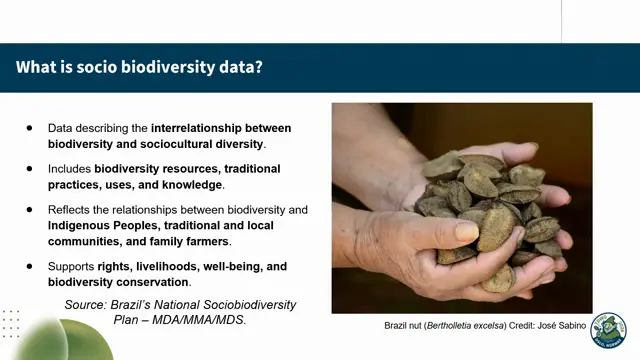
Extending Darwin Core to Represent Sociobiodiversity and Traditional Knowledge
Representing traditional knowledge in biodiversity standards needs new terms, knowledge-centred (not species-centred) models, and careful governance of who holds and publishes the data.
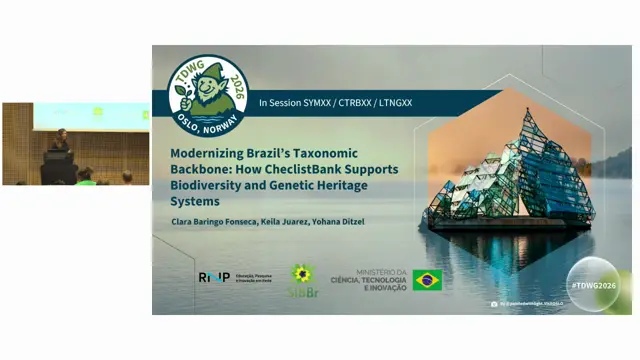
Modernizing Brazil's taxonomic backbone: how ChecklistBank supports biodiversity and genetic heritage systems
ChecklistBank lets a small national node assemble one consistent taxonomic backbone for legal, portal and permitting systems.
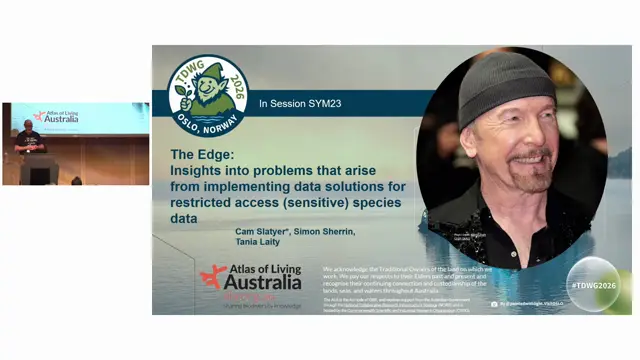
The Edge: Insights into problems that arise from implementing data solutions for restricted access (sensitive) species data
Plan RASD treatments carefully, because taxonomy, data errors and associated records can silently defeat simple rules like 'generalise to 10 km'.