
Explore the conversation.
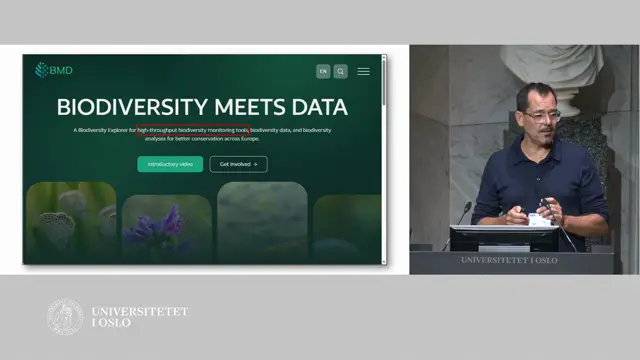
Mainstreaming high-throughput biodiversity monitoring using AI
AI identification platforms like ARISE can take sensor data automatically to GBIF-published, standardised data for protected-area managers, but training costs are high and human verification still matters.
Niels Raes ↗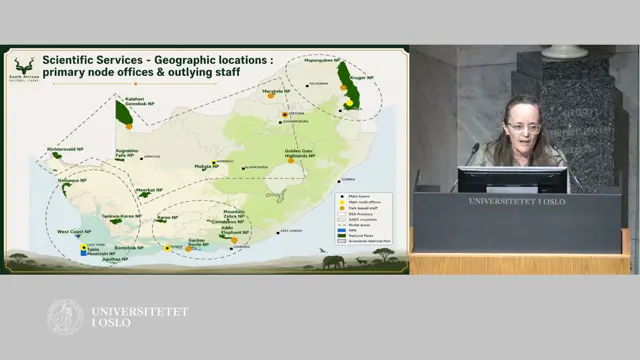
Using automation to consolidate biodiversity occurrence data in South African National Parks
Automating the harvest, integration and summary of biodiversity data lets park staff get evidence-based species lists and dashboards without laborious manual compilation.
Judith Botha ↗
Building a taxonomic reference authority for conservation: the Digital Catalogue of Biodiversity of Poland
Poland now has an expert-maintained, fully referenced national checklist published through GBIF and ChecklistBank.
Piotr Tykarski ↗
Ground-Truth from the Ground Up: Community-Led Occurrence Data for Prosopis juliflora Restoration in Kutch's Climate-Stressed Drylands
Community ground-truthing through voice-based, local-language tools makes satellite invasive-species maps reliable and restoration locally owned.
Pranav Jha ↗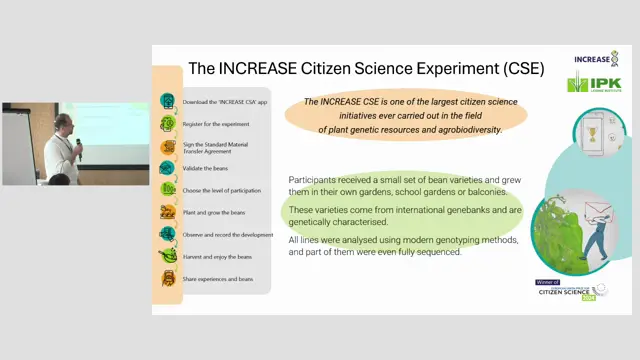
Growing Together: Community-Driven Conservation of Plant Genetic Resources
Giving citizens seeds, a good app and clear tutorials can yield large phenotypic datasets and community-based conservation of crop diversity.
Markus Oppermann ↗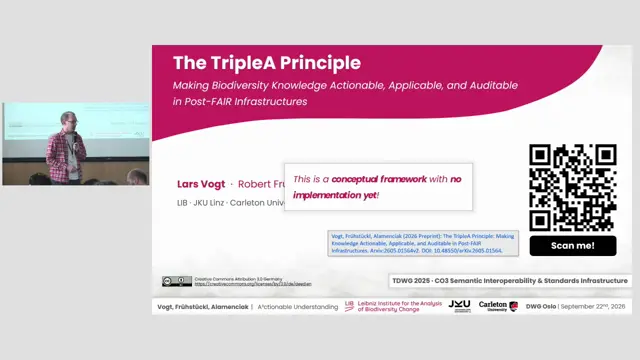
The Triple A Principle: actionability, applicability and auditability for actionable biodiversity knowledge
Actionable biodiversity knowledge needs procedural content with explicit applicability conditions and evidence, not just FAIR metadata.
Lars Vogt ↗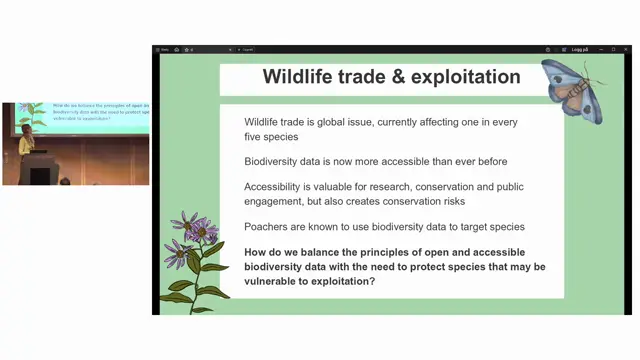
Using wildlife trade data to support proactive RASD decision-making
Wildlife trade data can act as an early warning system to protect species' locality data before formal conservation assessments catch up.
Charlotte Lassaline ↗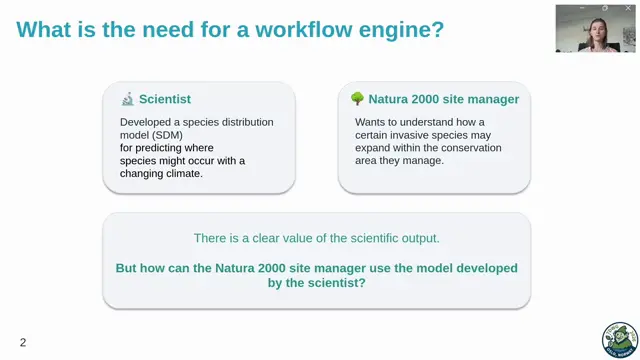
BMD workflow engine: FAIR workflows, RO-Crate and FAIR Signposting for a European biodiversity data space
Packaging containerised workflows and their runs as RO-Crates with FAIR Signposting lets non-technical users run models remotely and get machine-actionable, citable results.
Lena Perzlmaier ↗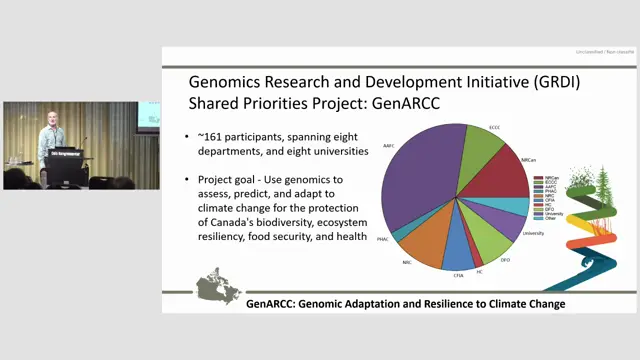
Canada’s need for synthesis for Adaptation and Resilience to Climate Change
Genomic data can only support climate adaptation synthesis if metadata are captured with standards from the start and linked to discoverable infrastructures like GBIF.
James Macklin ↗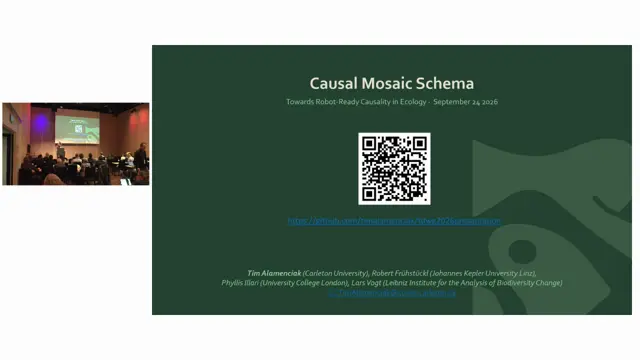
Causal Mosaic Schema: Encoding Causal Claims in Ecological Literature as Machine-Actionable Knowledge Graphs
Encoding how and how strongly the literature claims causation, not just what causes what, can link siloed ecological knowledge into decision-support tools for practitioners.
Tim Alamenciak ↗
Post-BioDT lessons and next-generation biodiversity digital twins
BioDT delivered pilots and, above all, mutual understanding between modellers and data people; the next generation must find real users and real conservation impact rather than chase the digital twin label.
Claus Weiland, Dimitri, Sharif Islam ↗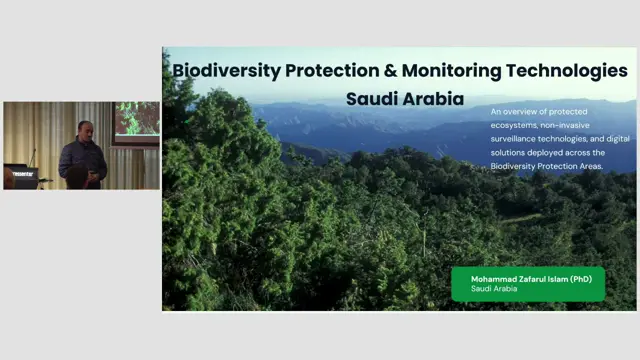
Integrating advanced monitoring technologies for spatially explicit, ecosystem-based biodiversity conservation across diverse habitats in Saudi Arabia
Saudi Arabia's network of 35 Biodiversity Protection Areas combines reintroductions, spatial risk mapping and satellite, camera-trap and drone monitoring to conserve species across very diverse ecosystems.
Mohammad Zafarul Islam ↗