
Growing Together: Community-Driven Conservation of Plant Genetic Resources
Markus Oppermann · Community-Powered, Research-Ready: Citizen Science for a Digital Future
The short versionGiving citizens seeds, a good app and clear tutorials can yield large phenotypic datasets and community-based conservation of crop diversity.
What this was about
Markus Oppermann presents the citizen science experiment of the INCREASE project, which sent well-defined sets of common bean varieties to citizens across Europe via a smartphone app with a material agreement. Participants grew the beans, recorded defined traits and images, and could exchange material (with DOIs assigned), producing more than 100,000 phenotypic observations from about 25,000 registered participants in nearly every EU country since 2021. National Facebook groups, native-language support and country-specific media worked best, and the project had to cap shipments at 5,000 in the third round due to demand; it also tested decentralized, community-based conservation as an alternative to gene banks.
Why it matters. It demonstrates a scalable citizen-science model for plant genetic resources that both raises awareness and generates research data.
In the room
- Aims: raise awareness of plant genetic resources, collect phenotypic data across Europe, and trial decentralized conservation.
- Participants register in an app, sign an agreement, receive five bean varieties, grow them and record traits and images.
- More than 100,000 single phenotypic observations; about 25,000 registered citizen scientists.
- Material exchange between participants with DOIs assigned to material.
- National Facebook groups (older gardener community) and native-language support were key; TV/radio worked in Italy, newspapers in Germany.
- Data quality depends on a well-designed app and detailed tutorials.
- Demand overwhelmed capacity; the third round was capped at 5,000 shipments.
Notable moments
Transcript
Automatically generated captions can contain mistakes, especially in names and technical terms. Times are relative to the room recording.
Read the transcript ↓
Related talks.
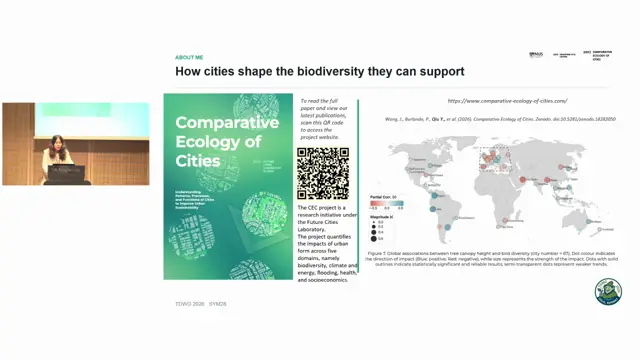
Reporting structure and sampling-bias correction in citizen-science bird data across Asian cities
Abundant citizen-science records do not guarantee inference support; reporting structure can distort richness hotspots and urban-biodiversity relationships unless it is diagnosed and controlled.
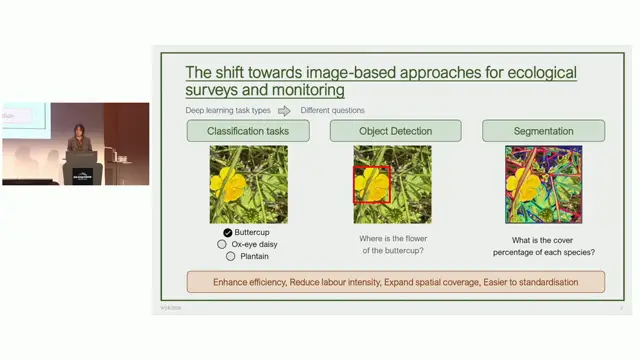
Are plant image datasets ready for AI-enabled community assessment? A systematic review of bias, representativeness and annotation quality
Current plant image datasets are not yet ready for AI-enabled ecological monitoring, especially for spatially explicit tasks and annotation quality.
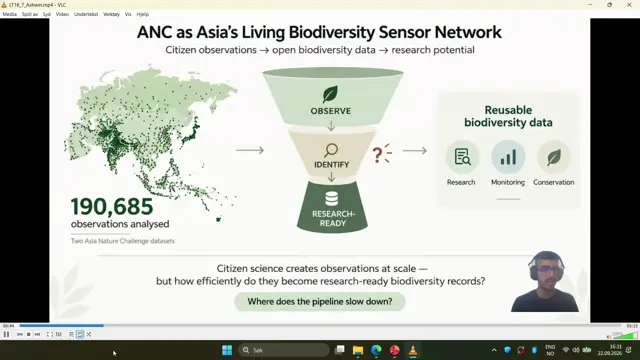
The Asian Nature Challenge as a Beacon of Citizen Science: Regional Contributions, Macroecological Data Networks, and Strategies for Optimizing Taxonomic Identification Efficiency in India
More observations do not mean more usable data; identification capacity is the bottleneck for India's citizen science.