
Causal Mosaic Schema: Encoding Causal Claims in Ecological Literature as Machine-Actionable Knowledge Graphs
Tim Alamenciak · From Mobilizing Data to AI-Ready Knowledge: Infrastructure for Multimodal Biodiversity Data
The short versionEncoding how and how strongly the literature claims causation, not just what causes what, can link siloed ecological knowledge into decision-support tools for practitioners.
What this was about
Tim Alamenciak opened with the Bandon Marsh restoration in Oregon, where re-flooding produced a salt marsh mosquito outbreak because restoration and mosquito ecology knowledge were siloed. He then presented the Causal Mosaic Schema, a LinkML labelled property graph schema based on Illari and Russo's mosaic view of causality. Nodes describe changes in ontology-grounded entities and attributes. Edges carry four annotation layers (claim strength and linguistic expression, philosophical account, 16 causal features, evidential basis) plus provenance, and annotation needs LLM assistance to scale. The resulting graph can feed evidence gap maps, fuzzy cognitive maps, Bayesian belief network structures and priors, and RAG for practitioners. He also set out its limits: no effect sizes, a Western-science and peer-reviewed-literature focus, and reliance on LLM annotation.
Why it matters. Restoration and conservation decisions depend on causal knowledge scattered across disciplines. A schema that preserves evidential strength and provenance makes LLM-assisted synthesis more defensible.
In the room
- Bandon Marsh: plugging drainage ditches restored tidal flooding but created standing water and a salt marsh mosquito outbreak, closing a golf course and prompting a public health advisory.
- Restoration ecology and mosquito ecology knowledge exist in silos and are not interoperable; EcoWeaver aims to connect them for practitioners.
- Causal Mosaic is a LinkML labelled property graph schema inspired by Illari and Russo's 'Causality', developed with Chris Mungall's group at Lawrence Berkeley National Lab.
- Nodes represent changes: entity type (taxon, environmental variable, management process, environmental process), ontology-grounded entity term, state/change qualifier, measured attribute and scope.
- Edges: 11 causal predicates, ~67 fields, 16 causal features and 8 philosophical accounts in 3 families, organised in four layers. Claims are transcribed as authors made them, not evaluated.
- The mosquito example alone gives 14 articles and 238 nodes; a graduate student manually annotated two papers in two months, so LLM-assisted annotation is necessary.
- Outputs: evidence gap maps, fuzzy cognitive maps (Kosko), Bayesian belief networks (structure and prior ranges, not fully automatic) and RAG over the graph.
Notable moments
Transcript
Automatically generated captions can contain mistakes, especially in names and technical terms. Times are relative to the room recording.
Read the transcript ↓
Related talks.
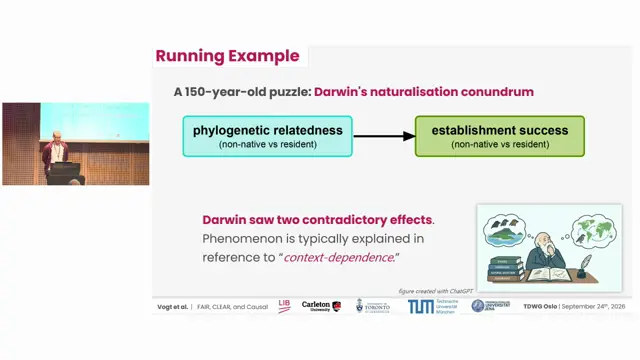
FAIR, CLEAR, and Causal: A semantic framework for ecological knowledge synthesis
Semantic Units can turn ecological causal claims into addressable, versioned graph objects to which evidence and failures can be pinned, helping ecology accumulate rather than merely accrue causal knowledge.
Using Large Language Models to enhance biodiversity knowledge extraction: From taxonomic treatments to graph-based knowledge systems
Taxonomic treatments hold underused habitat knowledge that LLMs and a provenance-preserving knowledge graph can structure and link to ecoregions, helping map data-poor species.
Multimodality for Knowledge Extraction from Historical Entomology Literature
Aligning text and illustrations in a multimodal knowledge graph can generate evidence-grounded captions and recover knowledge lost by text-only extraction.