
Explore the conversation.
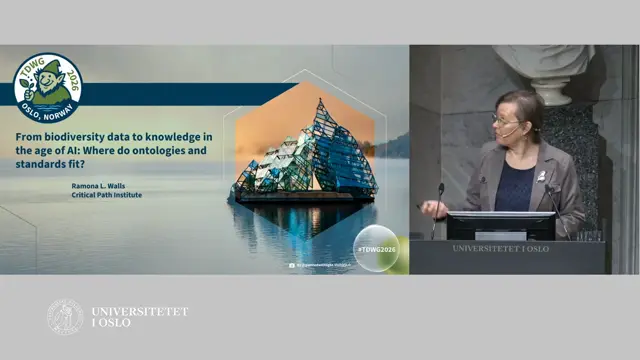
From biodiversity data to knowledge in the age of AI: where do ontologies and standards fit?
AI can generate data and candidate knowledge, but only standards, ontologies, provenance and governance let data become trusted evidence and therefore knowledge, which is why TDWG matters more than ever.
Ramona Walls ↗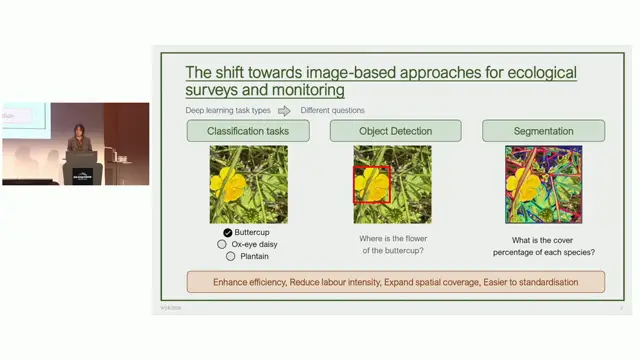
Are plant image datasets ready for AI-enabled community assessment? A systematic review of bias, representativeness and annotation quality
Current plant image datasets are not yet ready for AI-enabled ecological monitoring, especially for spatially explicit tasks and annotation quality.
Yuchen Zhao ↗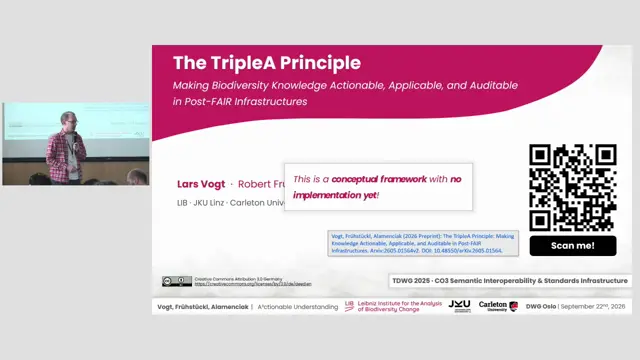
The Triple A Principle: actionability, applicability and auditability for actionable biodiversity knowledge
Actionable biodiversity knowledge needs procedural content with explicit applicability conditions and evidence, not just FAIR metadata.
Lars Vogt ↗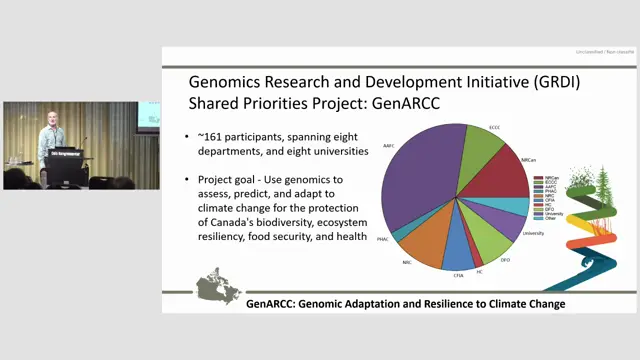
Canada’s need for synthesis for Adaptation and Resilience to Climate Change
Genomic data can only support climate adaptation synthesis if metadata are captured with standards from the start and linked to discoverable infrastructures like GBIF.
James Macklin ↗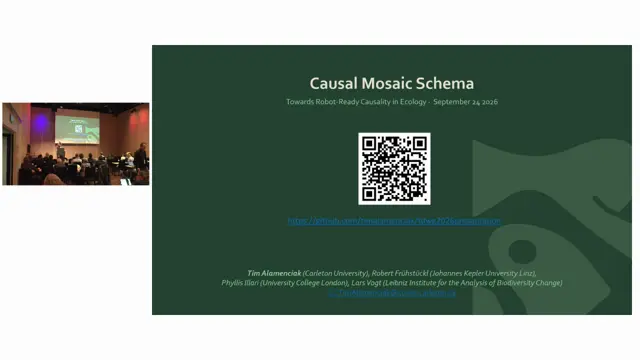
Causal Mosaic Schema: Encoding Causal Claims in Ecological Literature as Machine-Actionable Knowledge Graphs
Encoding how and how strongly the literature claims causation, not just what causes what, can link siloed ecological knowledge into decision-support tools for practitioners.
Tim Alamenciak ↗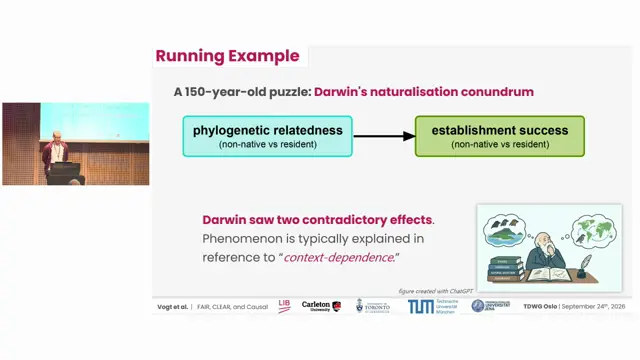
FAIR, CLEAR, and Causal: A semantic framework for ecological knowledge synthesis
Semantic Units can turn ecological causal claims into addressable, versioned graph objects to which evidence and failures can be pinned, helping ecology accumulate rather than merely accrue causal knowledge.
Lars Vogt ↗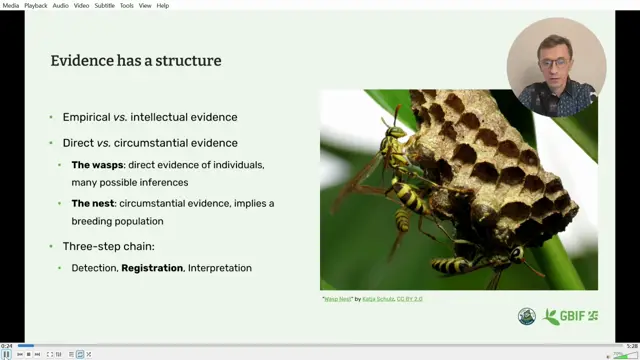
Handling evidence: a cross-disciplinary perspective
Biodiversity standards should stop treating what was recorded and what was concluded as the same kind of fact, borrowing evidence-handling practice from forensics, archaeology and medicine.
Dmitry Schigel ↗