
Post-BioDT lessons and next-generation biodiversity digital twins
Claus Weiland, Dimitri, Sharif Islam, Tanya Berger-Wolf, Ana · Operationalizing Biodiversity Digital Twins within Data Space Ecosystems
The short versionBioDT delivered pilots and, above all, mutual understanding between modellers and data people; the next generation must find real users and real conservation impact rather than chase the digital twin label.
What this was about
The convener framed the discussion around the lesson from BioDT that biological and ecological complexity could not be captured by large monolithic twins like Destination Earth's climate twins, leaving many specialised prototypes reliant on GBIF, LifeWatch and DiSSCo, and asked what a next-generation biodiversity digital twin should look like. A BioDT work package lead said twinning nature is naive and the project's lasting outcome was educational: modellers and data communities came to understand each other. Others stressed that users never asked for digital twins and simpler tools may solve problems, that outside Europe work must be decentralised (NEON, LTER, GBIF, iNaturalist, Amazon.ia), that twins risk being 'theatre' offering an illusion of control while habitat is destroyed, and that rapid-response twins for emerging threats could be valuable. It closed with a call to continue at an RDA digital twins session in London.
Why it matters. It is a candid, insider assessment of what a large EU biodiversity digital twin project did and did not achieve, useful for anyone designing follow-on infrastructure or funding calls.
In the room
- Large infrastructures like Destination Earth excel at continuous climate/meteorological data, but monolithic twins could not capture ecological modelling complexity.
- BioDT produced a gradient of pilot twins from simple to complex; they promised pilots and delivered pilots.
- The most lasting BioDT outcome was educational: modellers stopped assuming data 'fall from the sky' and data communities began to understand modellers.
- Communication between data scientists, biologists and social scientists improved; BMD's cubing work continues BioDT lessons.
- No scientist or user asked for a 'digital twin' or 'data space'; simpler tools that solve the problem may be fine and should be advertised as such.
- Outside Europe there is little centralised funding; decentralised or semi-centralised networks (NEON, LTER, GBIF, NatureServe, iNaturalist, STRI, Amazon.ia) are testbeds for transferring methods.
- Standards have progressed from FAIR data to open code, AI models and now workflows.
Notable moments
Transcript
Automatically generated captions can contain mistakes, especially in names and technical terms. Times are relative to the room recording.
Read the transcript ↓
Related talks.
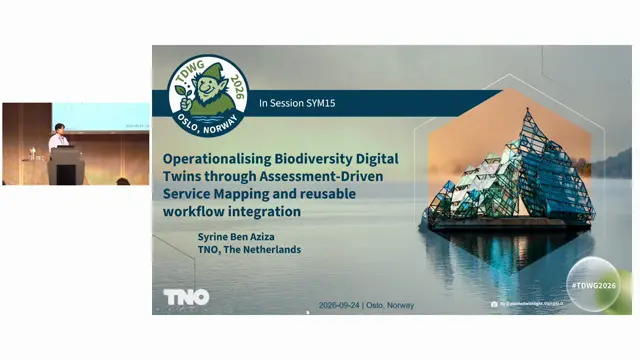
Operationalising biodiversity DT ecosystems through assessment-driven service mapping and reusable tools and workflow integration
A simple, purpose-first assessment that maps a team's needs and capabilities to an inventory of existing tools helps digital twin projects reuse rather than rebuild.
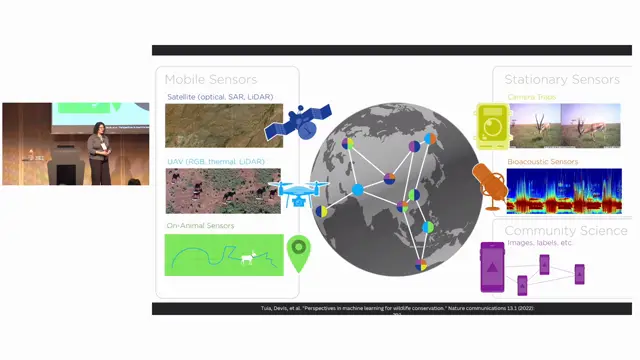
Digital Twins as System-Optimization Tools: Provisioning Edge and Cloud Infrastructure for Biodiversity Monitoring at Scale
Digital twins should close the sim-to-real loop for the sensor systems too, letting teams plan where and how to deploy multimodal monitoring before going into the field.
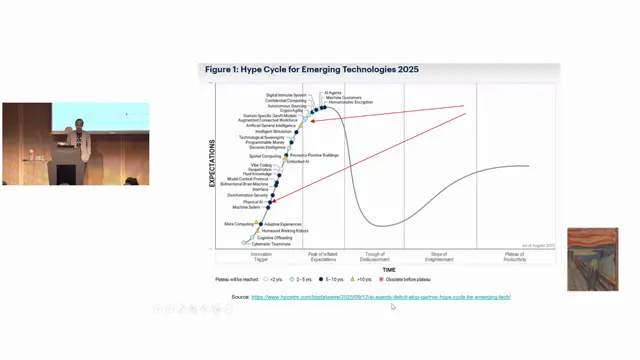
From Buzzwords to Blueprints: What It Really Takes to Operationalise Biodiversity Digital Twins
Use buzzwords to get funded, then break them down into concrete blueprints: metadata, catalogues, governance and stewardship in the middle layer.