
The Triple A Principle: actionability, applicability and auditability for actionable biodiversity knowledge
Lars Vogt · Semantic Interoperability and Standards Infrastructure
The short versionActionable biodiversity knowledge needs procedural content with explicit applicability conditions and evidence, not just FAIR metadata.
What this was about
Lars Vogt argues that FAIR data and machine-actionability are insufficient for actionable knowledge in interventions such as restoring a degraded mangrove site. He proposes three nested criteria - actionability (procedural knowledge of what to do), applicability (explicit context conditions under which it works) and auditability (evidence of where it succeeded or failed, feeding back into conditions) - and a representation using the Semantic Units Framework: action units, applicable action units and audited applicable action units, plus conditional action units with question and directive units that turn a knowledge graph into a context-sensitive decision support system. The framework is conceptual, with a preprint on arXiv.
Why it matters. It pushes knowledge-graph design beyond describing what is the case toward supporting decisions and interventions such as ecosystem restoration.
In the room
- Many "FAIR" datasets have FAIR containers (metadata) but not FAIR content.
- Machine-actionability usually means data transformation; human actionability includes epistemic and intervention operations.
- Actionability: procedural knowledge (directives, steps toward a goal) is largely absent from FAIR infrastructures.
- Applicability: actionability does not equal applicability due to context dependencies; explicit applicability conditions are needed.
- Auditability: applicability reports feed back to refine conditions (e.g. salinity outside documented success range).
- The three As are nested and proposed as necessary and sufficient for the representational side of actionable knowledge.
- Semantic units make statements first-class typed, addressable units; action units link input, output, plan and objective units.
Notable moments
Transcript
Automatically generated captions can contain mistakes, especially in names and technical terms. Times are relative to the room recording.
Read the transcript ↓
Related talks.
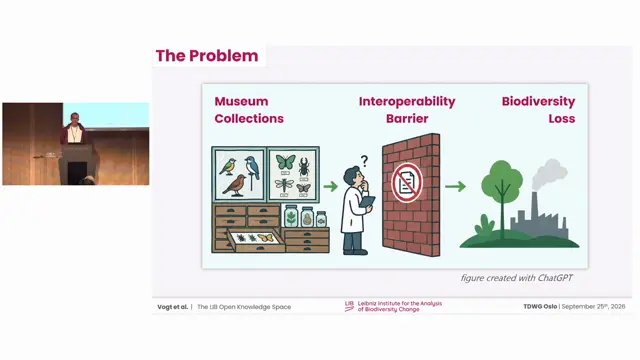
The LIB Open Knowledge Space: A semantic architecture for FAIR, CLEAR, and AI-ready biodiversity knowledge
Knowledge can enter the LIB Open Knowledge Space as natural language immediately and be formalised step by step, so content becomes FAIR, CLEAR and AI-ready incrementally.
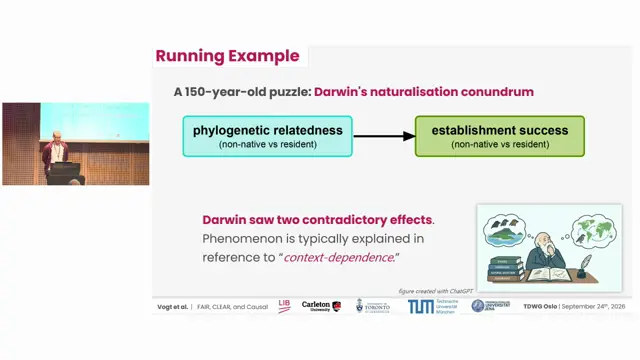
FAIR, CLEAR, and Causal: A semantic framework for ecological knowledge synthesis
Semantic Units can turn ecological causal claims into addressable, versioned graph objects to which evidence and failures can be pinned, helping ecology accumulate rather than merely accrue causal knowledge.
From biodiversity data to knowledge in the age of AI: where do ontologies and standards fit?
AI can generate data and candidate knowledge, but only standards, ontologies, provenance and governance let data become trusted evidence and therefore knowledge, which is why TDWG matters more than ever.