
Explore the conversation.
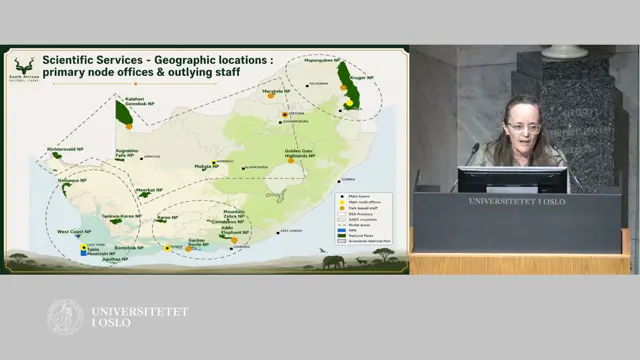
Using automation to consolidate biodiversity occurrence data in South African National Parks
Automating the harvest, integration and summary of biodiversity data lets park staff get evidence-based species lists and dashboards without laborious manual compilation.
Judith Botha ↗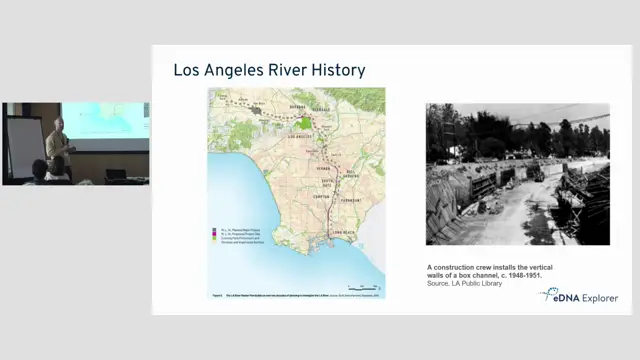
An eDNA Platform for Community-Powered LA River Restoration
An eDNA analysis platform let community groups without bioinformatics expertise measure how river channelization shapes biodiversity.
Ryan Martin ↗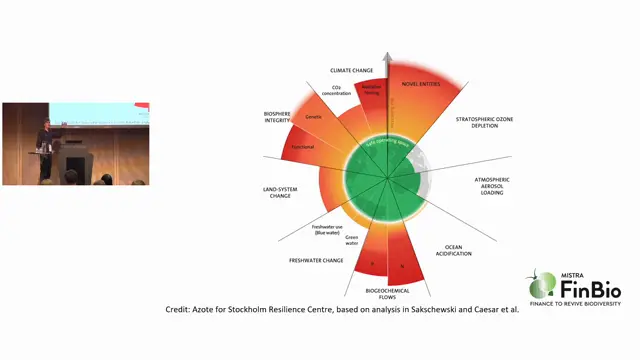
Data Quality in Focus: Bridging the Biodiversity Data Gap for Sustainable Finance
Biodiversity assessments for finance need local data; a tiered data-quality hierarchy like carbon accounting could make them credible.
Emma Granqvist ↗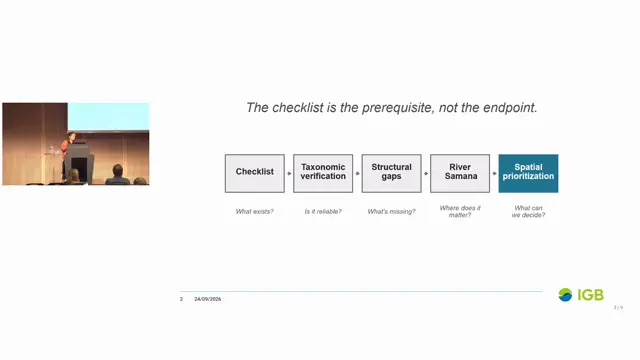
A species-level taxonomic catalog of Neotropical freshwater insects: building a consensus reference for occurrence data integration and conservation planning
Without a reliable species-level checklist, Neotropical freshwater insect occurrences, distribution models and conservation arguments cannot be built.
Alejandra Correa-Bedoya ↗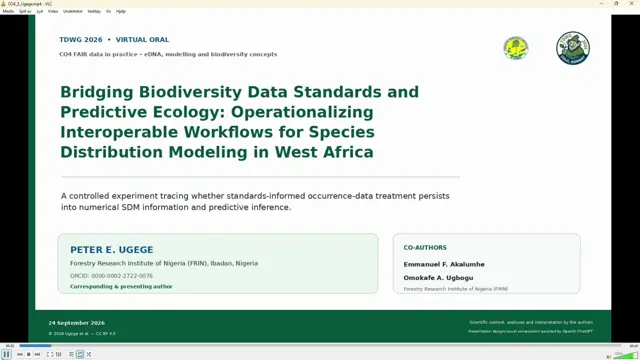
Bridging Biodiversity Data Standards and Predictive Ecology: Operationalizing Interoperable Workflows for Species Distribution Modeling in West Africa
Standards change what enters a modelling pipeline, but workflow design determines whether that difference survives and validation design determines what claims can be made.
Peter Ugege ↗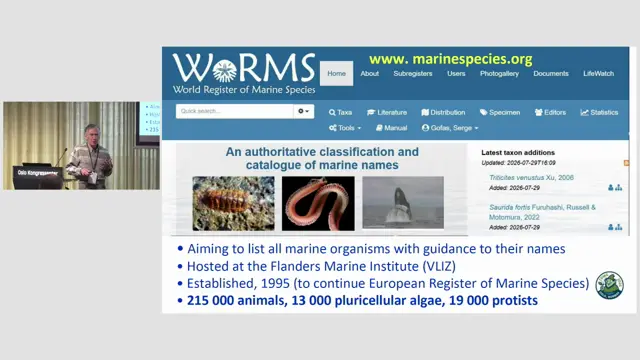
Mapping geographical distributions in the World Register of Marine Species
A country-aware, hierarchical marine geoscheme will let WoRMS and others record and query distributions consistently, pending a solution for defining spatial units in a TDWG standard.
Serge Gofas ↗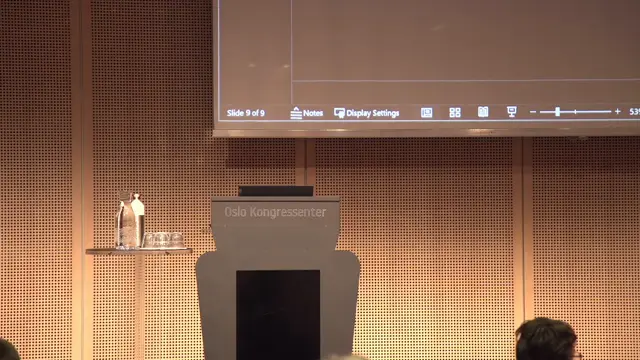
Post-BioDT lessons and next-generation biodiversity digital twins
BioDT delivered pilots and, above all, mutual understanding between modellers and data people; the next generation must find real users and real conservation impact rather than chase the digital twin label.
Claus Weiland, Dimitri, Sharif Islam ↗
Rethinking “absence” in biodiversity data collection and modeling
Separating observation from inference means recording 'detected' and 'not detected' rather than presence and absence.
Rob Stevenson ↗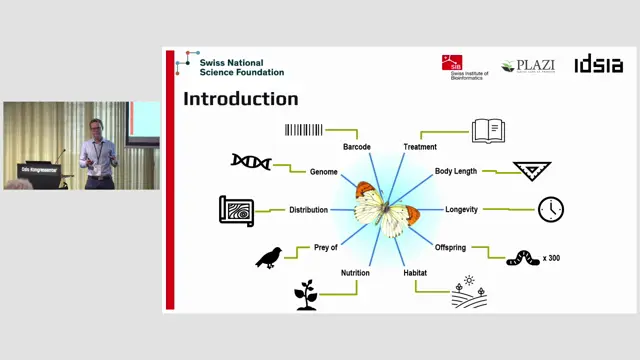
Species trait literature mining to support integrative biodiversity distribution modelling
Demonstrating research use cases like trait-informed distribution modelling is key to persuading funders to support literature mobilisation infrastructure.
Robert Waterhouse ↗
The BMD Cubing Engine: Harmonizing Biodiversity and Earth Observation Data
BMD's cubing engine turns a declarative YAML recipe into reproducible, provenance-documented data cubes that harmonise GBIF occurrences with climate and Earth observation data on one grid.
Mathias Dillen ↗
Integrating advanced monitoring technologies for spatially explicit, ecosystem-based biodiversity conservation across diverse habitats in Saudi Arabia
Saudi Arabia's network of 35 Biodiversity Protection Areas combines reintroductions, spatial risk mapping and satellite, camera-trap and drone monitoring to conserve species across very diverse ecosystems.
Mohammad Zafarul Islam ↗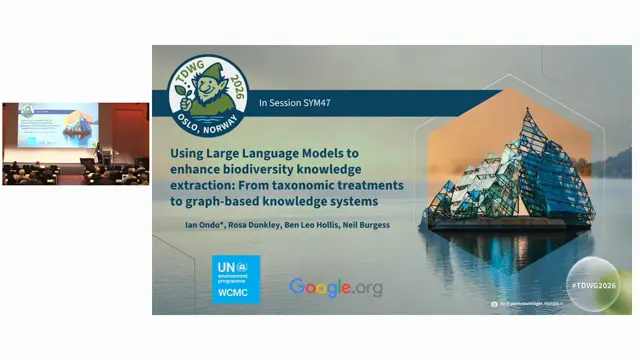
Using Large Language Models to enhance biodiversity knowledge extraction: From taxonomic treatments to graph-based knowledge systems
Taxonomic treatments hold underused habitat knowledge that LLMs and a provenance-preserving knowledge graph can structure and link to ecoregions, helping map data-poor species.
Ian Ondo ↗