
Explore the conversation.
Digitising heritage for science: the Medical Entomology Museum as a platform for entomological biodiversity research and vector-borne disease surveillance
Digitised historical mosquito vouchers become reusable evidence that gives context to current vector surveillance.
Eunice Jamesboy ↗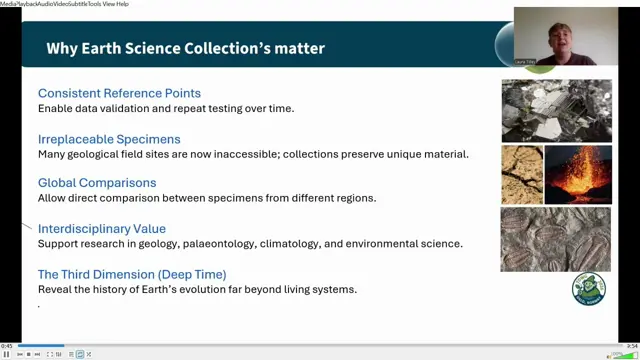
Improving access to Earth science collections data via GeoCASe and the European Open Science Cloud (GeoDARA)
Linking specimen-rich GeoCASe records to dataset-level DCAT descriptions could let deep-time collection data feed modern environmental observation infrastructures.
Laura Tilley ↗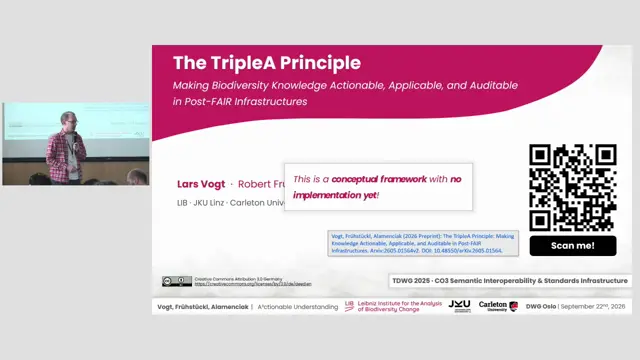
The Triple A Principle: actionability, applicability and auditability for actionable biodiversity knowledge
Actionable biodiversity knowledge needs procedural content with explicit applicability conditions and evidence, not just FAIR metadata.
Lars Vogt ↗
AI Ready Standards with Croissant for Type Specimens Catalog Datasets
Combining LLM extraction, Darwin Core and Croissant metadata offers a route from historical specimen catalogues to FAIR, ML-ready datasets.
Sefika Efeoglu ↗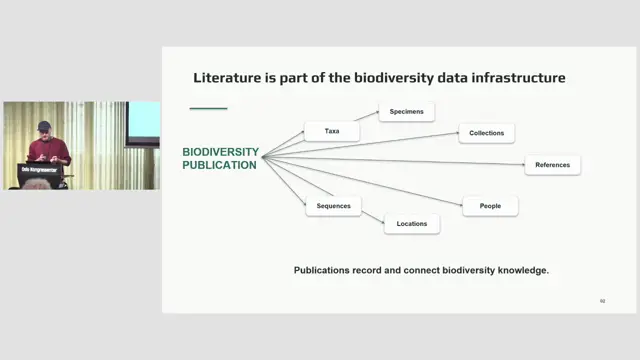
Biodiversity literature as FAIR and AI-ready data by design (and how to get there)
Don't just liberate biodiversity literature, publish it liberated.
Chris Le Coquet ↗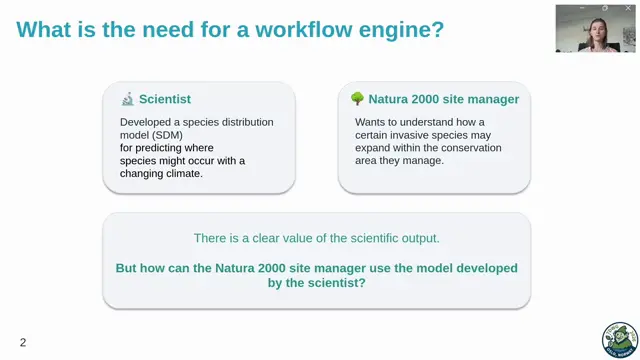
BMD workflow engine: FAIR workflows, RO-Crate and FAIR Signposting for a European biodiversity data space
Packaging containerised workflows and their runs as RO-Crates with FAIR Signposting lets non-technical users run models remotely and get machine-actionable, citable results.
Lena Perzlmaier ↗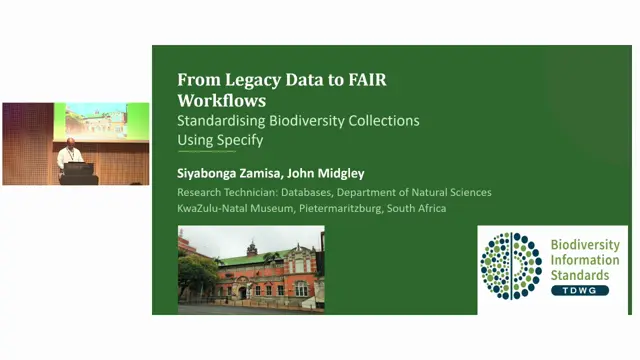
From Legacy Data to FAIR Workflows: Standardising Biodiversity Collections Using Specify
Standardised workflows, not just a new database, turned 11 differently managed collections into GBIF-ready data.
Siyabonga Zamisa ↗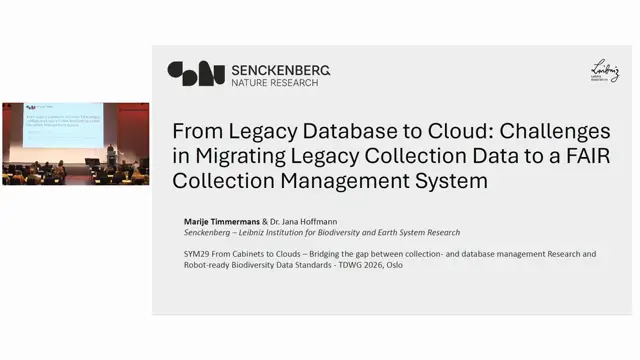
From Legacy Database to Cloud: Challenges in Migrating Legacy Collection Data to a FAIR Collection Management System
A dedicated data manager who acts as liaison and uses iterative prototypes can make a small institute's move to a shared CMS workable despite fragmented legacy practices.
Marije Timmermans ↗
Extracting Structured Biodiversity Knowledge from Literature with AI-Assisted Workflows
A hybrid text-layer/OCR tool can free tables from grey-literature PDFs into CSV with about 83% precision, but it misses a third of tables, especially narrow ones.
Yağmur Güleç ↗
The LIB Open Knowledge Space: A semantic architecture for FAIR, CLEAR, and AI-ready biodiversity knowledge
Knowledge can enter the LIB Open Knowledge Space as natural language immediately and be formalised step by step, so content becomes FAIR, CLEAR and AI-ready incrementally.
Lars Vogt ↗