
Explore the conversation.
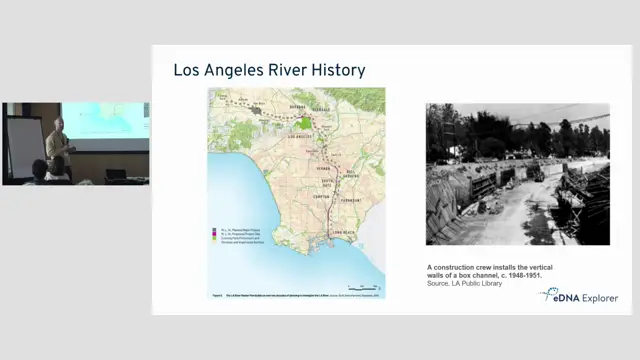
An eDNA Platform for Community-Powered LA River Restoration
An eDNA analysis platform let community groups without bioinformatics expertise measure how river channelization shapes biodiversity.
Ryan Martin ↗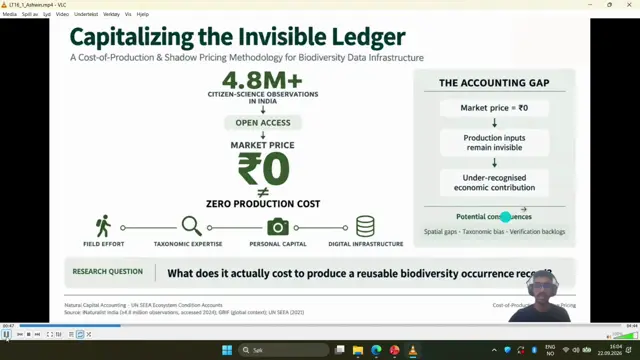
Capitalizing the Invisible Ledger: A Cost-of-Production and Shadow Pricing Methodology for Valuing Open-Source Biodiversity Assets in India
Open access removes the price of biodiversity data, not its production cost; citizen science is under-recognised national data infrastructure.
Ashwin A ↗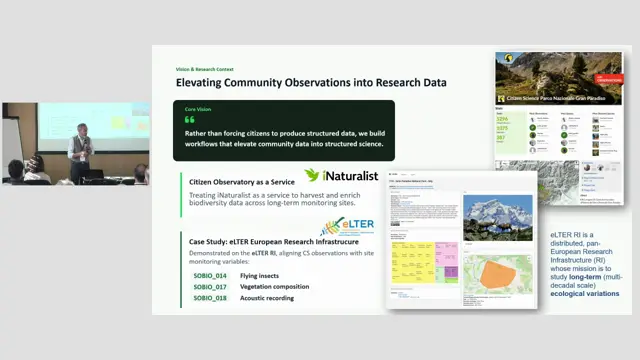
From citizen observations to long-term ecological knowledge: integrating iNaturalist records into LTER framework through automated enrichment
Rather than forcing citizens to produce structured data, automated enrichment elevates iNaturalist records into research-ready data for eLTER sites.
Alessandro Oggioni ↗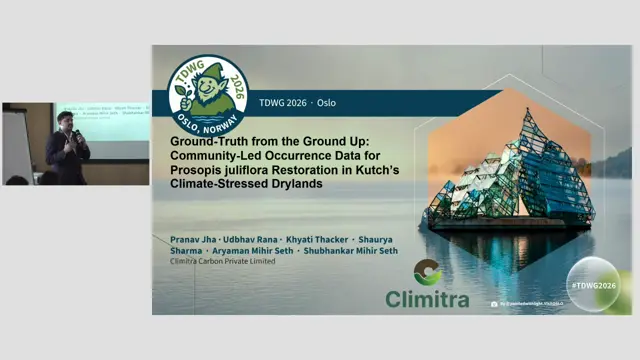
Ground-Truth from the Ground Up: Community-Led Occurrence Data for Prosopis juliflora Restoration in Kutch's Climate-Stressed Drylands
Community ground-truthing through voice-based, local-language tools makes satellite invasive-species maps reliable and restoration locally owned.
Pranav Jha ↗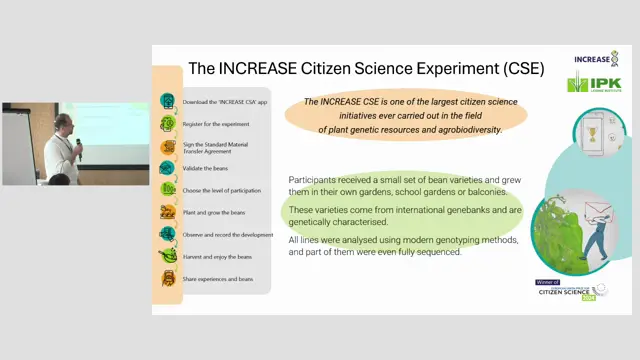
Growing Together: Community-Driven Conservation of Plant Genetic Resources
Giving citizens seeds, a good app and clear tutorials can yield large phenotypic datasets and community-based conservation of crop diversity.
Markus Oppermann ↗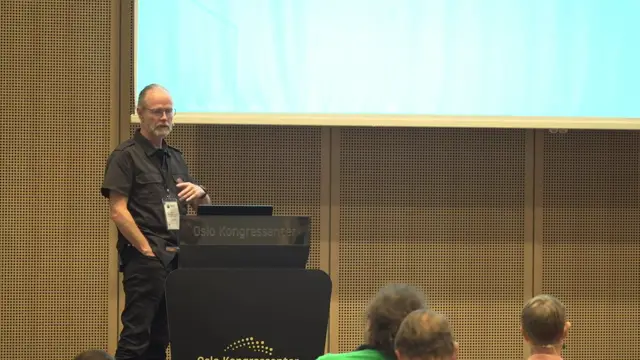
Managing observations when taxonomy changes: the case of Artportalen and Dyntaxa
Concept-based taxon IDs with traceable history let a large observation system absorb taxonomic change pragmatically.
Johan Liljeblad ↗
Soundscape China: Listening to the Sounds of Nature with AI
Soundscape China is building a nationwide acoustic sensor network, database and AI models, gathering 3.6 million recordings in its first year.
Congtian Lin ↗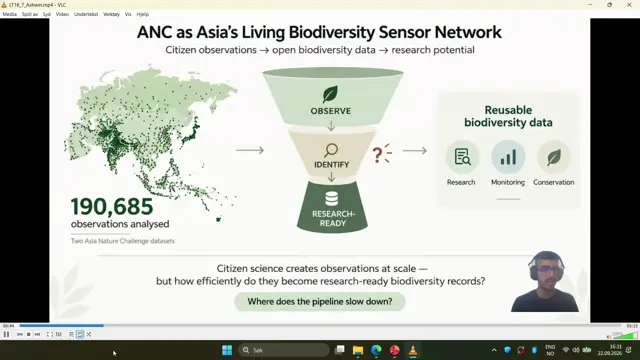
The Asian Nature Challenge as a Beacon of Citizen Science: Regional Contributions, Macroecological Data Networks, and Strategies for Optimizing Taxonomic Identification Efficiency in India
More observations do not mean more usable data; identification capacity is the bottleneck for India's citizen science.
Ashwin A ↗
The Swedish experience on verification and how to improve quality on observations
Human verification remains essential, and the community needs a standard to exchange verification status between systems.
Mora Aronsson ↗
The WildLIVE Portal: Towards Scalable Wildlife Monitoring through the Integration of Citizen Science and Human-in-the-Loop AI Workflows
WildLIVE combines a model registry, provenance-tracked human verification and FAIR publication to move camera trap data from raw images to publishable data.
Rajapreethi Rajendran ↗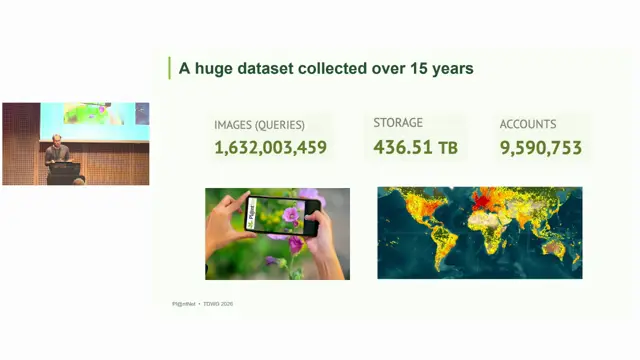
From 1.5 Billion Raw Queries to AI-Ready Biodiversity Data: Human-AI Collaborative Curation Pipelines in Pl@ntNet
Pl@ntNet's human–AI pipeline filters a vast, noisy stream into two GBIF datasets and training data, with separate branches for opted-in human-validated and automatic occurrence-only data.
Alexis Joly ↗
Phenobase: a harmonized, AI-ready knowledge base of global plant phenology
Combining ontologies with machine learning lets Phenobase close global phenology data gaps, but making the result AI-ready requires per-record model provenance, quality and citation.
Robert Guralnick ↗
From Standardized Field Methods to AI-Ready Knowledge: The LEPMON Project with the LAUP Infrastructure Stack for Automated Moth Monitoring
LEPMON's LAUP portal shows an end-to-end infrastructure for camera-based moth monitoring that builds Camtrap DP into routine data management, making millions of observations downloadable and analysable.
Peter Grobe ↗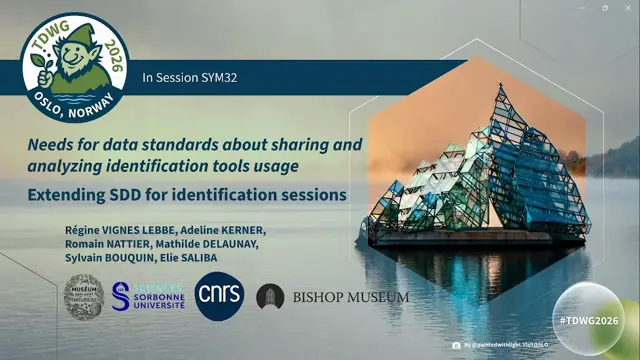
Needs for data standards about sharing and analyzing identification tools usage
SDD should be extended so identification sessions (context, uncertain responses, backtracking and AI outputs) become open, shareable data, not just the keys.
Régine Vignes Lebbe ↗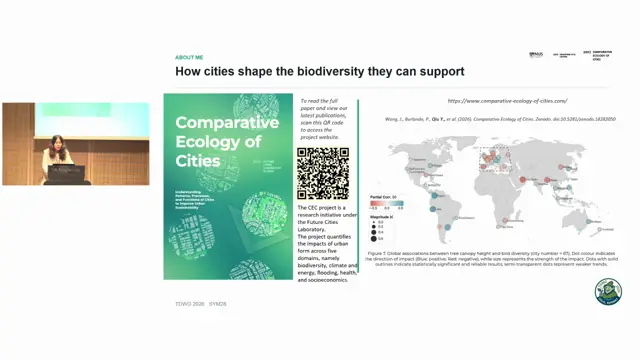
Reporting structure and sampling-bias correction in citizen-science bird data across Asian cities
Abundant citizen-science records do not guarantee inference support; reporting structure can distort richness hotspots and urban-biodiversity relationships unless it is diagnosed and controlled.
Yeshan Qiu ↗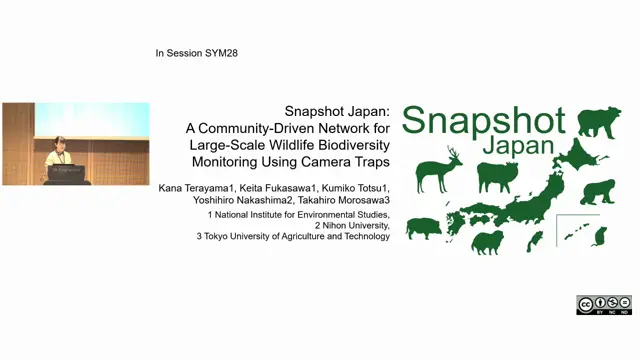
Snapshot Japan: A Community-Driven Network for Large-Scale Wildlife Biodiversity Monitoring Using Camera Traps
Community support plus a simple standard protocol and Camtrap DP publishing let Snapshot Japan scale camera-trap monitoring from 9 to 65 sites in three years.
Kumiko Totsu ↗