
Managing observations when taxonomy changes: the case of Artportalen and Dyntaxa
Johan Liljeblad · National & Global Taxonomic Backbones
The short versionConcept-based taxon IDs with traceable history let a large observation system absorb taxonomic change pragmatically.
What this was about
Johan Liljeblad explained how Sweden's 26-year-old citizen observatory Artportalen stays aligned with the national taxonomic database (Dyntaxa, started 2004), which uses stable taxon-concept identifiers rather than names. Taxonomy is published continuously and harvested nightly, but Artportalen applies changes every two months with news notes: name changes need no action, lumps move observations to the new taxon ID, and splits keep observations on a 'collective taxon' unless information (e.g. geography or phenology) allows assignment to one segregate. Edge cases include chained lumps, excluded taxa and fully revised concepts, so the process remains semi-manual with expert review, which is manageable at about 100 new taxa and 10-15 reassignments per cycle.
Why it matters. A working national model for keeping millions of observations consistent with an evolving taxonomy, relevant to any portal linked to a changing backbone.
In the room
- Every taxon has an ID and at least one recommended name; the ID stays stable to the concept while names change, and changes are traceable.
- Taxonomy is harvested nightly (Darwin Core file) but applied to Artportalen every second month to manage changes and inform users.
- Not every taxon in the database is reportable; a filter controls what can be reported.
- Lumps move observations to the replacing ID; splits keep observations on a collective taxon unless extra information allows reassignment.
- Complications include multi-step lumps, taxa later excluded from Sweden, and totally revised concepts with no single target.
- Around a million records are added per two months; about 100 new taxa and 10-15 reassignments per cycle are checked by organism-group experts.
- Sweden has about 60,000 species in the database and observations of about 40,000.
Notable moments
Transcript
Automatically generated captions can contain mistakes, especially in names and technical terms. Times are relative to the room recording.
Read the transcript ↓
Related talks.
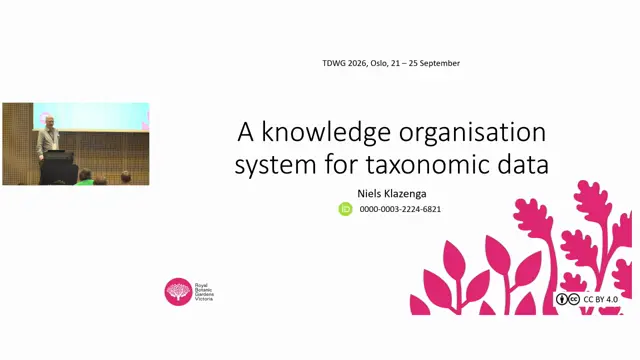
A knowledge organisation system for taxonomic data
Separating taxon data into layers with immutable taxon concepts at the centre gives a practical path to implementing TCS and fixing checklist quality problems.
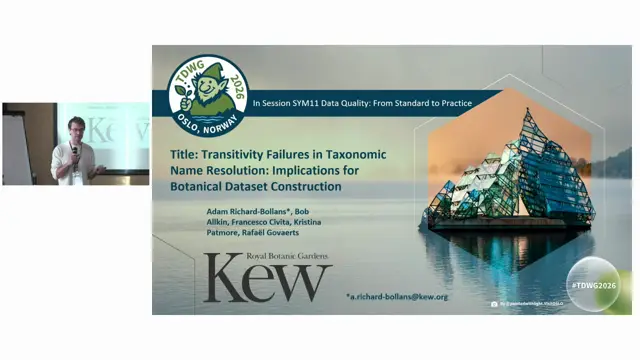
Transitivity Failures in Taxonomic Name Resolution: Implications for Botanical Dataset Construction
Always keep original verbatim names so datasets can be re-resolved against the latest taxonomy.
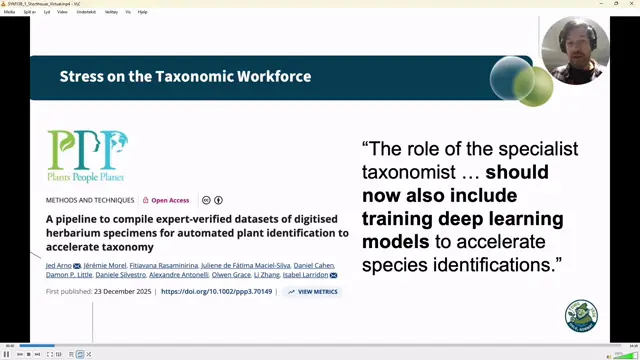
Open Digital Curation and Round-Tripping Biodiversity Data Enhancements Across Collection Infrastructures: Six Years and 50 Million Links in Bionomia
Round-tripping is much harder than expected, and data managers must fully populate identifiedBy so taxonomists' expertise is credited.