
Explore the conversation.
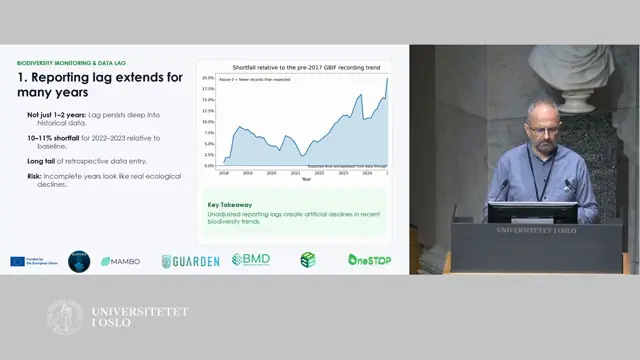
Reducing the lag from observation to action
Timeliness is a missing biodiversity knowledge shortfall: publish soon, publish often, and improve continuously.
Quentin Groom ↗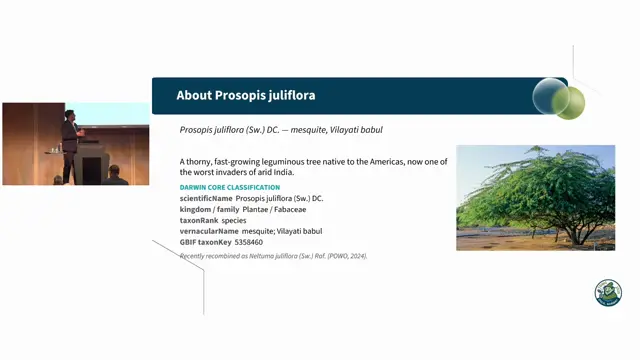
From satellite embeddings to Darwin Core: an open, ensemble-AI workflow for Prosopis juliflora mapping and reusable training-dataset generation
Satellite embeddings plus hyperspectral signatures and ground validation can map invasive Prosopis at scale and generate reusable, attributable training data.
Pranav Jha ↗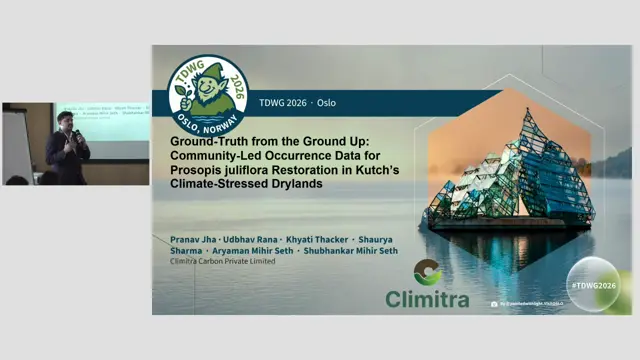
Ground-Truth from the Ground Up: Community-Led Occurrence Data for Prosopis juliflora Restoration in Kutch's Climate-Stressed Drylands
Community ground-truthing through voice-based, local-language tools makes satellite invasive-species maps reliable and restoration locally owned.
Pranav Jha ↗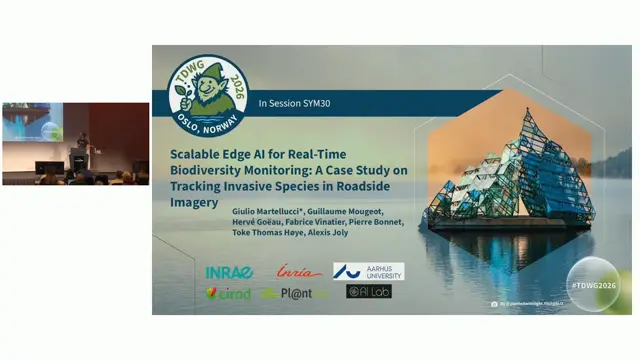
Scalable Edge AI for Real-Time Biodiversity Monitoring: tracking invasive plant species in roadside imagery
Distilling a tiling-based plant identifier into a single ConvNeXt model makes high-resolution roadside invasive-species monitoring fast, cheap and more accurate.
Giulio Martellucci ↗
The Swedish experience on verification and how to improve quality on observations
Human verification remains essential, and the community needs a standard to exchange verification status between systems.
Mora Aronsson ↗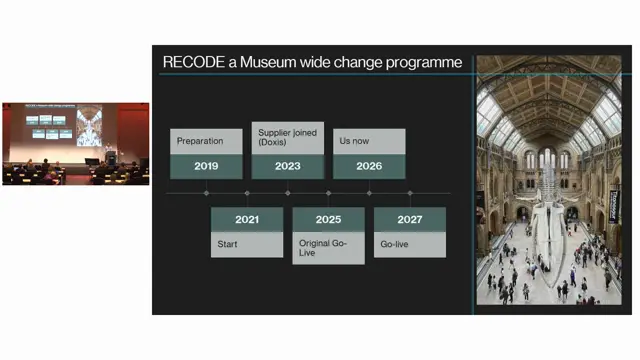
Old habits and new visions: Exploring the RECODE data model, future integration and data enhancement
Normalising decades of flat CMS data into relational entities and workflow-driven processes gives NHM a foundation for integrations and AI, but it needs institutional governance.
Steen Dupont ↗