
Snapshot Japan: A Community-Driven Network for Large-Scale Wildlife Biodiversity Monitoring Using Camera Traps
Kumiko Totsu · From Standards to Implementation: Connecting Observation Data in Asia to GBIF Infrastructure
The short versionCommunity support plus a simple standard protocol and Camtrap DP publishing let Snapshot Japan scale camera-trap monitoring from 9 to 65 sites in three years.
What this was about
Kumiko Totsu presented Snapshot Japan, the only Asian regional initiative of Snapshot Global, which runs a standardised annual September-October camera-trap survey with researchers, citizen groups, schools, NPOs and companies. She described the protocol (at least eight unbaited cameras per site, 200 m-5 km apart, site selection by disturbance level and habitat), participant support (websites, help desk, webinars, camera lending, a participant-only Shiny visualisation app), and the data flow from Wildlife Insights through expert-checked identifications to Camtrap DP conversion with an R tool, publication as data papers in Biodiversity Data Journal and on GBIF. Sites grew from 9 in 2023 to 32 in 2024 and 65 in 2025.
Why it matters. It is a practical model for extending standardised camera-trap monitoring and GBIF publication into Asia, where Snapshot Global coverage is thin.
In the room
- Long-term citizen monitoring needs community maintenance, quality control of identification and protocols, and internationally standardised data formats.
- Snapshot Japan was established in 2023 with eight principal investigators; a five-person management team runs it.
- Annual cycle: QC and publication of the previous year's data, participant feedback, recruitment, deployment in September-October, tutorials, and uploading by a deadline.
- Protocol: at least eight cameras per site, 200 m to 5 km apart, no bait or lures, site selection by combinations of disturbance level and habitat type.
- Data are uploaded and tagged in Wildlife Insights, checked by the management team with taxonomic experts, converted to Camtrap DP with an R tool on GitHub, and published as data papers and GBIF datasets; a beginner-friendly converter is being developed.
- Sites increased from 9 (2023) to 32 (2024) to 65 (2025), covering Hokkaido to Okinawa, with growing participation from NPOs, companies and high schools.
- Participants joined mainly out of interest, for camera lending, and through recommendations within research networks.
Notable moments
Transcript
Automatically generated captions can contain mistakes, especially in names and technical terms. Times are relative to the room recording.
Read the transcript ↓
Related talks.
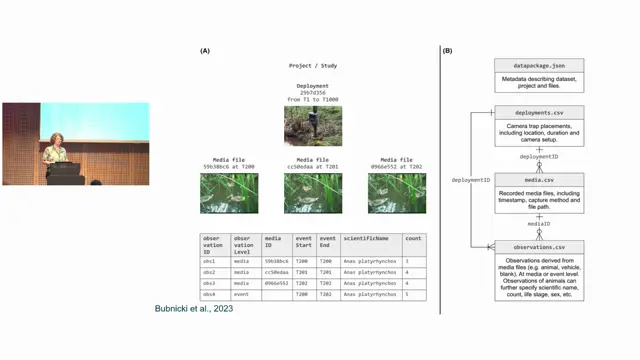
Camtrap DP: extending data standard designed for camera trapping research to support AI workflows and new data sources
Camtrap DP fits data from any stationary sensor, and converging community feedback shows how to extend it for AI provenance and multimodal monitoring.
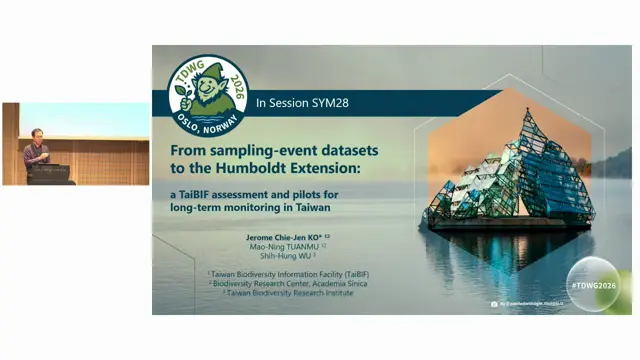
From sampling-event datasets to the Humboldt Extension: a TaiBIF assessment and pilots for long-term monitoring in Taiwan
Giving monitoring-data providers immediate site-level trend feedback, based on a minimal set of Humboldt terms, can motivate adoption better than asking for the full extension.
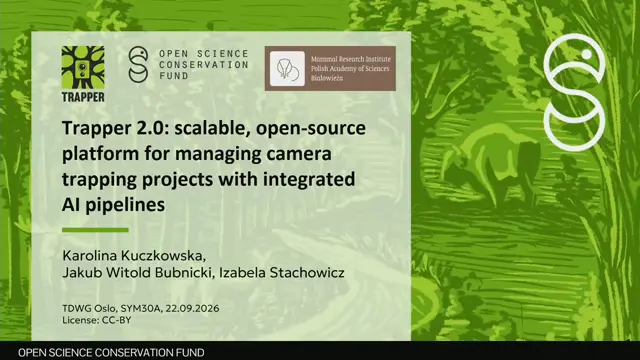
Trapper 2.0: scalable, open-source platform for managing camera trapping projects with integrated AI pipelines
Trapper 2.0 offers an open, model-agnostic, edge-deployable pipeline for camera trap photos and videos with expert review and Camtrap DP export.