
From Standardized Field Methods to AI-Ready Knowledge: The LEPMON Project with the LAUP Infrastructure Stack for Automated Moth Monitoring
Peter Grobe · AI Driven Monitoring and Species Identification
The short versionLEPMON's LAUP portal shows an end-to-end infrastructure for camera-based moth monitoring that builds Camtrap DP into routine data management, making millions of observations downloadable and analysable.
What this was about
Peter Grobe presented the German LEPMON project, a nationwide automated monitoring programme for nocturnal moths using standardised UV light-screen cameras (ARNI) along urbanisation gradients in eight cities, across habitats and via a citizen-science rollout, totalling around 104 devices. After two seasons it has 2.6 million raw images from over 17,000 nightly runs, yielding 4.3 million crop observations. He described the LAUP (LepMon Annotation and Upload) portal, which couples AI localisation and classification, citizen-science annotation and expert validation, and demonstrated a new map-based filter and download that exports data as a Camtrap DP package, with crops referenced as IIIF URLs rather than stored derivatives.
Why it matters. It is a working, large-scale example of the insect data standardisation challenges raised in the previous talk, showing how standardised field hardware, integrated annotation workflows and Camtrap DP export can make automated monitoring data usable for biodiversity-change research.
In the room
- Lepidoptera make up about 16% of known insect species; Germany has about 2,200 microlepidoptera (mostly too small for cameras) and 1,440 macrolepidoptera, about 1,300 of them nocturnal, which are the project focus.
- Deployment design: five traps per city along a sealing gradient from ~100% (centre) to 0% (outskirts) in eight cities, plus a 25-trap habitat programme, 17 externally funded traps and a citizen-science rollout, about 104 devices running March to October.
- ARNI (Automatic Recorder of Nocturnal Insects) devices, in Pro and citizen-science versions largely 3D-printed, have a UV light, defined-size screen, environmental sensors and a dimmable flash, imaging every two minutes at the same resolution so images are comparable.
- Time-lapse from Jena shows moth numbers peaking around 1 AM and declining by 4-5 AM; moths rarely rest, making tracking difficult.
- Workflow: AI localisation and species classification, then citizen-science annotation of bounding boxes, then expert validation, since amateurs cannot reliably identify.
- LAUP (LepMon Annotation and Upload) manages projects, devices and images and supports map-based filtering and download of data as a zipped Camtrap DP package (deployments, media, observations plus datapackage descriptor).
- Crops are not stored: bounding boxes are stored as coordinates on the original image and each crop is addressed via a IIIF URL, saving space; observation identifiers link back to media and deployments.
Notable moments
Transcript
Automatically generated captions can contain mistakes, especially in names and technical terms. Times are relative to the room recording.
Read the transcript ↓
Related talks.
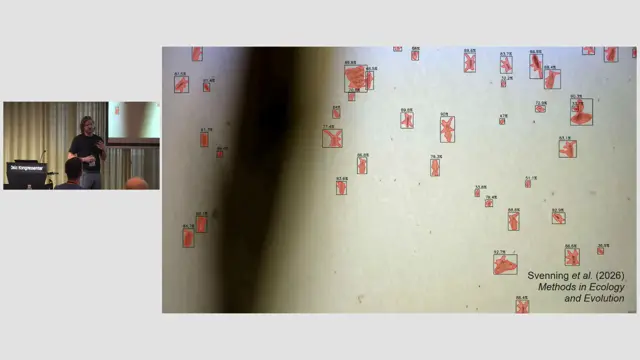
Standardizing Multimodal Insect Monitoring Data for AI-Ready Pipelines: Lessons from an InsectAI Community Datathon
Camtrap DP can largely accommodate automated insect monitoring data today, but the community needs agreed guidance and a few targeted extensions (track IDs, parent media and crop offsets, target taxonomic scope, identification provenance) to handle insect-specific challenges.
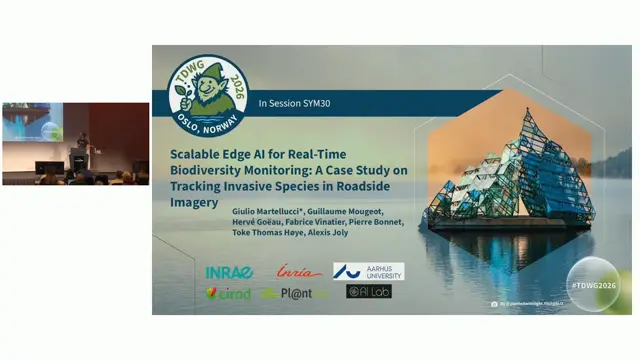
Scalable Edge AI for Real-Time Biodiversity Monitoring: tracking invasive plant species in roadside imagery
Distilling a tiling-based plant identifier into a single ConvNeXt model makes high-resolution roadside invasive-species monitoring fast, cheap and more accurate.
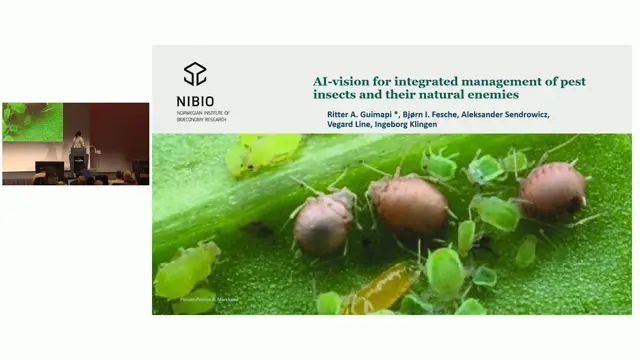
AI-vision for integrated management of pest insects and their natural enemies
Moving precision spraying from static weeds to mobile pests and their natural enemies is blocked mainly by the difficulty of collecting representative image data.