
Needs for data standards about sharing and analyzing identification tools usage
Régine Vignes Lebbe · May the Data Be Structured: Linking Descriptions, Identification and AI
The short versionSDD should be extended so identification sessions (context, uncertain responses, backtracking and AI outputs) become open, shareable data, not just the keys.
What this was about
Vignes Lebbe proposed extending SDD so that it records how identification tools are used as well as the keys themselves. Drawing on the SPIPOLL citizen-science programme, where Xper3 logged participants' identification pathways in a closed format, she argued that an identification session is more than a path through a key graph: it combines context, observations with uncertainty, navigation including backtracking, and in hybrid cases AI outputs. She outlined a session model made of question, response and result steps and linked it to a planned Xper4 identification service.
Why it matters. Recorded identification sessions could show where users go wrong, improve keys and provide rich training and evaluation data for AI models, because they capture the reasoning as well as the final name.
In the room
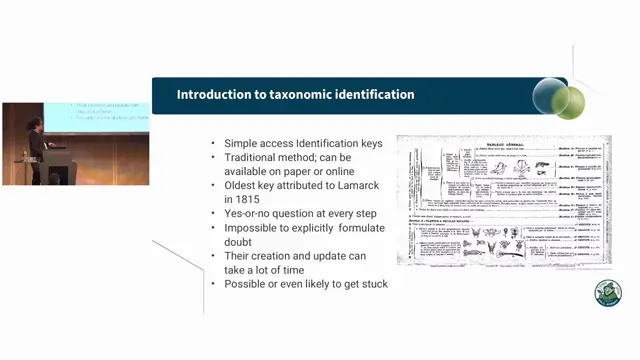
- Identification has moved from single-access keys to free-access keys, AI tools and now hybrid approaches, used in research, education, citizen science and public outreach.
- In SPIPOLL (MNHN citizen science on flower-visiting insects) the Xper3 team recorded identification pathways. This enabled analysis of character choice sequences, errors, feedback and metrics such as backtracking frequency, but only in a closed format.
- An identification session is not merely a path through a key graph: it needs who identified what specimen, observations, uncertainty, corrections, backtracking and AI contributions.
- The proposal is to add three objects to SDD (identification context, identification session, identification process). The talk focused on the session.
- A session is a sequence of steps: question, response or result. Qualitative responses may hold several states with confidence; quantitative ones hold values or intervals with accuracy. Uncertainty must not be lost.
- A result leads to a new question, an end, or a backtrack to a previous question. An end may give one or more taxa with compatibility or probability and does not imply success.
- For hybrid identification, at minimum store a reference to the trained model and its output (e.g., taxa with probabilities).
Notable moments
Transcript
Automatically generated captions can contain mistakes, especially in names and technical terms. Times are relative to the room recording.
Read the transcript ↓
Related talks.
Structured identification keys complementing AI: closing the corpus bottleneck with AI-assisted digitisation
AI and identification keys are complementary, and LLM-assisted digitisation of printed literature now makes it feasible to build structured keys at scale for expert review.
Ctrl+Alt+SDD: A Historical Review Toward a Standard Reboot
SDD is well-documented but dormant and imperfectly interoperable, and the Xper4 rebuild is an opportunity to reopen and modernise it together with the community.
Open Digital Curation and Round-Tripping Biodiversity Data Enhancements Across Collection Infrastructures: Six Years and 50 Million Links in Bionomia
Round-tripping is much harder than expected, and data managers must fully populate identifiedBy so taxonomists' expertise is credited.