
Explore the conversation.
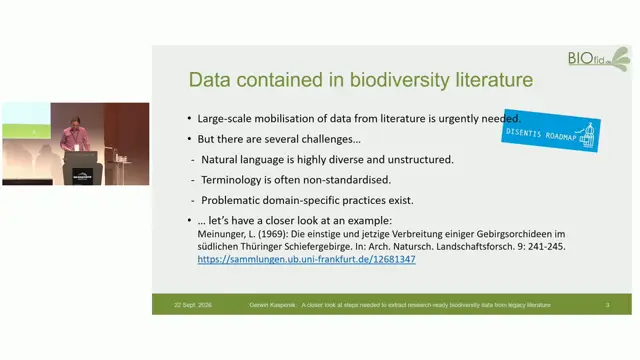
A closer look at steps needed to extract research-ready biodiversity data from legacy literature
Legacy literature data can only be unlocked by combining better OCR/NLP with taxonomic rigour that accounts for synonymy, shifting concepts, coreference and mixed languages.
Gerwin Kasperek ↗
A knowledge organisation system for taxonomic data
Separating taxon data into layers with immutable taxon concepts at the centre gives a practical path to implementing TCS and fixing checklist quality problems.
Niels Klazenga ↗
Managing observations when taxonomy changes: the case of Artportalen and Dyntaxa
Concept-based taxon IDs with traceable history let a large observation system absorb taxonomic change pragmatically.
Johan Liljeblad ↗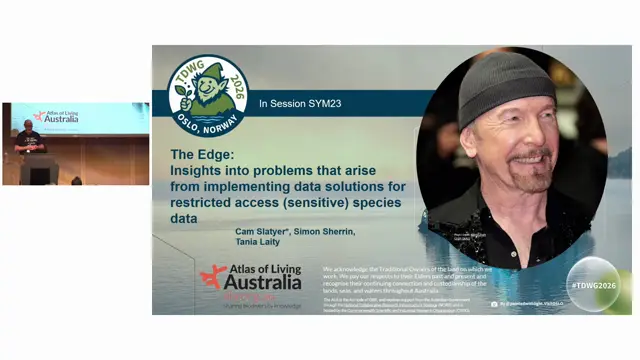
The Edge: Insights into problems that arise from implementing data solutions for restricted access (sensitive) species data
Plan RASD treatments carefully, because taxonomy, data errors and associated records can silently defeat simple rules like 'generalise to 10 km'.
Cameron Slatyer ↗
Applying Data Standards at the Royal Botanic Garden Edinburgh
Identifiers are how RBGE is standardising legacy herbarium data and reconnecting items spread across four separate collection management systems.
Robyn Drinkwater ↗
Freshwater data platforms: acronym soup, abundance, classifications and data quality
The freshwater community prefers connected, specialised platforms feeding GBIF over one system, but must address abundance data, classification consistency and trust in data from diverse providers.
Koen Martens, Anne Lyche Solheim, Olaf Banki ↗
From 'Lost in Translation' to Fit-for-Purpose Data: Why Ecologists and Conservation Practice Still Need Groupings and Uncertainties
Biodiversity data systems must be able to record identification uncertainty and taxonomic groupings, or ecologists face a choice between false certainty and lost ecological information.
Bernhard Kløw Askedalen, Natalie ↗
Integrating Specify in broader Science infrastructure
Specify works best at RBG Victoria as one component of a wider hub-based science infrastructure, with custom tools filling its gaps.
Niels Klazenga ↗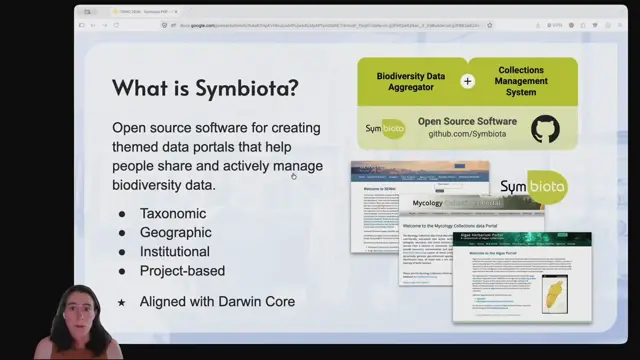
Mobilizing rich, interoperable, and secure fossil data from underserved collections using Symbiota
Targeted Symbiota enhancements around geological context, taxonomy and relationships make a low-barrier CMS viable for under-resourced fossil collections.
Erica Krimmel ↗