
A knowledge organisation system for taxonomic data
Niels Klazenga · National & Global Taxonomic Backbones
The short versionSeparating taxon data into layers with immutable taxon concepts at the centre gives a practical path to implementing TCS and fixing checklist quality problems.
What this was about
Niels Klazenga argued that problems with taxonomic checklists are data-quality issues that are fixable, and presented a layered data model developed as a reference implementation for his flora following ratification of TCS 2 (Taxon Concept Schema) last December. The model separates concerns into semantics (taxon concepts), syntax (names, typification, usages), authority (references, agents), governance (taxon trees and revisions) and narrative (profiles), plus identity, infrastructure and extension layers, using 'sidecar' patterns to keep taxon concepts immutable. He mapped layers to TCS, Plinian Core and Darwin Core, noted that governance is not covered by any standard, and proposed a conceptual model for taxon data developed with the Darwin Core maintenance group.
Why it matters. Offers a concrete reference architecture for taxon-concept-based systems and identifies gaps (governance, conceptual model) in current TDWG standards.
In the room
- TCS was ratified last December; reference implementations are needed for uptake.
- Taxon concepts (scientific hypotheses) are central; names sit in a separate syntax layer, following David Remsen's distinction between syntax and semantics.
- Authority (references, agents) links to all layers; governance holds taxon trees, nodes and revisions; narrative holds profiles and most flora content.
- Identity (external IDs such as IPNI, Tropicos, MycoBank), infrastructure and extension layers support the system.
- Sidecar extensions (name types, reference roles) and functional sidecars (tree node, profile) keep taxon concepts immutable.
- Maps (name usages, relationships) are used in tabular data but are not entities with identifiers.
- Phylogeny had to be core rather than an extension since it expresses domain semantics.
Notable moments
Transcript
Automatically generated captions can contain mistakes, especially in names and technical terms. Times are relative to the room recording.
Read the transcript ↓
Related talks.
Strengthening Taxonomic capacity and Biodiversity Information in Education
Taxonomy and biodiversity informatics need to be visible, modern parts of curricula, and TDWG should revive its curriculum interest group to secure training and knowledge transfer.
Machine-Ready Botanical Data: Mapping Integrated Collections and Traits with Darwin Core Data Package
Darwin Core Data Package can serve as a semantic integration layer for a botanical garden's diverse collections and trait data, and MBG's draft mapping is offered for community refinement.
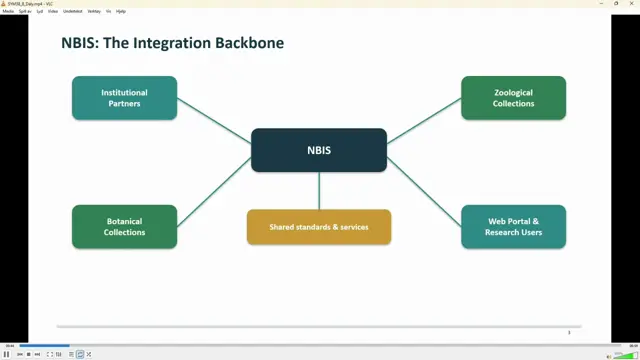
Architecting the National Biodiversity Information System: Standards-Driven Workflows for South Africa’s Botanical and Zoological Data
SANBI sustains NBIS through a statutory mandate plus a roadmap of diversified funding, partnerships and demonstrated return on investment.