
Mobilizing rich, interoperable, and secure fossil data from underserved collections using Symbiota
Erica Krimmel · Solutions for Research Collection Management Systems Challenges
The short versionTargeted Symbiota enhancements around geological context, taxonomy and relationships make a low-barrier CMS viable for under-resourced fossil collections.
What this was about
Erika Krimmel described a project (started 2023) to make Symbiota work for fossil collections, which are underrepresented despite Symbiota's popularity with small, under-resourced collections. A new Paleo Data Portal serves as testbed. Enhancements released in Symbiota 3.4 include GBIF GeoTime–based chronostratigraphy entry with auto-populated hierarchy, and staging scripts for stratigraphic and morphology remarks. There is inclusive numerical-time search, a Macrostrat geology map layer (also in georeferencing), and taxonomy sourced from Catalogue of Life XR via ChecklistBank to trace errors. Other additions: default 'FossilSpecimen' basis of record, description fields for material type, and relationships such as part/counterpart and slab-with. Features are documented in Symbiota Docs and a new Paleodata Knowledge Hub, and collections are being onboarded.
Why it matters. It extends the benefits of a widely used, low-cost platform to paleontological collections and improves how geological time data reach GBIF.
In the room
- Symbiota's pre-2023 paleo module had undocumented custom fields, and geological context was not searchable or exportable publicly.
- Chronostratigraphic entry now uses a controlled vocabulary aligned with GBIF GeoTime and the International Chronostratigraphic Chart.
- Search over geological time is inclusive using the vocabulary's numerical timescale, based on researcher feedback.
- Macrostrat API geology layer is available in map search and georeferencing.
- Taxonomy is sourced from Catalogue of Life Extended Release in ChecklistBank, allowing tracing and reporting of incorrect higher taxonomy.
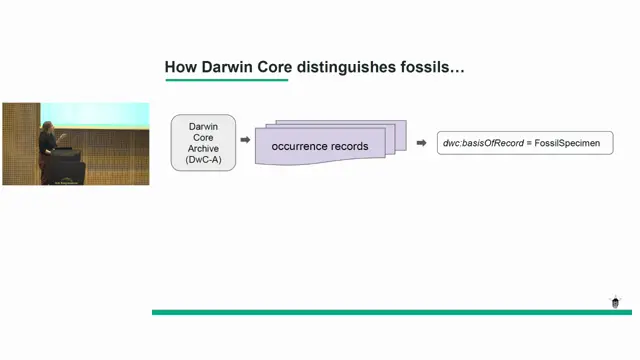
- Collections can set FossilSpecimen as the default basis of record.
- Relationships document part/counterpart pairs and slab associations with uncatalogued material; links to MorphoSource, MorphoBank and BHL.
Notable moments
Transcript
Automatically generated captions can contain mistakes, especially in names and technical terms. Times are relative to the room recording.
Read the transcript ↓
Related talks.
A community-curated controlled vocabulary for fossil collections using dwc:materialEntityType
A granular, community-derived vocabulary for dwc:materialEntityType would let users filter fossil records by what the material actually is, which basisOfRecord cannot do.
Sharing Extended Specimen Data from Symbiota Portals using Registered Extensions
Existing registered Darwin Core extensions met each of Symbiota's extended-specimen needs, so look for existing standards before inventing new ones.
A framework for aligning collections data with the global data ecosystem from data creation to extension in the Smithsonian National Museum of Natural History Department of Paleobiology
Making paleo collections work in the global data ecosystem needs an iterative, full life-cycle framework, not one-off digitisation.