
From 'Lost in Translation' to Fit-for-Purpose Data: Why Ecologists and Conservation Practice Still Need Groupings and Uncertainties
Bernhard Kløw Askedalen, Natalie · A consensus taxonomic reference for improved freshwater biodiversity data and knowledge
The short versionBiodiversity data systems must be able to record identification uncertainty and taxonomic groupings, or ecologists face a choice between false certainty and lost ecological information.
What this was about
Bernhard Askedalen and colleague Natalie performed a sketch in which a botanist tries to record uncertain water plant identifications (cf., agg., col., sensu lato) and a database cannot store them, so records are either overstated or bumped to genus, losing ecological information. They showed herbarium sheets with multiple conflicting determinations and noted that for some groups initial names can be as low as 6% correct on expert revision. Natalie found cf. in only 0.1% of water plant and 1.1% of benthic algae observations in NIVA datasets, because reporting pipelines drop uncertainty. They asked how systems should represent uncertainty and taxonomic groupings consistently; the audience suggested keeping these qualifiers with the data, flexibility across organism groups, an identification-uncertainty term, and a BIMS-style identification certainty column with include/exclude decisions.
Why it matters. Monitoring data used for ecological status assessments routinely contain cf., aggregates and sensu lato concepts; standards that erase them degrade both data honesty and usability.
In the room
- Sketch: 'cf.' for a sterile Sparganium angustifolium cannot be recorded, so it is entered as certain; Utricularia vulgaris without flowers is bumped to genus by a red-list data check; 'agg.', 'col.' and 'sensu lato' are not supported.
- Genus-level records lose information useful for within-lake trends and ecological condition assessment based on species assemblages (e.g. eutrophication tolerance).
- Paying customers provide little incentive to make records verifiable.
- Herbarium sheets can carry three to six different names from different people; for some groups the first name given can be as low as 6% correct, with 94% separated as another species on expert revision.
- In selected NIVA datasets from the 1960s to last year, cf. appeared in only 0.1% of water plant and 1.1% of benthic algae observations.
- Information exists internally but is lost or transformed when reporting to national systems: uncertain identifications reported as certain, reduced to genus, or aggregates handled via pseudo-taxa.
- Question posed: how should biodiversity systems represent uncertainty and taxonomic grouping consistently without losing ecological meaning?
Notable moments
Transcript
Automatically generated captions can contain mistakes, especially in names and technical terms. Times are relative to the room recording.
Read the transcript ↓
Related talks.
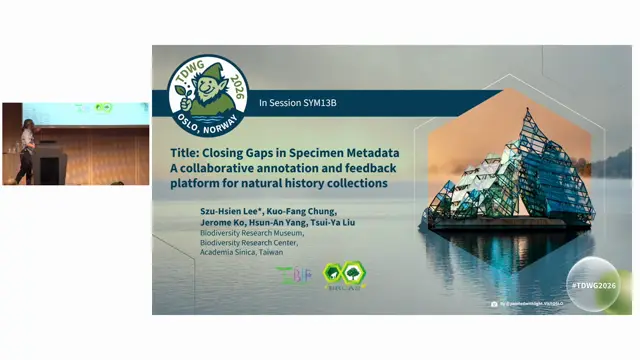
Closing Gaps in Specimen Metadata: A Collaborative Annotation and Feedback Platform for Natural History Collections
A national collaborative annotation platform with AI-assisted transcription can close metadata gaps across many Taiwanese collections.
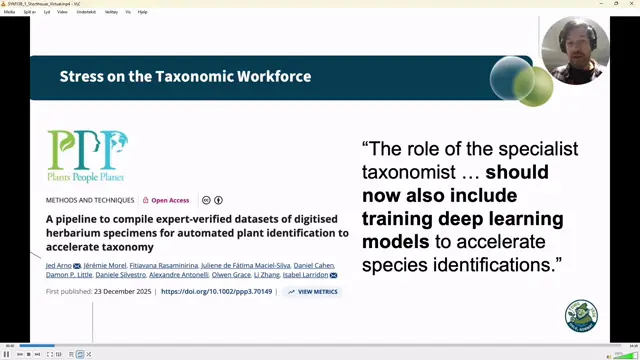
Open Digital Curation and Round-Tripping Biodiversity Data Enhancements Across Collection Infrastructures: Six Years and 50 Million Links in Bionomia
Round-tripping is much harder than expected, and data managers must fully populate identifiedBy so taxonomists' expertise is credited.
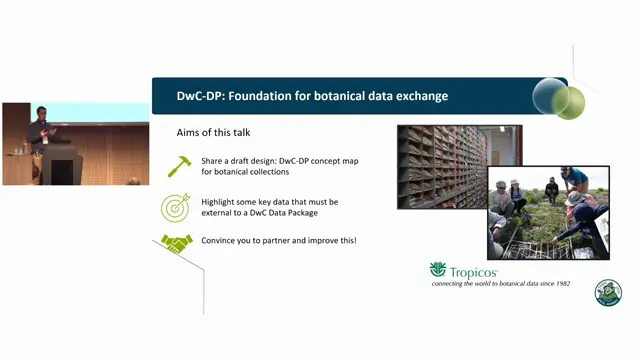
Machine-Ready Botanical Data: Mapping Integrated Collections and Traits with Darwin Core Data Package
Darwin Core Data Package can serve as a semantic integration layer for a botanical garden's diverse collections and trait data, and MBG's draft mapping is offered for community refinement.