
A closer look at steps needed to extract research-ready biodiversity data from legacy literature
Gerwin Kasperek · BHL at 20: A New Chapter for Biodiversity Literature and Data - Transforming BHL: Data Extraction, Semantic Navigation and Future Interfaces
The short versionLegacy literature data can only be unlocked by combining better OCR/NLP with taxonomic rigour that accounts for synonymy, shifting concepts, coreference and mixed languages.
What this was about
Gerwin Kasperek surveyed the obstacles to extracting research-ready data from legacy literature, using a 1969 German botanical article as an example. OCR errors propagate through NLP stages, and OCR quality evaluation itself is hard; synonyms are numerous (The Plant List had 44% synonyms and 33% accepted names) and abbreviated genus names are ambiguous across groups; taxon concepts shift over time (e.g. Linnaeus' Quercus robur) and modifiers like sensu lato/stricto matter; homonyms span taxa and places (Liparis, Paris); coreferences (C. viride, 'var. nanum') span sentences; and documents mix languages including Latin. He called for coordinated technical solutions (better OCR and its evaluation, domain-aware NLP, nomenclatural ontologies, per-sentence language detection) and taxonomic rigour (stronger backbones, Taxon Concept standards, temporal disambiguation).
Why it matters. Clarifies why AI extraction from historical texts is harder than it looks and which standards and tools are needed to get research-ready historical baselines.
In the room
- Historical baselines of biodiversity need literature data.
- OCR errors reduce keyword search reliability and degrade NER further.
- Abbreviated names like E. rubiginosa can refer to plants, worms or fungi.
- Shifting taxon concepts are more challenging than synonymy.
- Coreference resolution needs general transformer NLP plus nomenclatural ontologies.
- Many NLP tools assume one language per document; Latin is low-resource.
Notable moments
Transcript
Automatically generated captions can contain mistakes, especially in names and technical terms. Times are relative to the room recording.
Read the transcript ↓
Related talks.
Biological occurrence data from historic scientific correspondence: enabling automated approaches for structured data extraction from body text
A Darwin Core-aligned annotated corpus from MfN journals provides a reference for evaluating automated occurrence extraction from historical texts.
BHL and the Planetary Knowledge Base: Structuring Biodiversity Literature for the Next Generation
NHM is re-OCRing all of BHL with modern models and extracting entities into a knowledge graph, with confidence gating to protect BHL data quality.
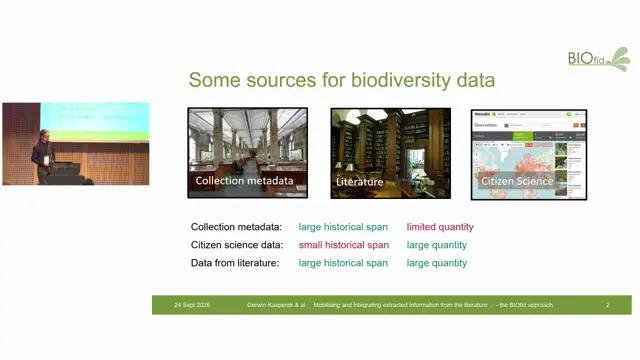
Mobilising and integrating extracted information from the literature into a biodiversity data ecosystem - the BIOfid approach
BIOfid mobilises Central European biodiversity literature with NLP, ontologies and standards, because raw LLM extraction still hallucinates identifiers and needs verification.