
Old habits and new visions: Exploring the RECODE data model, future integration and data enhancement
Steen Dupont · Solutions for Research Collection Management Systems Challenges
The short versionNormalising decades of flat CMS data into relational entities and workflow-driven processes gives NHM a foundation for integrations and AI, but it needs institutional governance.
What this was about
Steen Dupont gave an update on NHM London's RECODE programme (since 2019) to replace a 20-year-old CMS, with go-live expected early next year on the Doxis platform. The data model was heavily normalised: about 70 object record types and 54,000 fields were reduced to about 6,500 in use and then 600–700 fields in four collection object entities (biological, geological, extraterrestrial, human-made). The new system uses true relationships, separates objects from processes, and enforces stricter taxonomy and location hierarchies. Videos of the UAT environment showed a data model viewer, agent relationships, a workflow engine (parallel acquisitions, sequential loans, silent movement control) and a bulk-ingest template builder that outputs CSV/JSON with dynamic errors.
Why it matters. It is a rare look inside a large museum's CMS rebuild, with concrete numbers on field reduction and design choices other institutions can learn from.
In the room
- RECODE began in 2019; the system is in UAT and expected to go live at the start of next year.
- Current system: about 70 object record types and about 54,000 fields, reduced to about 6,500 used, then about 600–700 fields.
- Four target collection object entities: biological, geological, extraterrestrial, human-made.
- True relationships replace value fields; objects are decoupled from processes; stricter taxonomy and location hierarchies are enforced.
- Workflow engine supports parallel processes (acquisition), strictly ordered processes (research loans for compliance) and silent processes (movement control with history).
- A bulk template builder generates CSV and JSON with dynamic error handling for ingest, update and fixes; the JSON can feed other APIs.
- Business studio admin layer exposes integrations, AI, the data model and search fields; governance is needed to avoid new silos.
Notable moments
Transcript
Automatically generated captions can contain mistakes, especially in names and technical terms. Times are relative to the room recording.
Read the transcript ↓
Related talks.
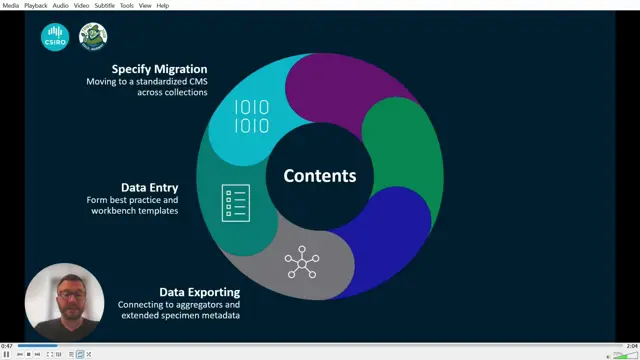
From Data Entry to Distribution: Streamlining Biodiversity Workflows with Specify at CSIRO
Layered standards in templates, roles and training let CSIRO keep five Specify instances consistent while each collection keeps its own outputs.
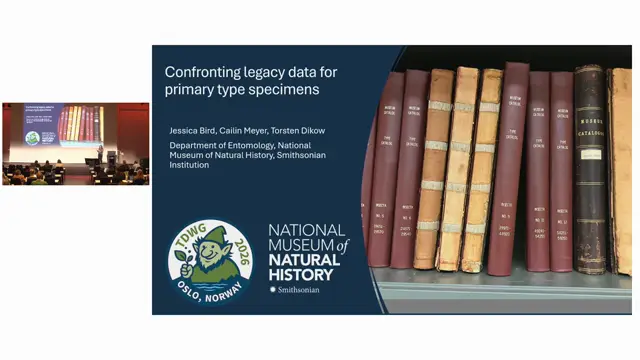
Confronting legacy data for primary type specimens
Decades of database migrations left the second-largest insect collection's type catalogue unreliable, and only a full physical inventory is fixing it.
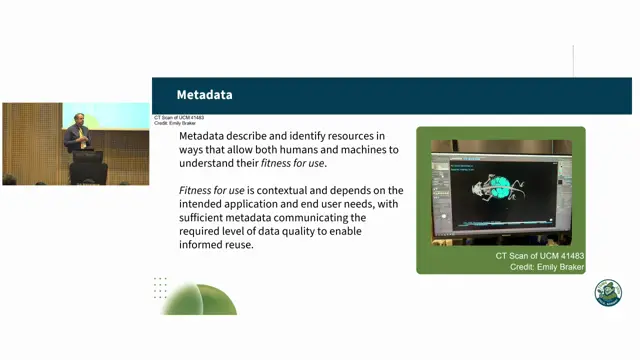
Metadata matters: perceptions on the implementation of Darwin Core in the biocollections cyberinfrastructure
Standardisation through Darwin Core can mask nuance, and practitioners report complex data, missing guidelines and limited capacity as the main implementation barriers.